
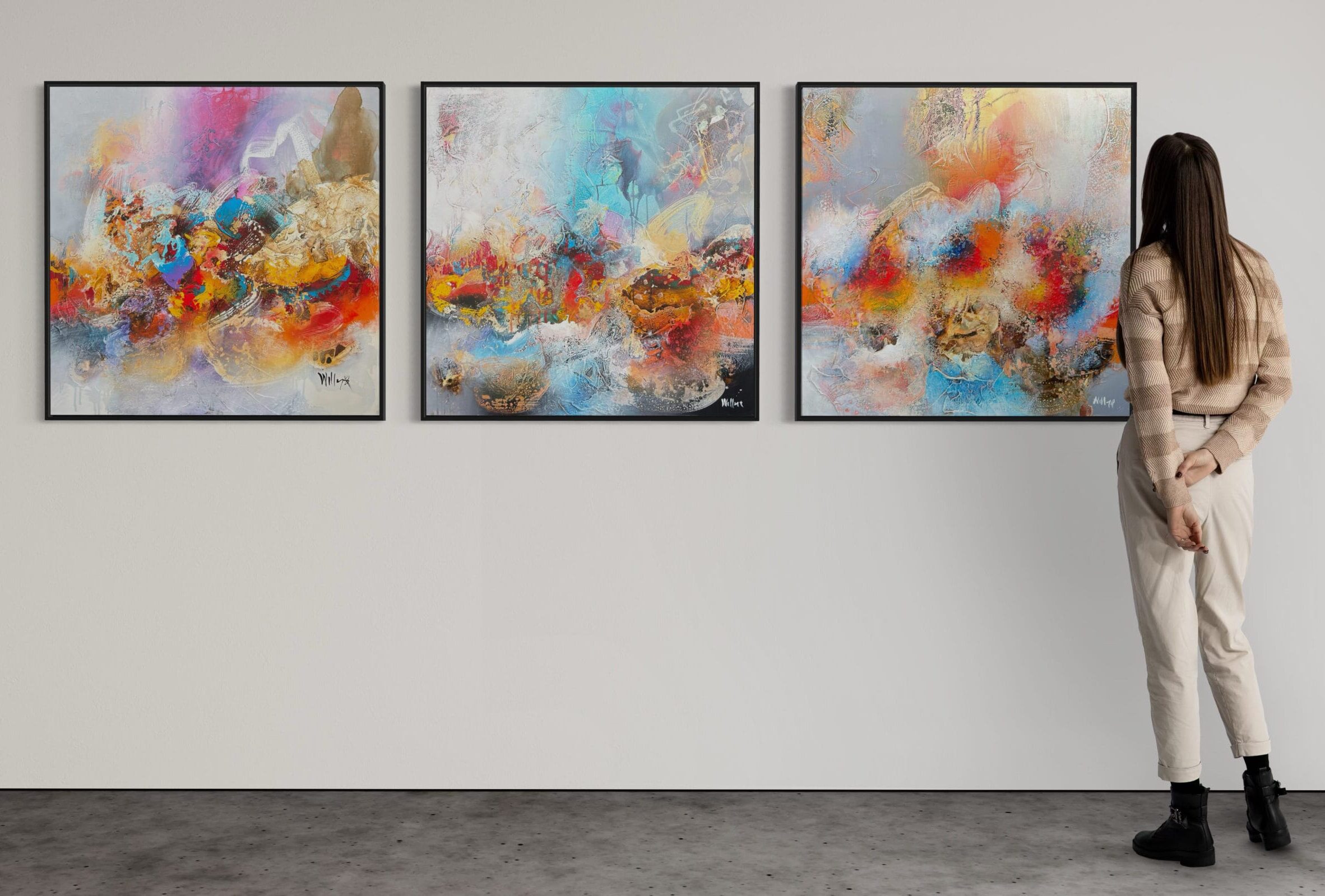
You stand in a gallery, see a 1958 abstract painting next to a work by a living artist and think: what exactly is the difference modern and contemporary art? We hear that question often, and rightly so. The terms are similar, but they do not mean the same thing. Those who know the distinction often look at art for the home or office with more peace of mind, more pleasure and also more focused.
The difference modern and contemporary art at once clear
In short, modern art usually refers to a historical period of art, roughly from the late 19th century to about the 1960s or 1970s. Contemporary art is art of today, made by artists of our time. That sounds simple, but in practice it’s a little more nuanced.
Modern art is often about innovation within art itself. Artists broke with traditions, experimented with form, color and perspective and sought new ways of showing reality. Think of movements such as impressionism, expressionism, cubism and abstract art. The focus was often on style, imagination and the development of a new visual language.
Contemporary art begins where modern art ends, but it is not just a sequel. It responds much more directly to today’s world. Themes such as identity, technology, climate, migration, media and society regularly play a role. In this regard, contemporary art can be painting, but just as easily photography, installation art, video, mixed media or a combination thereof.
When is art modern and when is it contemporary?
The easiest way to make the distinction is through both time and context. Modern art belongs to a defined art historical period. Contemporary art is more current and is usually closer to the present, often from about 1970 to the present.
Yet year alone is not enough. A painting made today in a style strongly reminiscent of modernist abstraction remains contemporary art. After all, it is work of this time, made in this cultural context. Conversely, a work from 1930 does not become contemporary art because it still looks fresh today. It remains modern.
This is immediately why the terms sometimes get mixed up. Many people actually mean by modern art: sleek, abstract or non-classical. In colloquial language, we understand that. Art historically, it is more accurate to link modern to the period and contemporary to the now.
Characteristics of modern art
Modern art emerged at a time of great change. Industrialization, urbanization, new science and political shifts affected how artists viewed and worked. They no longer just wanted to paint beautifully and faithfully. They wanted to innovate.
This is why modern art often looks investigative. Form and composition were given independent roles. Color became more expressive. Visible reality was allowed to be distorted, simplified or even abandoned altogether. A landscape no longer had to look exactly like a landscape to still be convincing as art.
Well-known characteristics include experimentation, stylistic innovation and abandonment of academic rules. Modern art can be emotional, but it can also be very formal and analytical. This depends very much on the movement. An expressionist seeks something different from a cubist, and an abstract artist again seeks something different from a surrealist.
Characteristics of contemporary art
Contemporary art is less easily captured in one style. It is precisely this breadth that is characteristic. Whereas modern art often had recognizable movements, contemporary art is pluralistic. Artists use whatever fits their idea – paint, wood, text, photography, found materials or digital techniques.
The layer of meaning is also often different. In contemporary art, the concept regularly plays a bigger role. Not only how something was made counts, but also why. A work can raise questions, chafe or open a social conversation. At the same time, contemporary art does not have to be complicated. There is also much contemporary art that appeals directly through color, atmosphere, material or a strong composition.
For many collectors and interior-oriented buyers, this is a pleasant misunderstanding to correct: contemporary art is not automatically difficult or distant. It can be very accessible and fit right in with everyday life.
The difference modern and contemporary art in appearance
In the home or workplace, the distinction is often felt in the look. Modern art regularly has historical connotations. Even when a work is abstract, it often feels connected to a moment in art history. It can bring calm, serenity and a certain timelessness.
Contemporary art more often feels direct, current and personal. It may be sharper, more playful or minimalist. Sometimes a work responds to trends in design, sometimes not at all. This also makes the choice more personal. The question then is not only what you like, but what you want to live with on a daily basis.
For an interior, that makes a difference. Modern art can work beautifully in a classic or modern home because it often has a lot of image tranquility. Contemporary art can energize a space, surprise or give it more individuality. Neither is better. It depends on taste, space, light and the mood you are looking for.
Why the terms are so often used interchangeably
The fact that modern in everyday language often simply means new or contemporary does not help. Those who say, I like modern art, sometimes actually mean art that is not traditional. So that might as well be contemporary art.
Galleries, home magazines and consumers do not always use the words strictly art historical as a result. This is understandable, but it can be confusing if you want to get a focused orientation. Especially when you want to buy or rent a work, it is nice to know what you are looking at. Not to make it more difficult, but rather to make better choices.
What does this mean if you want to buy or rent art?
For most people, the distinction is useful primarily because it provides direction. If you are looking for a work with an art historical basis, a particular movement or a classic modernist feel, then you are likely to look at modern art or contemporary art that builds on it. On the other hand, if you are looking for something by a living artist, with a contemporary feel or signature, you are more likely to end up with contemporary art.
There is also something practical at play here. Contemporary art often offers more freedom in format, material and price level, simply because the range is wider and more readily available. That makes it accessible to those who want to start with art on the wall, without being tied down to a big decision right away.
That is exactly where personal advice is valuable. A work can be beautiful on its own, but turn out differently in your space. Then it helps if you can look at the use of color, size, frame, placement and how the work coexists with furniture, light and material in the room. At Amersfoort Art we often see that people only really dare to choose when art becomes concrete in their own environment.
You don’t have to choose between modern or contemporary
Perhaps one of the most pleasant insights is this: you don’t have to be an art historian, nor do you have to choose strictly camp modern or camp contemporary. In fact, many interiors are made stronger by a combination. A modern abstract work next to a contemporary graphic image can work surprisingly well, as long as color, rhythm and scale are balanced.
This mix is also interesting in the office. Modern art can exude confidence and calm, while contemporary art adds energy and timeliness. Which direction fits best depends on the function of the space and the impression you want to make on yourself, visitors or employees.
What do you pay attention to when in doubt?
First, look less at the label and more at your reaction. Do you keep looking? Does the work fit the mood you are looking for? Does it feel powerful, quiet, exciting or just familiar? Only then can you ask questions about period, artist, technique and placement.
Those hesitating between modern and contemporary art would do well to not only compare online but to actually look. On screen, much looks alike. Only in real life do you see the skin of the paint, the layering, the size and presence of a work. Just then it becomes clear what suits you.
Choosing art does not have to be a test where you have to give the right answer. Rather, it is an encounter. And the better you understand the difference between modern and contemporary, the easier it will be to find something that is not only beautiful, but feels truly in place.


