
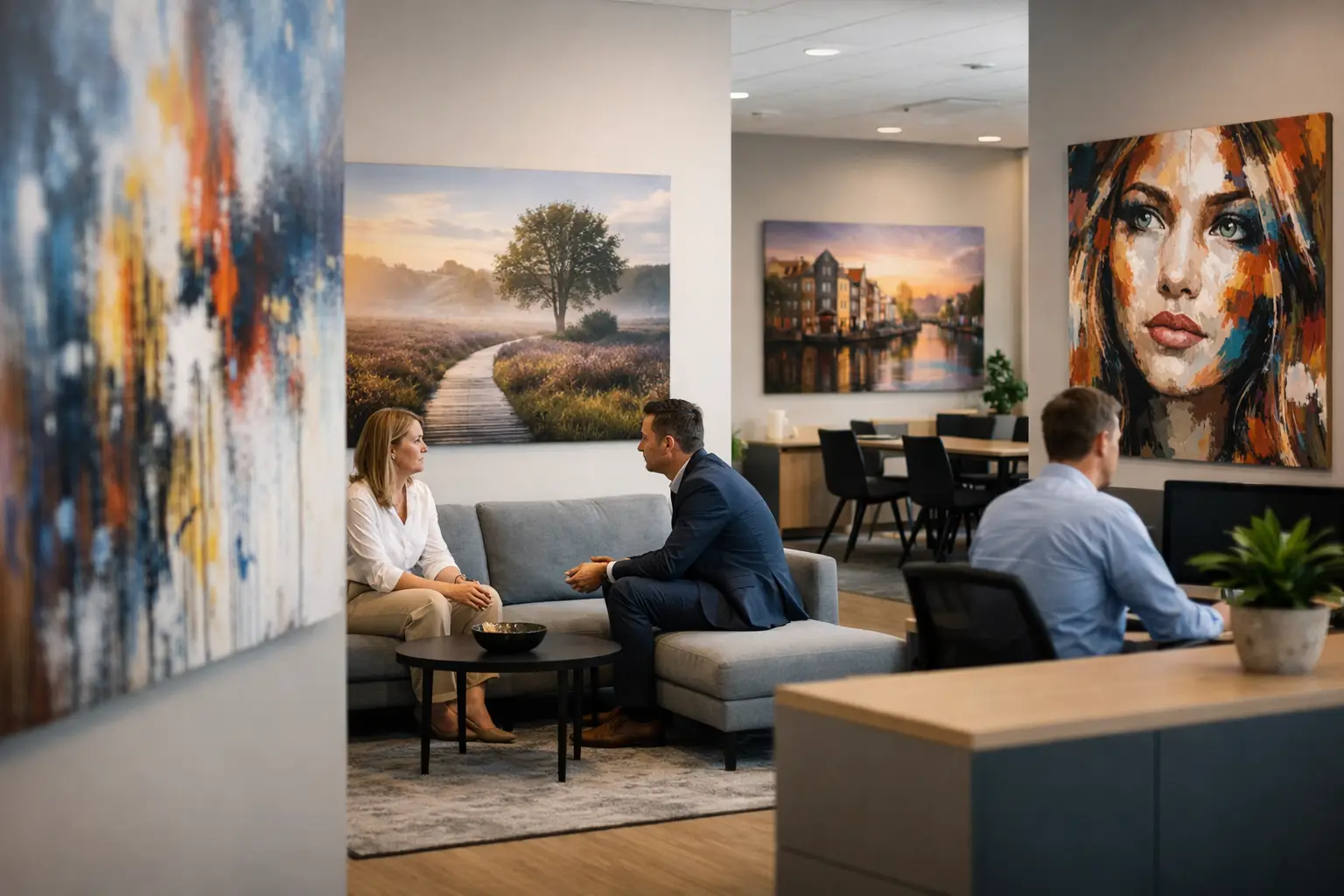
A bare lobby with nothing but a logo says little about the people who work there. A carefully chosen piece of art, on the other hand, does just that: it instantly adds color, character, and a topic of conversation. That’s why anyone looking for examples of office design with art is usually seeking not just something beautiful to hang on the wall, but a work environment that employees, visitors, and customers will remember fondly.
Art in the office doesn’t have to be formal, expensive, or complicated. It’s precisely by considering a space’s function, the natural light, and the people who use it every day that you can make the right choice. Below are eight examples that show what art can add to a variety of workplaces.
Why Art Does More Than Just Fill a Wall
An office is rarely just a place to get work done. It’s a place for discussions, concentration, welcoming guests, celebrations, and sometimes even seeking a moment of peace. Art can enhance these different moments. An abstract piece can energize an open workspace, while a serene landscape in a conference room can create space for conversation.
The best choice isn’t necessarily the piece that everyone immediately finds beautiful. A work of art should feel free to evoke certain feelings or raise questions. However, it must fit the atmosphere you want to create. A creative agency might opt for bold colors and an unexpected size. A medical practice or consulting firm might benefit more from layered, understated art with warm tones. The difference lies in the intention, not in a fixed stylistic rule.
8 Examples of Office Design Incorporating Art
1. A striking piece in the entryway
The entrance is a logical place for a single large work of art. Visitors often pause there for a moment, wait for an appointment, or deliberately slow their pace as they walk inside. Don’t opt for a collection of small works here, which can create visual clutter; instead, choose a piece that makes an impact from a few meters away.
A colorful abstract painting works well in a modern lobby with lots of glass, concrete, or light-colored walls. In a space featuring wood, natural stone, and soft lighting, a graphic piece in earth tones can help create a sense of cohesion. Leave plenty of empty wall space around the artwork. That sense of calm allows the artwork to truly make an impact.
2. A rotating art display in the reception area
While the entrance makes a first impression, the reception area invites you to linger a bit longer. A rotating exhibition featuring three to five works gives this space its own rhythm. It’s also a practical solution if you want to discover which art suits your organization best.
Choose works that share something in common—such as a color, technique, or subject—without making everything identical. A combination of paintings, prints, and photographs can be surprisingly beautiful when the framing is coordinated. By changing the selection a few times a year, the space remains vibrant for both regular employees and returning visitors.
3. Calming Art in Concentration Workstations
In spaces where people need to concentrate for long periods of time, less is often more. A very busy image directly across from a desk can be distracting, no matter how compelling the artwork itself may be. Instead, opt for art with clean compositions, natural forms, or a limited color palette.
That doesn’t mean it has to be boring. A subtle etching, a photograph with an interesting play of light, or an abstract piece in deep blue and sand tones can actually give a workspace a polished look. Ideally, hang the artwork in the line of sight as someone enters the room, not directly behind a computer screen. That way, art remains a pleasant respite for the eyes.
4. The Art of Conversation in the Conference Room
A conference room calls for a different kind of focus. Here, art can break the ice before the conversation begins, without taking over the meeting. A piece with detail, depth, or a surprising perspective invites a brief comment and makes the space feel less anonymous.
Avoid very literal images that already define the message, such as standard cityscapes at a real estate firm or the inevitable team photo. Contemporary art leaves more room for personal interpretation. For a long conference table, a horizontal piece often looks well-proportioned. If the room has little natural light, a piece with light areas or bright colors can prevent the space from feeling closed in.
5. Local recognition without feeling like an advertisement
Organizations with strong ties to their local community can use art to make that connection tangible. Think of a contemporary interpretation of the landscape, architecture reduced to lines and shapes, or photography of recognizable details from the region. It doesn’t have to be a tourist-y image to still feel familiar.
This approach works well in an office where many clients come from the same area. It creates a subtle sense of connection. It’s best to choose an artist with a unique perspective, so the work doesn’t become mere decoration. It’s precisely that personal interpretation that makes it authentic.
6. Color as a Guide Through a Large Office
In larger offices, departments, hallways, and flexible workspaces can easily become visually disconnected from one another. Art can help create a sense of cohesion. For example, use a distinct accent color for each floor or zone, which is repeated in various artworks. This creates a sense of familiarity without requiring every wall to be painted the same color.
A hallway with multiple doors is ideal for a small series of artworks displayed at the same height. Space the works sufficiently apart and keep the lighting subdued and even. This is also a place where art can surprise: employees walk past it every day and notice a different detail each time. Be mindful of reflections from windows and ceiling lights, especially with works displayed behind glass.
7. A Personal Project in the Executive Office
The executive office or partner’s office can be more personal than the common areas. Here, art reveals who someone is and what an organization values. This could be a unique painting, a sculpture on a low cabinet, or a carefully framed print.
The pitfall is choosing a piece solely for its status. A work that has clearly been chosen with care is more compelling than something that’s simply meant to be large or well-known. Consider combining one main piece with a smaller work that provides a counterbalance to it. This makes the space feel more human, especially when many business meetings take place there.
8. Art in the cafeteria or common area
The place where people grab coffee or have lunch often deserves more attention than it gets. It is precisely here that informal interactions between coworkers take place. Art that incorporates humor, color, or an unexpected technique can break the ice and give an everyday space more character.
Be sure to choose materials that are appropriate for the setting. In a busy space with a lot of foot traffic, placing a fragile object on a narrow pedestal isn’t always a good idea. A securely framed piece, a wall-mounted object, or a sculpture in a safe spot is more practical. Art should invite conversation, but it doesn’t need to be constantly moved or protected.
How to Choose Art That Will Continue to Work in the Office
Don’t start by asking which style is popular; start with the space itself. Measure the available wall space, observe where people stand or sit, and note how the light changes throughout the day. A piece that feels just right in a gallery might look too small on a large white wall. Conversely, a large-scale piece can quickly become too dominant in a narrow hallway.
The frame also deserves attention. A frame not only protects the artwork but also helps determine how it relates to the interior. A slim black frame can give photography or prints a modern look. Wood adds warmth, while a light-colored box frame gives a painting a sense of space. When displaying multiple works, a consistent choice of frames creates a sense of calm, even if the art itself varies.
It’s perfectly normal to have doubts, especially when several colleagues are weighing in. Renting art is an attractive interim step in such cases. You’ll get to experience how a piece of art interacts with light, furniture, and everyday use, without having to make a final decision right away. At Amersfoort Art, personalized advice is just as much a part of the process as viewing art in a real work or living environment.
Art as Part of a Pleasant Work Routine
A well-designed office doesn’t have to be impressive at all times. Above all, it should be a pleasant place to come into day after day. Art helps achieve this when it is treated not as a mere decoration, but as a deliberate element of the space.
Give a piece of art the space, light, and attention it deserves. Not only will it make a wall more beautiful, but it can also make an ordinary workday start with something that stays with you for a while.


