
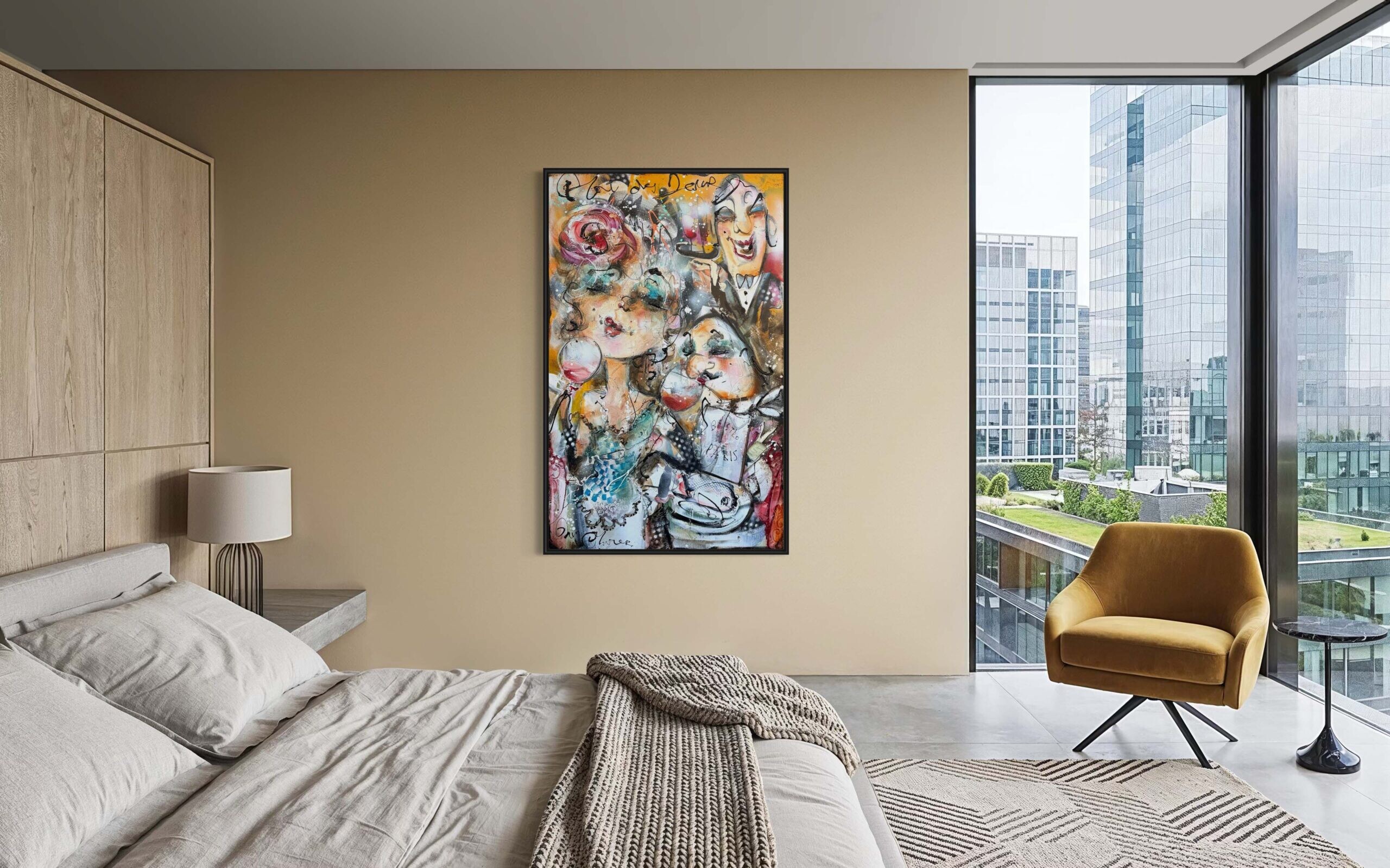
A wall can be as beautifully painted as it is, without the right artwork, a space sometimes continues to feel flat. That is exactly why Guy Olivier art appeals to so many people. His work often has instant presence: color, movement and a clear visual language that not only complements an interior, but really gives it direction.
For those looking for art that feels accessible and at the same time has a distinct character of its own, Guy Olivier’s work is interesting to look at quietly. Not only because it is decoratively strong, but precisely because it can energize a space without becoming restless. This makes it suitable for a living room as well as a reception area, office or meeting room.
What makes Guy Olivier art recognizable?
With many artists, you have to take a longer look before a work reveals itself. With Guy Olivier, the first impression is often immediately powerful. His oeuvre is usually characterized by expression, rhythm and a sense of spontaneous movement. This makes for works that live on the wall.
Yet the appeal is not only in striking color or shape. It is precisely the balance that makes it interesting. A work may be present, but it must also continue to function in an interior. Therein often lies the difference between art that is beautiful in a gallery and art that really comes into its own at home or in the workplace.
Those looking for a work with personality, but without detached art language, quickly come to this artist. His work often appeals immediately, even if you are not involved with art on a daily basis. That is a quality in itself. Good art does not need a complicated explanation to come in.
Guy Olivier art in the home or office
You don’t choose a work of art in isolation from the space. This is especially true with more expressive work. Guy Olivier art can lift a room, but it requires conscious placement. In a minimalist interior, it can actually be an exciting accent. In a warmer, more eclectic interior, it can deepen the existing atmosphere.
For the home, it is smart to look not only at color, but also at pace. Some works bring tranquility, others dynamism. In a dining room or living space, it’s okay to be more pronounced. In a bedroom or quiet workspace, you may prefer a work that has energy without being too dominant.
For business spaces, the situation is slightly different again. There, not only personal taste counts, but also charisma. A powerful work of art can make an entrance more professional, give a meeting room more character or make an office feel less anonymous. At the same time, it must fit the function of the space. A work that feels perfect at home is not automatically appropriate for a formal reception area.
That’s why looking in context is so important. Dimensions, light and distance from furniture or architecture help determine how a work comes across. In a photograph, something sometimes looks modest, while on the wall it works much more powerfully.
What do you look for when choosing Guy Olivier art?
The first pitfall is thinking that you should select primarily by color. Of course color is important, but it is rarely the only thing that matters. Composition, size and appearance weigh just as heavily. A work can fit perfectly in terms of color and yet do little for the space.
Rather, start by asking what the artwork should bring. Do you want a real eye-catcher? Are you looking for a connection between furniture and wall? Or do you want a work that makes a business space less austere? Once that is clear, choose more sharply.
Next comes the format. This remains one of the most underrated points. Too small quickly looks lost, especially over a sofa, dresser or large conference table. Too big can be beautiful, but it needs air. An expressive work by Guy Olivier needs space to breathe properly.
Surface and finish also deserve attention. A work on canvas feels different from a work behind glass or in a frame. This is not a detail, but part of the overall impression. In a sleek interior, a sober presentation can do a lot. In a more classic setting, the finish may sometimes be richer.
The atmosphere of the work should suit you
You don’t buy or rent art just for the sake of it. You live with it. Therefore, it is wise not to rely solely on an initial enthusiastic reaction. Also ask yourself whether you want to continue to see the work over a longer period of time. That sounds simple, but it prevents impulse buys that you will later tire of.
In Guy Olivier art, feeling plays a major role. The vibrancy of the work often attracts immediate attention. This is positive, but it also means you need to consider whether that energy fits with your daily use of the space. In a lively living room, it may be perfect. In a quiet reading nook, perhaps less so.
There is no set rule here. It depends on your taste, your decor and the function of the room. This is precisely why personal advice is so valuable. Not to take over the choice from you, but to see more clearly together which work is really right.
Buy or experience first?
Not everyone wants to make a final decision right away, and that is quite understandable. Art is personal. What convinces in a gallery may turn out differently at home because of light, color on the wall or the relationship to the rest of the interior.
For many people, it works well to first experience how a work of art looks in their own environment. Especially with an artist with a clear signature, this can remove a lot of doubt. You only really see what a work does when it hangs in its place. Sometimes you are immediately confirmed in your choice. Sometimes another format or another work turns out to fit better.
That process need not be complicated. It is precisely when art is approached in an accessible way that there is room to choose calmly and with confidence. That also fits with how many people today approach art: not as a quick purchase, but as a conscious addition to living or working.
Why this type of art often remains interesting for a long time
Trends in interior design change quickly. Art does not have to go along blindly with that. In fact, a well-chosen work of art often endures precisely because it is more than a style element. Guy Olivier art can become a fixture in a space, even if furniture, colors or layout change.
This is because strong art not only connects beautifully, but also remains independent. The work carries its own character. As a result, it remains interesting even as the rest of the interior evolves. This is an important difference from purely decorative wall filling, which often loses its tension after a few years.
At the same time, it is good to remain realistic. Not every work fits into every space for life. Sometimes a work of art moves from the living room to an office, or vice versa. That, too, is part of living with art. So a good choice is not necessarily one for always in exactly the same place, but one that you can enjoy for a long time.
Guy Olivier art as personal statement
A work of art says something about taste, but also about how you want a space to feel. If you choose work by Guy Olivier, you are often choosing character and vibrancy. That makes it suitable for people who don’t want to decorate their interiors too carefully.
This does not mean that everything has to be pronounced or large. Especially in a subdued space, one powerful work may be enough. Conversely, in a spacious interior, a larger or more expressive piece may be needed to make a real impact. It’s always about proportion.
Those who enjoy guidance in this will usually benefit more from honest conversation than from big words. Does this work fit your wall, your light and your way of living or working? That is the question that counts. From that approach, art becomes more manageable and especially more fun to choose from.
At Amersfoort Art, too, we find that people often make relaxed choices once they feel that art doesn’t have to be a complicated world. With the right guidance, it becomes easier to find work that is not only beautiful, but actually falls into place.
A good work of art does not have to take over everything in a space. Sometimes it is enough that it adds just that one element that was still missing: excitement, warmth, color or tranquility. When you look at Guy Olivier art, pay attention not only to what you see, but more importantly to what it does to the space and to you.


