
You see a work that immediately does something to you. The color matches your interior, the size fits exactly on that one wall and the look lingers. Then often comes the next question: do you choose an original artwork or limited edition? It’s a logical doubt, because both can be beautiful, but they don’t always fit the same desire, space or way of buying.
Those looking for art for the home or office quickly find that this choice is less black and white than it seems. An original often has strong emotional value and uniqueness. A limited edition can be attractive precisely because of its price, accessibility and the opportunity to bring work by a beloved artist into your home in an accessible way.
What is the difference between an original artwork or limited edition?
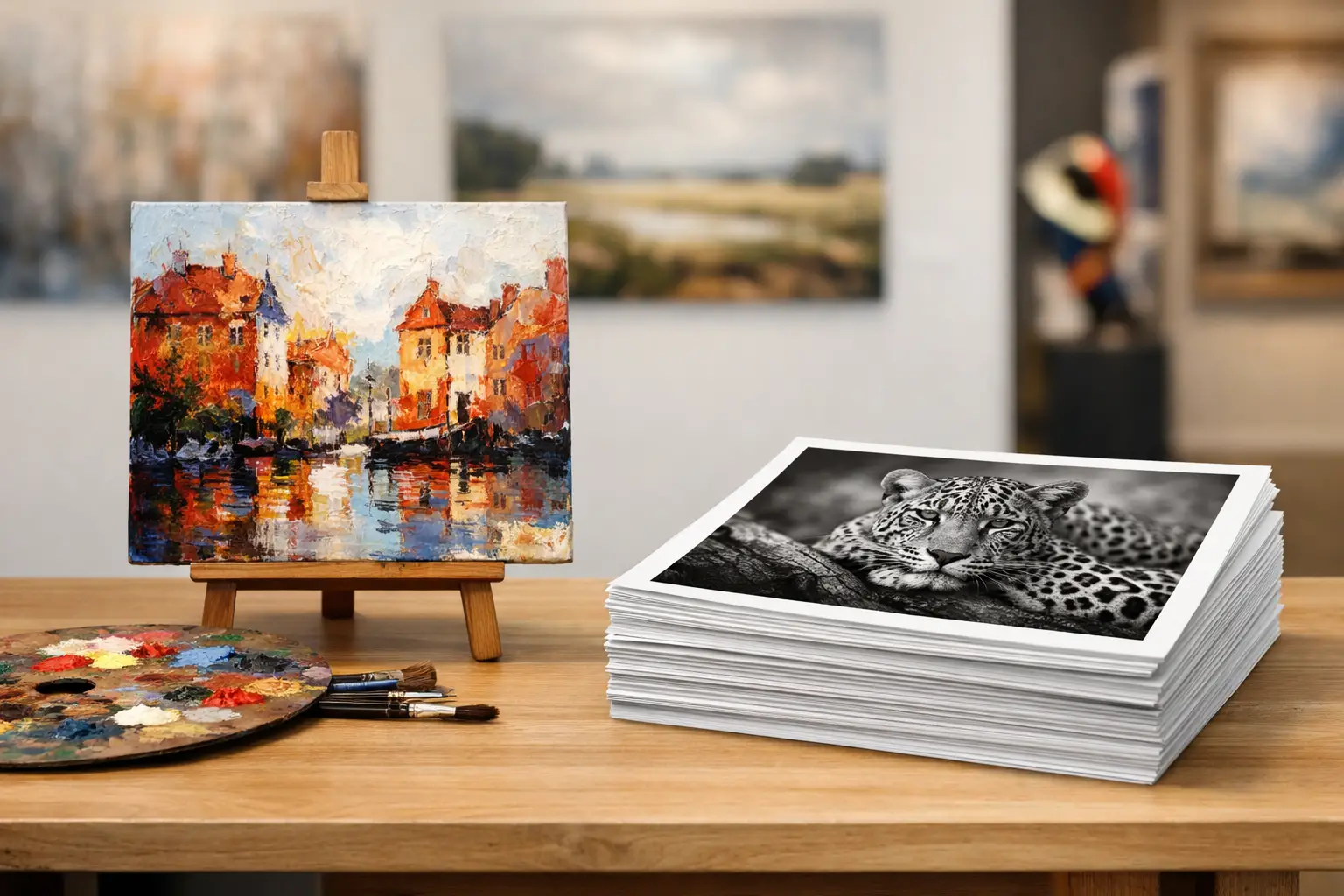
An original work of art is a unique work created by the artist himself. Think of a painting, drawing, collage or mixed media of which only one exists. It is that uniqueness that matters a lot in how a work feels. You can often see the hand of the maker in the paint stroke, texture, layering and small irregularities that give a work character.
A limited edition is an artwork published in a limited, predetermined edition. This can be, for example, a silkscreen, lithograph, etching, photographic print or giclée. Usually these works are numbered and often signed. It is therefore not an unlimited reproduction, but a controlled edition whose number is known.
That distinction is important. A limited edition still has artistic value, especially when the artist is actively involved in the production and finishing. But it remains a work that exists with multiple copies, whereas an original is by definition a one-off.
When does an original fit better?
An original piece of art is often the best choice if you are looking for something with a distinct presence of its own. In a living room, hallway or conference room, an original can really set the tone. The work lives differently on the wall precisely because material, depth and detail are not repeatable.
An original also feels emotionally like another purchase for many people. You are not just buying a sculpture, but a one-off object with its own history. This plays an extra role if you have been collecting art for some time, are looking for a special work for a specific place, or want to make a purchase that will last you for years.
On the other hand, an original usually requires more investment. Not only financially, but sometimes also in decision making. Precisely because it is unique, you want to be sure that the work really suits your taste, light and interior. For some buyers, that’s exactly the charm. For others, it makes the step bigger.
The power of material and handwriting
In original art, the material plays a larger role than many people expect beforehand. The sheen of paint, the texture of paper, the thickness of a line or the skin of the canvas create a presence that does not come across as well in photographs. This often makes original works particularly suited to spaces where you live or work close by.
Those who are sensitive to finish and detail usually notice this difference immediately. An original does not require explanation. It just stands there.
When exactly is a limited edition smart?
A limited edition is often a very good choice if you are looking for quality but also want to remain practical. Perhaps you want to start buying art without immediately spending a large amount of money. Or you are in love with an artist’s visual work, but an original is out of budget. If so, a limited edition offers an accessible route.
This is also often interesting for business environments. In offices, reception areas or project furnishings, you want appearance, but sometimes you also want to combine several works within a clear budget. Then a limited edition can give a lot of flexibility without sacrificing quality or appearance.
Another advantage is predictability. With high-quality print runs, color, size and finish are often clearly defined. That helps if you already know what size you need or if a work needs to fit into a sleek interior setting. This makes the choice feel easier for some customers.
Not every print run is the same
However, nuance is important. There is a big difference between a carefully crafted limited edition and a decorative print with no particular art value. Therefore, look not only at the image, but also at technique, print run size, signing, paper type and finish. A small edition with clear artist involvement feels different from a large-scale release.
Anyone considering an edition would do well to take those very details into consideration. They largely determine how the work looks, how exclusive it feels and how satisfied you will remain with it in the long run.
Price, exclusivity and experience
The choice between an original artwork or limited edition often revolves around three things at once: budget, exclusivity and daily viewing pleasure. Those three don’t always run in parallel.
An original usually scores highest on exclusivity. There is only one, and you notice that in its appearance. But exclusivity is not the most important thing for everyone. Some buyers especially want a strong image that enhances their space and feels pleasant to look at every day. Then a limited edition might as well be the right choice.
Price also plays a role, of course. A lower-priced work is not automatically a lesser choice. On the contrary. Sometimes it makes more sense to start with a nice edition that really makes you happy than to wait for an original that you are not yet ready for. Buying art doesn’t have to be an all-or-nothing decision.
What often helps is asking yourself a simple question: are you primarily looking for a unique object, or are you primarily looking for the right image for your space? That difference clarifies a lot.
Which fits your interior better?
In a quiet, sophisticated interior, an original can add a lot of excitement and depth. The subtle unevenness, handwork and unique construction often give a room more personality. Especially in a prominent place, this works strongly.
A limited edition fits just right when you are looking for focused color, size and overall harmony. For example, when you want to hang a series of works, build a specific wall or seek a cohesive look in multiple rooms. Then control over format and presentation is an advantage.
The framing, by the way, plays a bigger role in this than many people think. The same work can look quieter, more luxurious, more modern or warmer with the right frame. As a result, both an original and an edition can turn out very differently on the wall than you expect.
Still in doubt? Then look not only at value, but at use
Many people immediately try to judge the choice in terms such as investment or collector’s value. That’s allowed, but it’s rarely the whole story. Art lives in a space. You walk past it daily, receive guests with it, work with it or relax next to it. So the question is also how you will use the work.
Do you want a statement piece that really doesn’t have a second one? Then an original is the obvious choice. Do you want to admire a strong work by an artist, but within a manageable budget and with more practical leeway? Then a limited edition is often wiser.
For many clients, it works well to choose with their eyes and feelings first, and only then compare with their heads. If a work keeps coming back to mind, that usually says more than a technical description ever can.
A good choice is rarely just financial
The best choice is the one you continue to appreciate once the work hangs. Sometimes that’s the uniqueness of an original. Sometimes it’s the serenity of a beautiful limited edition that fits right into your home or work environment. At Amersfoort Art, we often see that people can’t really choose until they view the work in context – on the wall, in the light and in relation to the space.
Therefore, allow yourself the space to compare not only on paper, but especially on feeling, appearance and daily use. Art does not have to be complicated. Above all, it has to make sense when you look at it.


