
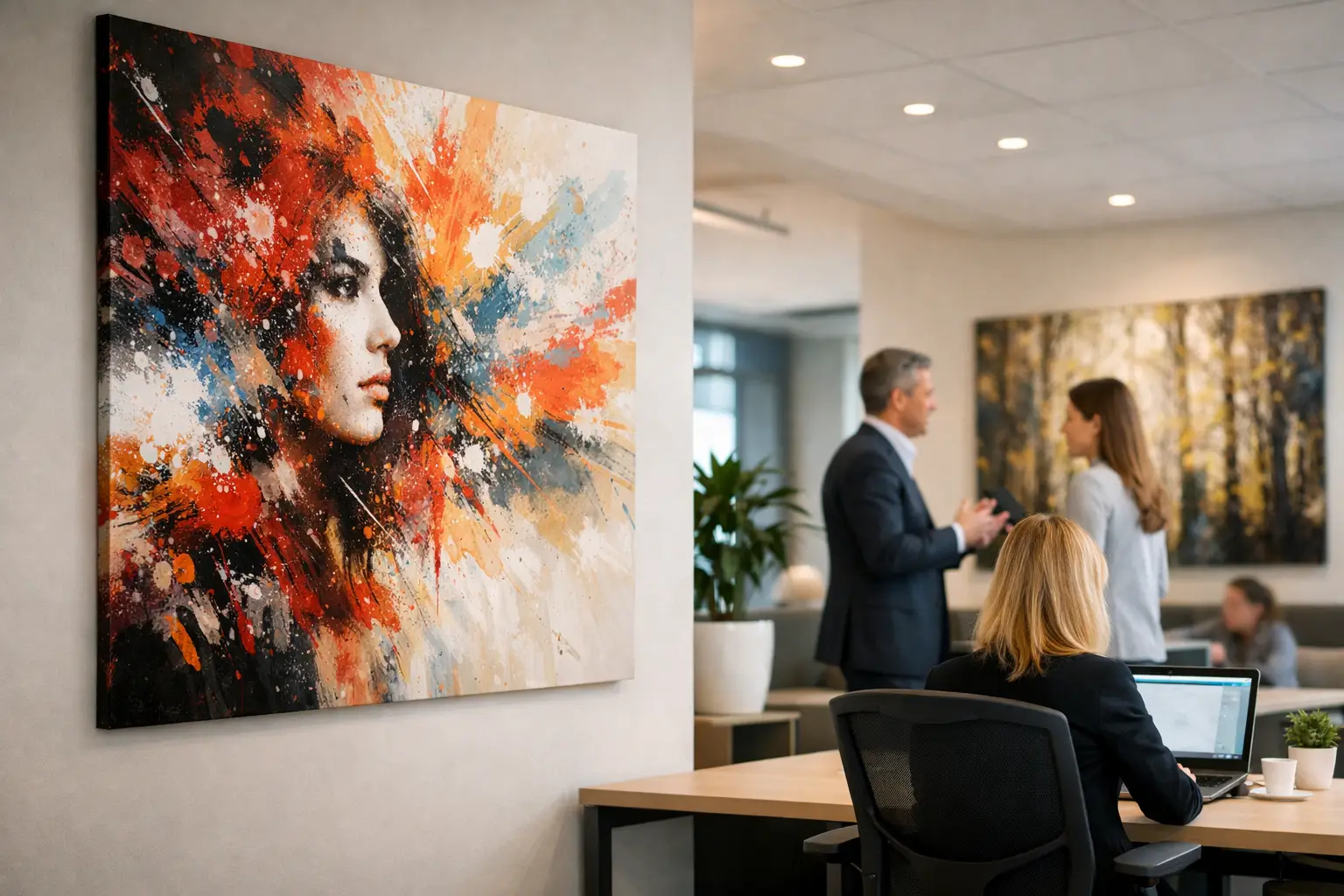
A bare entrance often says more than a company would like. Even before a meeting begins, visitors and employees are already forming an impression of the space, the atmosphere, and the level of attention to detail. That is precisely why art as corporate decor is not a mere detail, but a conscious choice. Good art not only makes a work environment more beautiful, but also more human, more relatable, and more impactful.
When designing an office, many companies first think of desks, lighting, and acoustics. That makes sense, since those are practical elements of a workspace. Yet it’s often the artwork on the wall or a sculpture in the lobby that gives the space its character. The difference between a functionally designed space and one that’s truly well-curated often lies precisely there.
Why Art as Corporate Decor Does More Than Just Fill Space
Art is sometimes seen as the final step. First, get the space in order; then, perhaps, add something to the walls. In practice, things usually work out differently. As soon as a space is finished but doesn’t yet have any art, it often still feels impersonal. Everything is just right, but nothing really stands out.
Art adds something that’s hard to achieve with standard office design: a sense of individuality. A carefully chosen piece of art can bring a sense of calm to a busy office, add warmth to a minimalist conference room, or make a reception area instantly more inviting. This isn’t just pleasant for visitors. Employees also spend hours every day in that environment and respond, consciously or unconsciously, to what they see around them.
Art also helps establish a company’s credibility. A notary office, healthcare organization, architectural firm, or family business does not require the same visual language. While one company may benefit from understated abstract work, another organization might opt for color, dynamism, or figurative elements. Art as corporate decor works best when it aligns with the organization’s identity, without becoming a contrived marketing tool.
Which spaces call for which art?
Not every area in a commercial building calls for the same approach. In an entrance or reception area, art should be immediately visible. A larger statement piece often works well there, because it welcomes visitors and sets the tone. In meeting rooms, balance is more important. Artwork that’s too busy can be distracting, while decoration that’s too plain adds nothing. Here, powerful pieces with a sense of calm in their composition often work well.
In the workplace, there’s another factor to consider: art should be present without causing disruption. Especially in open-plan offices, it’s wise to consider rhythm, color use, and scale. A series of works can be more effective in such settings than a single dominant piece. In hallways, executive offices, and waiting rooms, however, there is more room for individual choices.
The materials also make a difference. A framed piece has a different look than a large, unframed canvas. Sculptures, objects, or wall sculptures can add depth to a space, but they must fit in with traffic patterns and the room’s intended use. Art isn’t just a standalone accessory. It only really works well when it becomes an integral part of the space.
The lobby has different requirements than the workspace
Anyone selecting art for a company would be wise to first consider the function and use of each space. The lobby calls for a sense of prestige. A workspace calls for atmosphere and concentration. An executive office can be a bit more personal, while a waiting room should primarily exude calm and quality.
That may seem obvious, but this is precisely where things often go wrong. A single style is then applied throughout the entire building, even though the different spaces require something slightly different. A good selection feels cohesive without repeating the same thing everywhere.
How do you choose art that suits your business?
The best choice doesn’t start with taste alone, but with a few practical questions. How do you want a visitor to feel when they walk in? What kind of atmosphere fits your brand or organizational culture? And how formal—or, conversely, how welcoming—should the space feel?
Only then does the choice of style come into play. Abstract art is popular in commercial interiors because it leaves plenty of room for interpretation and often pairs well with modern decor. That doesn’t mean figurative art is any less suitable. On the contrary. In hospitality, healthcare, retail, or family-owned businesses, recognizable imagery can actually bring warmth and a sense of connection.
Color is just as important. Companies often play it safe by choosing neutral tones, whereas a single carefully placed piece with depth or contrast can have a much greater impact. At the same time, eye-catching isn’t always better. In some spaces, understated art actually has a stronger effect because it doesn’t demand attention but still exudes quality.
Size is also often underestimated. A piece that’s too small on a large wall looks lost. A piece that’s too large in a narrow space overwhelms the surroundings. Proportions are therefore more important than individual preferences. It helps to evaluate art not just based on a photograph, but in relation to the wall, lighting, and furniture.
Buy or experience first?
For many companies, that’s a relevant question. You want to be sure that a piece of art fits well in the space before making a final decision. That’s precisely why renting or an art lending service is often appealing to business clients. It lowers the barrier to entry, offers flexibility, and allows you to experience the art in practice first.
This is especially helpful when multiple spaces need to be designed or when an organization is still searching for the right visual direction. A piece of art may be strong on its own, but it might have a different effect than expected in a meeting room. In that case, experiencing it first isn’t a matter of doubt—it’s simply a sensible choice.
The Business Benefits of Art as Office Decor
The aesthetic benefit is usually self-evident. Yet that is not the only reason to invest in art. Companies also use art to make their environment more professional and distinctive. Especially in markets where trust, experience, and personal attention matter, the interior design reinforces the story you want to tell.
For employees, art can help create a more pleasant work environment. It doesn’t have to be grand or spectacular. In fact, a thoughtfully designed space feels more professional, more pleasant, and more balanced. People notice when an environment has been carefully curated.
The same applies to customers and business contacts. A well-designed interior inspires confidence—not because every company needs to be an art gallery, but because quality is evident in the details. Art shows that you’ve given thought to atmosphere, appearance, and the overall experience.
There is a nuance to this, though. Art shouldn’t feel like an imposed calling card. As soon as works are chosen too explicitly as mere status symbols, a space often loses its natural character. Good corporate decor lies precisely in the combination of quality, appropriateness, and tranquility.
Common Mistakes in Art for Commercial Interiors
The most common mistake is choosing based on empty space. There’s a blank wall, so something has to go there. That rarely yields the best result. Art then becomes mere filler, when it should actually give the space direction.
A second mistake is trying to match everything too closely. Art doesn’t have to be exactly the same color as the chairs or the carpet. In fact, when everything matches too literally, an interior loses its appeal. Cohesion is important, but contrast often makes a space more interesting.
Art is also often hung too high or too low. That may sound like a minor detail, but it has a significant impact on how professional a piece appears. Presentation is part of the overall look and feel. The right frame, the right size, and careful placement make a big difference.
It’s also worth taking changes in usage into account. A company may grow, relocate departments, or redesign spaces. In such cases, flexibility is valuable. Those who think about this in advance usually make more sustainable and smarter choices.
Personal advice makes all the difference
Choosing art for a business setting requires more than just flipping through a catalog. You want to know what works on a large wall, which style suits your industry, and how different pieces relate to one another. That’s precisely where the value of personalized guidance lies.
A full-service approach helps you make a decision more quickly—one that’s not only beautiful but also practical. This includes on-site consultation, help brainstorming combinations, visualizing the artwork on your wall, selecting the right framing, and reliable delivery. This makes the process clearer and helps you avoid making the wrong purchase.
For companies looking for quality without the hassle, this is often the best approach. At Amersfoort Art, for example, we regularly see business clients start with a single room and then expand to include a lobby, executive office, or conference room. Once art proves effective in practice, confidence naturally grows along with it.
Art in a business setting doesn’t have to be complicated. It does, however, require attention, a sense of space, and a willingness to look beyond standard decoration. Those who take that step often quickly notice that their workplace starts to feel different—more professional, more pleasant, and more personal. And that is precisely where the power of a well-chosen work of art lies.


