
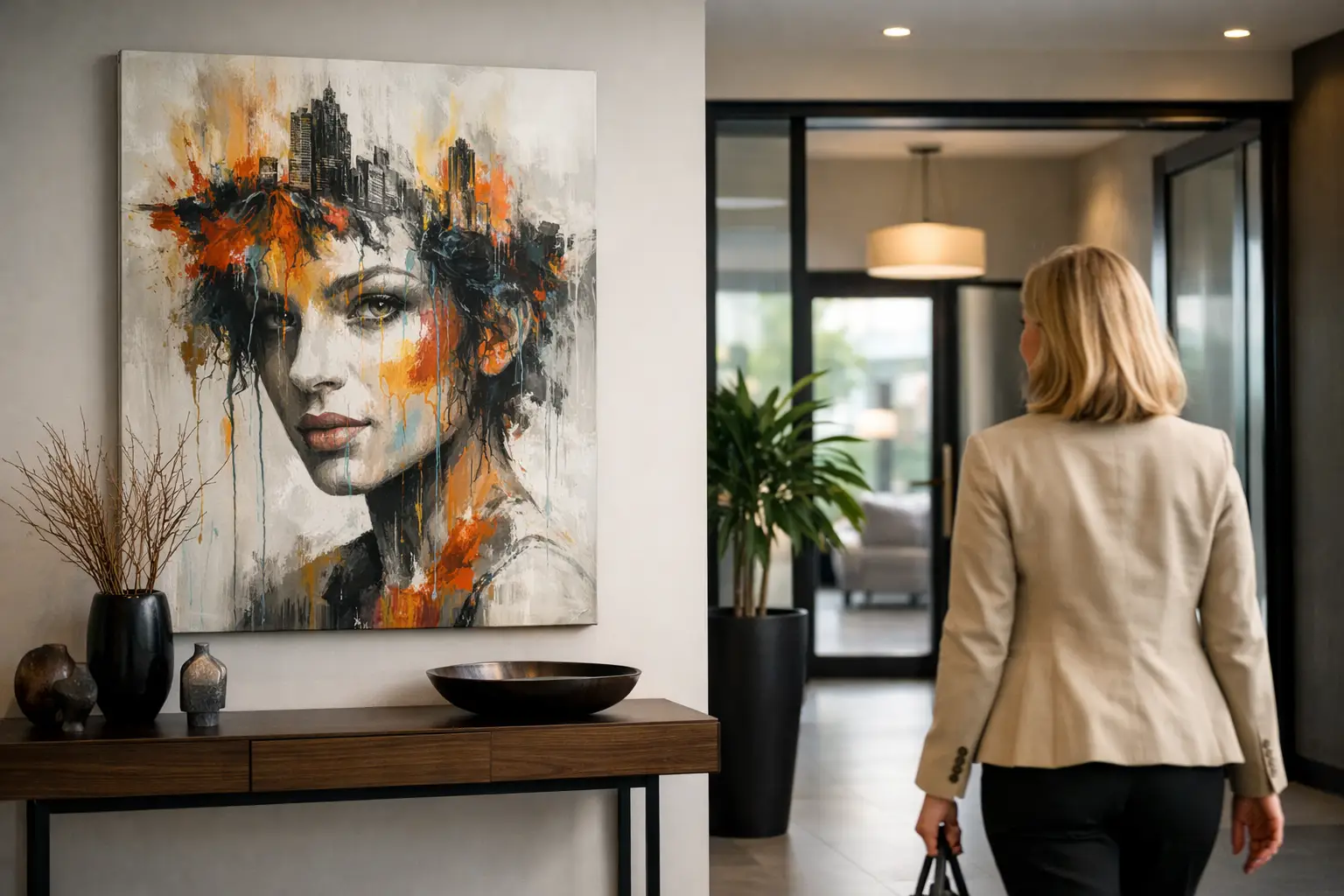
The entryway is often the smallest room in the house, but it’s the place where you enter every day and where guests are first welcomed. Choosing a work of art for the entryway is therefore more than just a final decorative touch. The piece immediately sets the tone: calm and refined, bold and energetic, or warm and personal. With the right choice, the entryway won’t feel like a mere passageway, but like a full-fledged part of your interior.
Start with the feeling you want to evoke
Don’t just look at what will fit on the wall. First, ask yourself what you want to experience the moment you walk through the door. A light, abstract piece can make a compact or dark entryway feel more open. A figurative artwork with recognizable forms, on the other hand, provides a sense of stability and creates a personal welcome. If you love contrast and an interior with character, then a colorful painting or graphic work can be exactly that one powerful accent.
The entryway doesn’t have to serve the same function as the living room. While you might opt for a calming atmosphere in the sitting area, the entryway can certainly feature something a bit more surprising. It’s a place where a piece of art can stand out without having to constantly hold your attention. Be sure to choose something that complements the atmosphere of the rest of your home. Not everything has to match exactly, but a color, material, or shape that recurs in the adjacent room creates a sense of cohesion.
Choosing a piece of art for your entryway: Start by looking at the wall
The available wall space largely determines which size works best. In a narrow hallway, a large horizontal piece can quickly appear too dominant, while a vertical artwork can actually emphasize the height of the space. When placed above a side table or bench, the artwork can generally be wider than when it hangs on its own on a narrow wall.
A practical rule of thumb is to hang the artwork at eye level, with the center approximately 145 to 155 centimeters from the floor. In an entryway where people mainly stand, the center can be hung slightly higher than in a sitting area. Also, leave enough space around the artwork. A small print that gets lost on a large empty wall won’t stand out as well, but a large canvas in a narrow passageway can feel oppressive.
Having trouble estimating the size? Temporarily mark the dimensions with painter’s tape or make a paper cutout. That way, you can immediately see how a particular size affects the proportions. Personal advice and a visual representation on the wall can be especially helpful if you’re torn between two sizes.
Be mindful of walking space and vulnerability
An entryway is a living space. Coats, bags, strollers, and groceries pass through it every day. So don’t hang a piece of art in a spot where you’ll constantly brush against it. A fragile object, a piece behind glass, or a relief should be placed at a sufficient distance from the coat rack and a high-traffic doorway.
The placement opposite the front door also deserves consideration. If you look directly at a piece of art as you enter, it will naturally take center stage. If the piece is hung on a side wall, it can be more subtle, creating a pleasant surprise as you walk in. Both choices can be good. It depends on how much attention you want to draw to the entryway.
Light Makes All the Difference
A beautiful piece of art can look flat if it’s poorly lit. Many galleries have limited natural light and therefore require a well-thought-out lighting plan. An adjustable spotlight or wall sconce helps bring out the color, texture, and brushstrokes. It’s best to choose warm white light so that the space remains inviting and the colors look natural.
Avoid a harsh spotlight that reflects directly off the glass. This happens especially with framed prints, photographs, and screen prints. A light source coming from slightly above at an angle often works better. For works on paper, it’s a good idea to protect them from bright, direct sunlight. This helps the colors stay vibrant longer.
A darker entryway can actually benefit greatly from art that features light areas, shine, or bright pops of color. Conversely, a subdued, dark piece on a light wall adds depth. So be sure to consider the lighting before choosing a color.
Choose colors thoughtfully, but don’t be too conservative
The color of the artwork doesn’t have to match that of your walls, floor, or accessories. If everything is the same shade, the artwork can easily blend into the interior. A deliberate contrast often adds more character: a blue-green piece next to a warm, sandy-colored wall, or a bold red accent in a neutral entryway.
If you want to create a calm atmosphere, look for a color that appears somewhere in the room—for example, in a rug, a vase, the color of a door, or a type of wood. It can be very subtle. Sometimes, even a small ochre-yellow detail in an abstract artwork is enough to create that connection.
When dealing with bold wallpaper or a wall with a lot of texture, simplicity may be the best choice. A graphic print, a piece with a calm composition, or a monochrome image helps keep the entryway balanced. On a smooth, white wall, however, art can add more depth and color. There’s no hard-and-fast rule that art always has to stand out. Sometimes, a subtle piece is exactly what a busy entryway needs.
Think about the material and framing
It’s not just the image that matters. The medium also plays a role in how the artwork comes across in your entryway. A painting on canvas has a warm, immediate presence and can make a powerful statement even without a frame. Photography, prints, and works on paper often gain added impact through a carefully chosen frame and mat.
A wooden frame can add warmth to a modern entryway with stone or sleek cabinet fronts. A slim black frame, on the other hand, provides a clean, contemporary setting. For a colorful or detailed piece, a simple frame is usually the best choice. With a minimalist print, the frame can be more prominent, as long as it doesn’t overwhelm the image.
Custom framing is especially valuable when a piece is an unusual size, needs protection, or when you want to present a series as a whole. In such cases, it’s not just the color and profile that matter, but also the correct distance between the glass and the paper. This ensures the artwork remains beautiful and receives the attention it deserves.
One statement piece or a small art wall?
A large piece of art is often the simplest way to give an entryway character. It creates a sense of calm, since you don’t have to combine many different elements. Especially on a tall or wide wall, a single, carefully chosen piece of art can make a bigger impact than several small objects.
A small art wall works well in a long hallway or near a staircase. In that case, combine pieces that share something in common: a color palette, a technique, a subject, or a similar frame. Too many different sizes and styles can look cluttered, especially in a space where coats, shoes, and mail are also present.
Plan the layout in advance, either on the floor or on paper. Leave a similar amount of space between smaller pieces. You don’t have to create a symmetrical arrangement, but it helps if there’s a clear concept behind the composition. For example, start with one favorite piece as an anchor and build the rest of the display around it.
Trying it out first might be a wise choice
Art looks different in a gallery than it does at home. The color of your walls, the natural light, and the distance from which you view the piece all change the experience. Renting is a great option, especially for an entryway, where light and space can sometimes be difficult to gauge. It gives you the chance to let a piece of art become part of your daily life for a while before you make a decision.
This isn’t just helpful when you’re unsure about style. Even if your interior design is still a work in progress, a flexible art lending service gives you the freedom to discover what suits you best. At Amersfoort Art, you can get guidance on making that choice, without art having to feel complicated or unapproachable.
Be sure to take the time to see what happens when you view the artwork for a few days as you arrive and leave. The best piece of art for your entryway is rarely just the one that’s beautiful on its own. It’s the piece that makes the space its own and warmly welcomes you every single time.


