
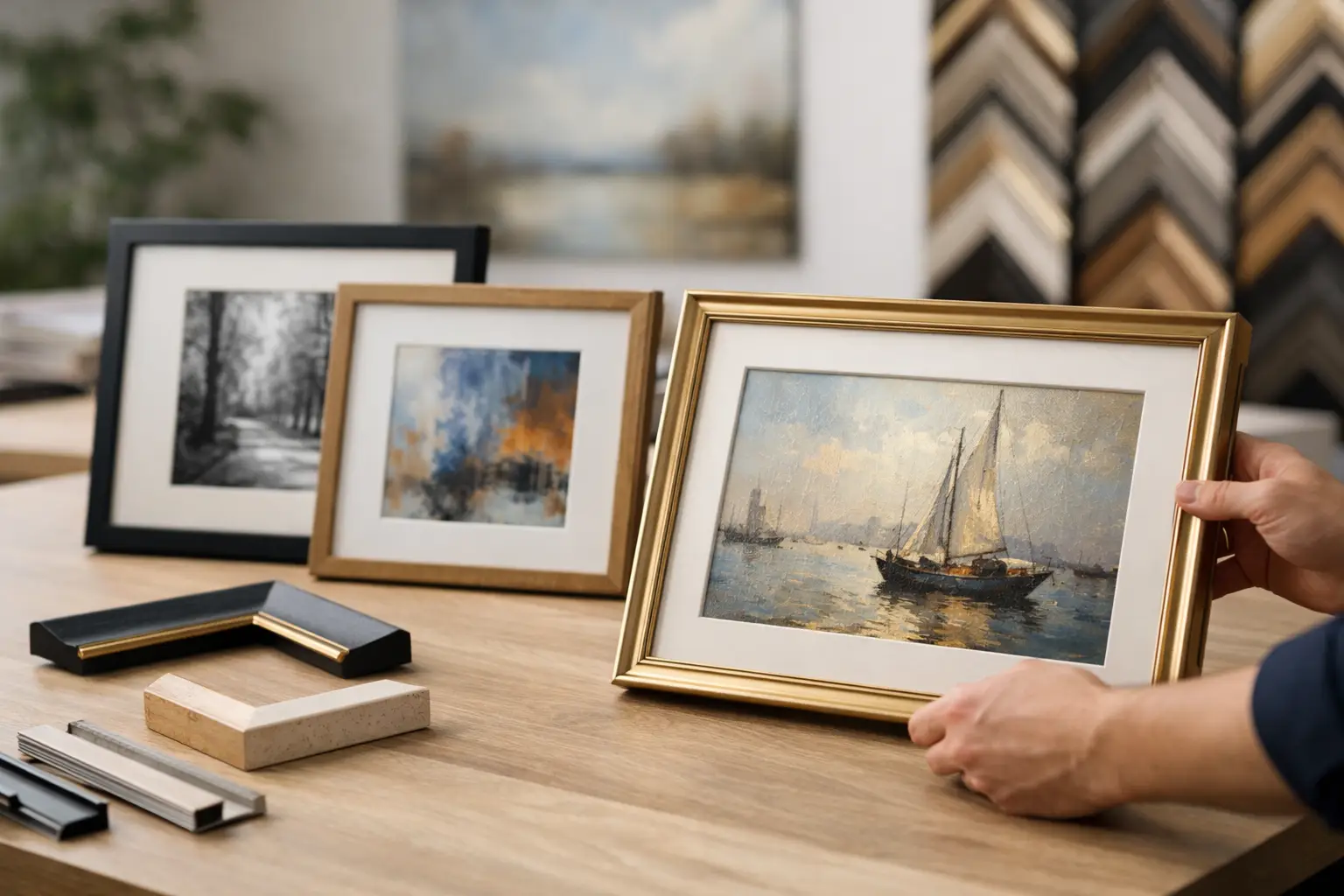
A powerful work of art can suddenly look flat on the wall if the framing isn’t right. This is precisely why custom moldings are not a detail after the fact, but an essential part of the presentation. The right frame supports the work, enhances the atmosphere of a room and makes everything come together – from color and material to size and light.
Why custom moldings do more than just frame
A standard frame often seems like a fine solution at first glance. Yet you quickly notice the difference as soon as a work does not fit nicely, a passe-partout is too narrow or the color of the frame clashes with the image. Art, photography, drawings and graphics are all about proportions. Just a few millimeters more rest around a work can provide more depth and balance.
Custom frames are therefore not only an aesthetic choice, but also a practical one. They match exactly the work you want to frame and where it will hang. This is important in a living room, but equally important in an office, reception area or meeting room. A frame should not attract attention on its own, unless that is a deliberate intention. Usually the best choice is the frame that enhances the artwork without competing with it.
Therein lies the nuance as well. Not every work requires an eye-catching, wide wooden frame. Sometimes a narrow aluminum frame works better, precisely because it is quieter. And with other works, a warm wooden tone does more than sleek black or white. It depends on the artwork, the setting and the effect you are looking for.
The right custom frame starts with the artwork
A good choice begins not with the frame wall, but with the work itself. What kind of technique was used? How strong is the use of color? Is it an original work of art, a photograph, a poster, a screen print or an object? Each type of work has different finishing requirements.
With a vulnerable work on paper, protection is often just as important as appearance. Issues such as acid-free material, the distance between glass and work and the choice of suitable glass play a greater role. With a colorful modern work, the question of how to keep the colors vibrant without the frame becoming too present can be central.
Size also counts. A small work can actually have more presence in a generous frame with passe-partout. A large work usually requires sturdiness, both visually and technically. Then you look not only at style, but also at construction and bearing capacity. After all, beautiful framing must also simply be solid.
Material sets the mood
Wood and aluminum are the most commonly chosen materials, but they give a totally different impression. Custom wood frames often have a warmer, richer and slightly softer feel. They fit well with paintings, graphics and interiors where texture and natural materials are important.
Aluminum looks sleeker and more modern. It is often chosen for photography, graphic works and business environments where clarity and simplicity are desired. That doesn’t mean aluminum always looks cool or wood always looks classic. The finish matters a lot. Matte, brushed, lacquered or just a subtle wood grain – these are choices that greatly influence the character of the frame.
Color is rarely a loose choice
Many people look to black, white or wood first, and that makes sense. Yet color in a frame never works on its own. A white frame can look fresh in a light interior, but become too harsh in a warm, earthy color palette. Black can add strength, but also overemphasize the edge if the work itself is subtle.
Therefore, color is usually chosen in relation to both the artwork and the space. Sometimes the frame matches an accent color in the work. Sometimes it matches a material in the interior, such as oak, steel or natural stone. The best choice is often not the most striking, but the most convincing.
Passe-partout and glass make the difference
Those who think of framing often think first of the outer edge. Yet passe-partout and glass determine at least as strongly how a work comes across. A mat gives air, focus and distance. It helps to present the image calmly and can give a smaller work more weight on the wall.
Proportions are essential here. A border that is too narrow quickly feels oppressive. A border that is too wide can actually push the work away. The shade of the passe-partout also plays a role. Bright white is different from off-white or a warm cream color. Especially with paper works, etchings or old prints, this makes a visible difference.
Glass is at least as decisive. Ordinary glass does not always suffice, especially in places with a lot of light. Reflection can literally put a beautiful work at a distance. This is when anti-reflective or museum glass is often a better choice. This is an investment, but one that pays off daily in viewing pleasure. Especially with art you really want to keep seeing, not just owning.
Custom frames for home and work
Home framing is often about atmosphere, consistency and personality. A work of art may stand out, but it must also fit into the space in which you live. In a living room a frame can add warmth, in a hallway brightness and tranquility. Bedrooms often call for subtlety, while a dining room or open living space can sometimes handle more contrast.
In business environments, the emphasis is often just different. There, representation plays a stronger role. Art and framing contribute to the first impression a company makes. A well-chosen frame shows that attention has been paid to quality and presentation. At the same time, the whole must remain professional and match the identity of the organization.
This is precisely why customization is so valuable. What works well at home is not automatically suitable for an office or practice space. Light, walking routes, wall color and viewing distance all have an influence. A frame that is beautiful up close may look too delicate on a large wall. Conversely, a substantial frame may become too dominant in a small space.
When standard does not meet
There are plenty of situations in which a standard size simply won’t do. Think of an artwork with different dimensions, a treasured photograph that needs to be professionally presented, a diploma or certificate that should be neatly and durably framed, or an object with depth that requires a special solution.
Even with art loans or changing collections, customization is often smart. Those who regularly change art on the wall want each work to look good. Sometimes a neutral base frame is the best solution. In other cases, each work requires its own approach. It depends on the collection, the space and how much flexibility is desired.
At Amersfoort Art, we often see people come in with a fairly concrete question – a frame for a photograph or artwork – and gradually discover how much difference the right finish makes. Not complicated, but careful. That’s exactly where customization becomes enjoyable: you don’t have to think of everything yourself, but you do get a solution that really fits.
Good advice prevents a mis-sale
You choose a frame differently than you choose a vase or cushion. Of course, taste may be leading, but good framing also requires technical and visual considerations. How vulnerable is the work? Does it hang in direct sunlight? Is the frame meant to blend into the interior or make a statement? And how does the image change under different types of glass?
That’s why personal advice almost always pays off. Not because it has to be complicated, but because small choices have a big impact. A slightly warmer frame tone, a different profile or a quieter passe-partout can be exactly the difference between fine and absolutely fine.
This also means that there is rarely one perfect solution. Sometimes several good directions are possible. Then it helps to consider budget, maintenance and use in addition to appearance. You may choose differently for a valuable original artwork than for a beautiful reproduction or family photo. Both deserve attention, but not always the same approach.
Custom moldings as part of the overall look
A work of art is never completely separate from its surroundings. The wall, the light, the furniture and even the distance from which you look play a role. This is precisely why custom frames often feel so natural once they hang. Everything seems to fall more into place.
That, ultimately, is the power of good framing. Not that the frame takes the lead in itself, but that the artwork gains peace, conviction and presence. Sometimes subtle, sometimes pronounced, but always with a clear purpose. If a work does something to you, it deserves a presentation that supports that feeling.
Anyone who takes the time to make that choice carefully usually finds that a frame is much more than a border around an image. It is the connection between art and space – and that is exactly where the difference you see every day arises.


