
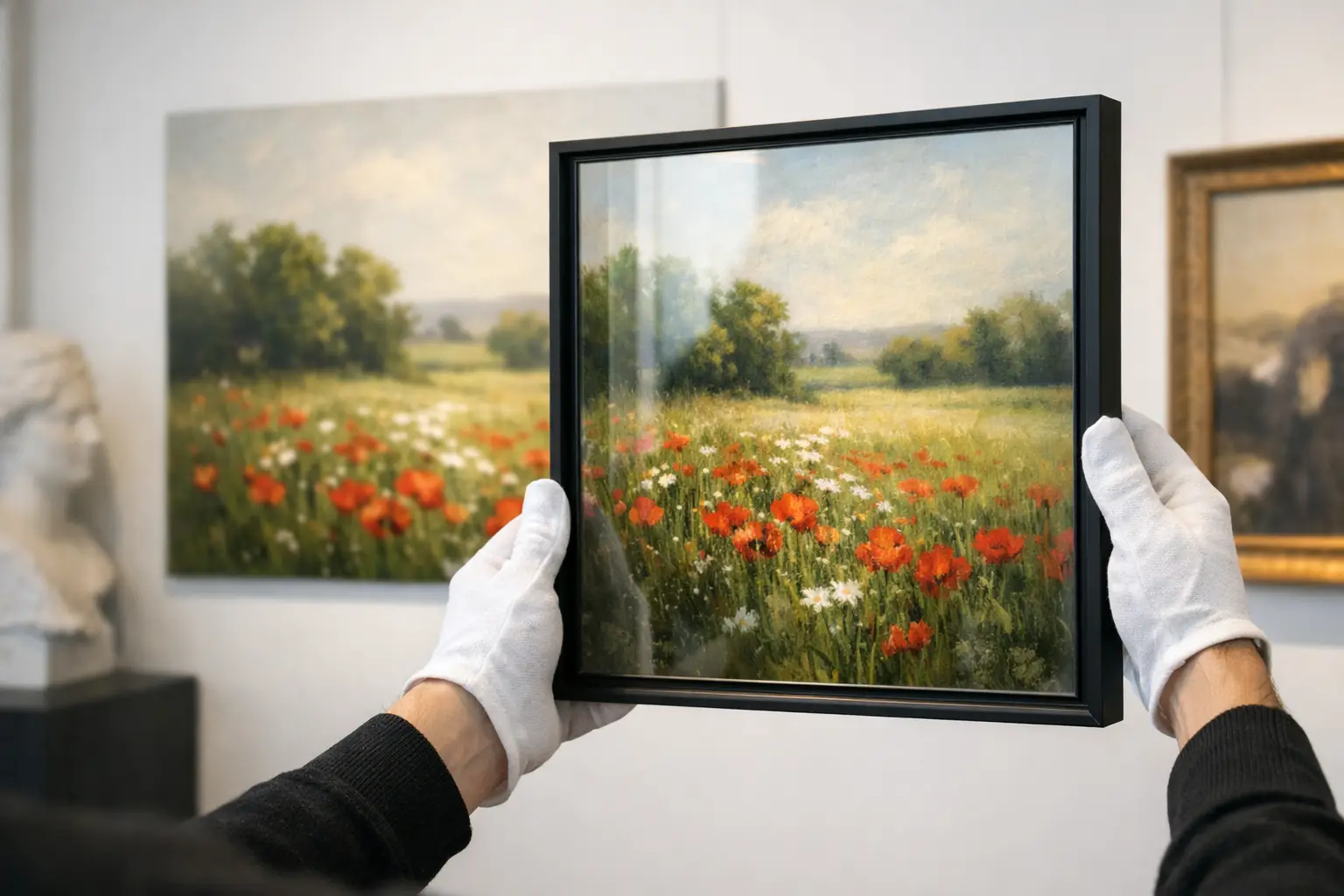
A work of art can be beautifully framed, yet still fail to look its best because of the wrong choice of glass. Anyone who has ever looked at a photo or drawing behind regular glass in a room with plenty of natural light knows how distracting reflections can be. The question of when to choose museum-quality glass therefore often doesn’t come up until the artwork is already hanging. Yet it’s precisely earlier in the process that this choice makes all the difference.
When should you choose museum-quality glass?
You should choose museum glass especially if you want to see the artwork itself, rather than reflections from windows, lights, or your own interior. The glass is designed to significantly reduce reflections and usually offers high UV protection as well. This allows you to see colors, details, and the paper’s texture more clearly, while the artwork remains better protected against discoloration.
This makes museum-grade glass particularly suitable for works on paper, photography, screen prints, watercolors, etchings, diplomas, or other items that are sensitive to light. With these types of works, it’s often not just about presentation, but also about preservation. A good frame does more than just add a finishing touch—it helps keep the artwork in good condition.
Still, museum-grade glass isn’t automatically the best choice in every case. It’s a premium product, and that’s reflected in the price. That’s why it’s wise to consider not only what’s technically best, but also where the artwork will be displayed, how valuable it is, and what you personally find important in terms of its appearance.
What Makes Museum Glass Different from Standard Glass
Standard glass protects a work of art from dust and contact, but often causes a lot of glare. This can be distracting, especially in living rooms, offices, and reception areas with large windows. You end up seeing not only the artwork, but also the surroundings in front of it.
Museum glass has a special coating that significantly reduces glare. As a result, the image appears calmer and more immediate. Colors remain more natural, and dark areas are less likely to become washed out by light. In photography and printmaking, this effect is often immediately apparent. It’s as if there’s less distance between you and the artwork.
In addition, museum glass filters out a large portion of harmful UV radiation. That’s no luxury. After all, paper, ink, and pigments react to light. So anyone who invests in a beautiful print, a cherished photograph, or an original work is choosing museum-grade glass not only for its aesthetic appeal but also for preservation.
In what situations is museum-grade glass really worth it?
The added value of museum glass is most evident in spaces with highly variable lighting. Think of a living room with large windows, a hallway where sunlight streams along the wall, or an office space with spotlights and glass walls. In such environments, standard glass can appear distracting. Museum glass creates a much calmer visual effect.
The difference is also significant when it comes to works of art with fine details. A subtle watercolor, a pencil drawing, an old map, or a black-and-white photograph quickly loses its nuance behind reflective glass. With museum glass, soft transitions and small details remain more visible.
It’s also a logical choice for pieces with emotional or financial value. For example, a framed family photo, a cherished memento, a work of art you bought to enjoy for years to come, or a piece hanging in a prestigious business space. In such cases, you generally don’t want to skimp on appearance or protection.
When working on paper, it’s often the smartest choice
Paintings on canvas do not require glass, but works on paper usually do. And paper, in particular, is fragile. Light, moisture, and temperature fluctuations affect how a work ages. Proper framing with appropriate glass is therefore not a luxury, but an essential part of responsible preservation and display.
With screen prints, lithographs, etchings, and photographs, you often see that customers first look at the frame’s color and style. That’s understandable, because those are the most visible elements. However, the glass plays at least as big a role in determining how the final result looks on the wall. A beautiful frame with the wrong glass detracts from the overall effect. Conversely, museum-quality glass elevates a simple, well-chosen frame to a whole new level.
In commercial interiors, visibility is especially important
In an office, conference room, or reception area, you rarely view a work of art from the ideal angle. You walk past it, sit under lighting, or view it from different positions. That’s when reflections become particularly distracting. Museum glass ensures that art remains clearly visible even in a functional space.
Not only is this more pleasant for employees and visitors, but it also enhances the space’s aesthetic appeal. Art should add something to an interior; it shouldn’t be lost in reflections.
When might museum-grade glass not be necessary?
Not every piece of art requires museum-quality glass. If a framed poster is hanging in a room with little direct light, and the piece is intended primarily for decorative purposes, then anti-reflective or clear glass can also be an excellent choice. Especially when budget is a major consideration, it’s important to take an honest look at the piece’s intended use, location, and value.
When it comes to picture frames for temporary prints or seasonal decorations, many people also prefer a simpler solution. That makes sense. You don’t need to use the most luxurious type of glass for every picture on the wall.
It is, however, important to understand the difference between anti-reflective glass and museum glass. Anti-reflective glass reduces reflections, but often results in a slightly duller image and a less clear view of details. Museum glass, on the other hand, combines low reflection with high transparency. As a result, the artwork appears more vibrant. Those who prioritize the quality of the viewing experience usually notice this difference right away.
When should you choose museum glass instead of anti-reflective glass?
This is a common question when it comes to framing. It makes sense, since at first glance both options seem to solve the same problem. Yet the difference lies in the finer details. Anti-reflective glass is a good middle ground if you want to reduce annoying reflections without immediately opting for the highest-end option. Museum glass is the better choice if color, depth, detail, and protection are truly important.
When it comes to valuable art, original works, and professional presentation, museum-grade glass is usually the best option. For decorative purposes or on a tighter budget, anti-reflective glass can be a very good choice. So it depends on how closely you’ll be looking at it, where the piece will be displayed, and how long you want to enjoy it.
Price is a factor—and that’s okay
Museum-quality glass is more expensive than standard or anti-reflective glass. That can make the decision a bit of a dilemma, especially if you’re having multiple works framed at the same time. Still, it helps to look not just at the extra cost, but at the overall result. With a beautiful work of art, a custom frame, and a spot where you look at it every day, the glass plays a major role in your enjoyment of the piece.
On top of that, a poor choice often ends up costing more in the long run than investing a little more upfront. This is especially true if, after installation, you realize that the artwork is barely visible at certain times of the day. In that case, the glass turns out to be not just a detail, but a decisive factor.
A practical approach often works best: choose museum-grade glass for the pieces that are truly important, and take a different approach for less fragile or temporary works. That way, you can stay within your budget without compromising on what really matters.
Take the space into account when making your decision
If you’re unsure, it’s a good idea to first take a look at the spot where the artwork will be hung. How much natural light is there? Are there windows across from the wall? Will there be spotlights above it? Will you be looking directly at it, or mostly at an angle? Questions like these often reveal more than just the value of the artwork.
In a bright home with open spaces, museum glass is a better choice than in a cozy reading nook without direct sunlight. And in a minimalist interior with lots of glass, shine, and light reflection, the difference can be even greater than you might expect.
That’s exactly why personalized advice on framing is so valuable. Not because the choice has to be complicated, but because a good solution depends on the whole picture: the artwork, the frame, the space, and the way you see it. At Amersfoort Art, we often find that customers aren’t truly convinced until they see the difference in person.
The best choice isn’t always the most expensive one, but it is the most suitable one
When should you choose museum-grade glass? Usually when visibility, tranquility, and protection become more important than just the basic finish. Not because it’s always necessary, but because it simply makes some works of art and spaces look much more beautiful. And when you walk past a piece of art every day that brings you joy, being able to see it clearly isn’t a luxury—it’s part of the pleasure.
So don’t just look at the price tag—focus instead on what you want to experience on your wall.


