
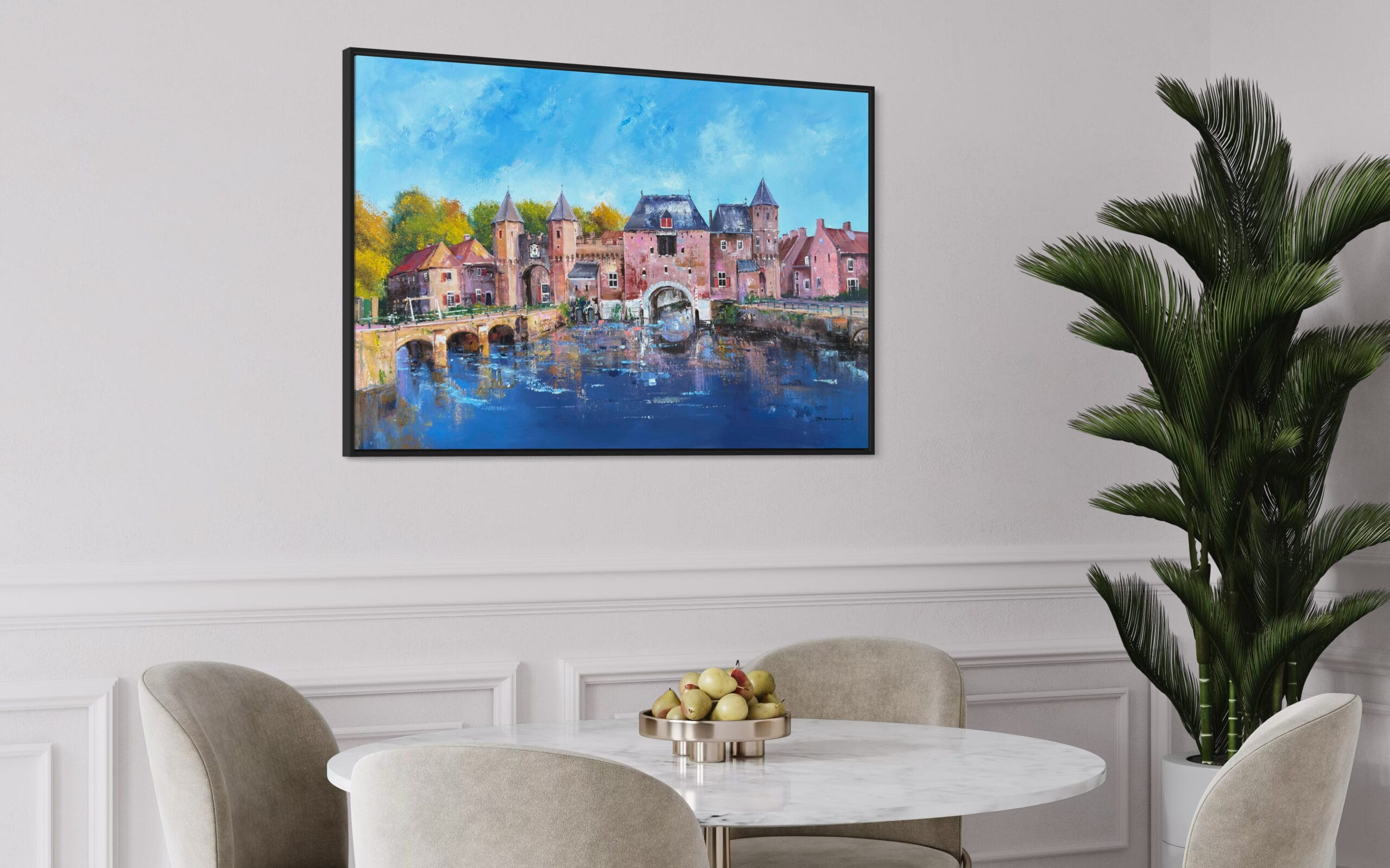
An empty wall doesn’t necessarily call for a grand gesture. Sometimes, just one piece with the right color, line, or vibe is enough to make a room your own. If you’re looking for artworks from Amersfoortis often looking not just for something beautiful to hang on the wall, but for art that fits a home, a workplace, or a special occasion for giving.
That’s what makes choosing art a personal decision. An abstract piece can bring a sense of calm to a busy interior, while an expressive painting can inject excitement and energy into a quiet space. There’s no set rule for good art in the home. However, it does help to consider what you want to see every day—and how a piece interacts with your space.
Artworks featuring Amersfoort at Amersfoort Art—for sale and for rent
Amersfoort Art has a beautiful collection of artworks centered on the theme of Amersfoort. View the collection online or stop by our gallery. Most of the artworks are also available through our art lending program.
The first reaction to a work of art is often the most valuable. Does your gaze linger? Does the work evoke a memory, a question, or a pleasant feeling? If so, there’s something worth exploring further. Art doesn’t have to be explained right away to be moving. In fact, a work that leaves room for your own interpretation often remains interesting for longer.
Next comes the practical side. Don’t just look at the image on a screen; also consider the size, material, and use of color. A small piece can have a surprisingly powerful impact above a side table or in an entryway. Above a sofa, dining table, or reception desk, a larger piece often needs to have more presence. The relationship to the wall is more important here than whether a piece is large or small on its own.
The atmosphere of the space also plays a role. In an interior featuring natural materials, prints, ceramics, or a subtle painting can complement the space beautifully. Does your home have lots of clean lines and muted tones? Then a colorful piece can offer a welcome contrast. Conversely, a refined, almost monochromatic piece of art can bring a sense of calm to a room where there’s already a lot going on.
Besides, it doesn’t all have to match perfectly. Art is allowed to have its own voice. A piece that falls just outside the color palette can add more depth to an interior than a choice that’s tailored exclusively to the couch or curtains.
Try it first: rent art before you buy
You don’t choose a work of art just with your eyes—you also choose it by living with it. The light changes throughout the day, the viewing distance at home is different than in a gallery, and sometimes a piece really comes into its own in a space. That’s why renting art is a great intermediate step for many people.
With an art lending service, you can experience a piece of art at home or in the office without having to make a major purchase decision right away. This is convenient if you’re unsure which style to choose, want to change pieces regularly, or want to first discover which artists and techniques suit you best. In a business setting, renting also offers the opportunity to let the look and feel of reception areas, meeting rooms, or workspaces evolve in tandem with a new interior design or brand identity.
Renting isn’t just for those who are uncertain. It’s also a good fit for people who enjoy variety. A light and airy piece can feel very different in the spring than a layered, warmer piece in the winter. Those who switch things up regularly see their surroundings with fresh eyes.
The decision between renting and buying therefore depends on your preferences. If you want to build a collection as a permanent part of your collection, then buying makes sense. If you’re looking for flexibility, want to take your time getting to know a piece first, or enjoy change, then renting may be more appealing. At Amersfoort Art, flexible rental and savings options cater to both ways of experiencing art.
How to Determine the Right Size for Your Wall
A beautiful piece of art may not stand out as well if it’s hung too high, too low, or too small. Especially when dealing with a large, empty wall, there’s a strong tendency to play it safe. Often, however, a larger piece actually works better because it visually anchors the space and doesn’t get lost in its surroundings.
Hang art at eye level as a general rule. In a sitting area or dining area, the artwork can be hung slightly lower, since you’ll usually be viewing it while seated. When hanging art above a piece of furniture, it’s best to create a clear sense of cohesion: leave enough space between the furniture and the frame, but avoid making the artwork appear to float above it.
A single piece of art isn’t always the best solution. Placing two works side by side can create balance on a wide wall, as long as there’s a clear connection in color, size, technique, or subject matter. A group of smaller works works well in a stairwell, hallway, or above a sideboard. First, lay out the composition on the floor or mark the outlines on the wall with painter’s tape. This way, you can quickly see if the proportions are right before drilling any holes.
Lighting deserves the same attention. Daylight can be beautiful, but bright sunlight is less suitable for many works of art. A well-placed lamp brings out the colors and textures better, without causing harsh glare on glass. When displaying works on paper, it’s especially important to protect them from direct light.
A frame is part of the artwork
Framing is sometimes seen as the final touch, whereas the frame actually has a significant impact on the artwork’s appearance. A carefully chosen frame protects the artwork and, at the same time, determines how it relates to the space. In the case of prints, photographs, and drawings, for example, the mat is not just a border: it creates space and draws attention to the image.
For a colorful painting, a simple, narrow frame may be the best choice. With a small piece, a wider frame can actually add extra depth. Wood adds warmth, black can look graphic and modern, while white often draws the eye entirely to the image. No single material is always better. The right choice depends on the artwork, the wall, and the atmosphere you want to create.
Custom framing is especially valuable for unusual sizes, delicate paper, or pieces with sentimental value. Think of an old poster, a family photo, a diploma, or a piece of art you bought while traveling. In such cases, you not only want it to be beautifully framed, but you also want the materials and finish to reflect the durability that the piece deserves.
If you’re unsure, bring a photo of the room with you and discuss various options alongside the artwork itself. A frame that looks modest in the store might make all the difference at home. Conversely, a bold frame might unintentionally draw attention away from the artwork.
Art for the home, the office, and as a personal gift
Art isn’t just for above the sofa. In the entryway, a small, original piece immediately creates a personal welcome. In a bedroom, a serene piece can bring a sense of calm. A sculpture on a cabinet, pedestal, or windowsill literally adds another dimension to an interior. Sculptures are particularly well-suited for places where a wall hanging might not be the obvious choice.
In the workplace, too, art does more than just fill an empty wall. It can soften the atmosphere in a reception area, give a meeting room character, and show that attention is paid to the environment in which people work together. Don’t base your choice solely on corporate colors. A piece of art that sparks conversation or is a pleasure to look at is often more valuable than an image that is purely decorative.
When giving art as a gift, you don’t always have to choose the entire piece for someone else. An artistic sculpture, a carefully framed print, or a contribution to a work can be more personal than a standard corporate gift. For an anniversary, a move, or a farewell, the story behind the choice is especially valuable. Explain why this particular piece or object is a good fit for that person.
Give yourself some space to look
The best choice is rarely made under time pressure. View a work up close and then from a few steps away. Notice what happens when you look at it again later. Some works of art are immediately compelling; others unfold slowly. Both reactions are valid, as long as the work sparks something in you.
Feel free to ask for advice on size, presentation, combinations, or the options for renting and buying. Personal guidance doesn’t make art any less personal—in fact, it helps you make a choice that will feel right for a long time. Above all, give yourself time to look, because a work of art that truly suits you turns a space into a place where you love to be.


