
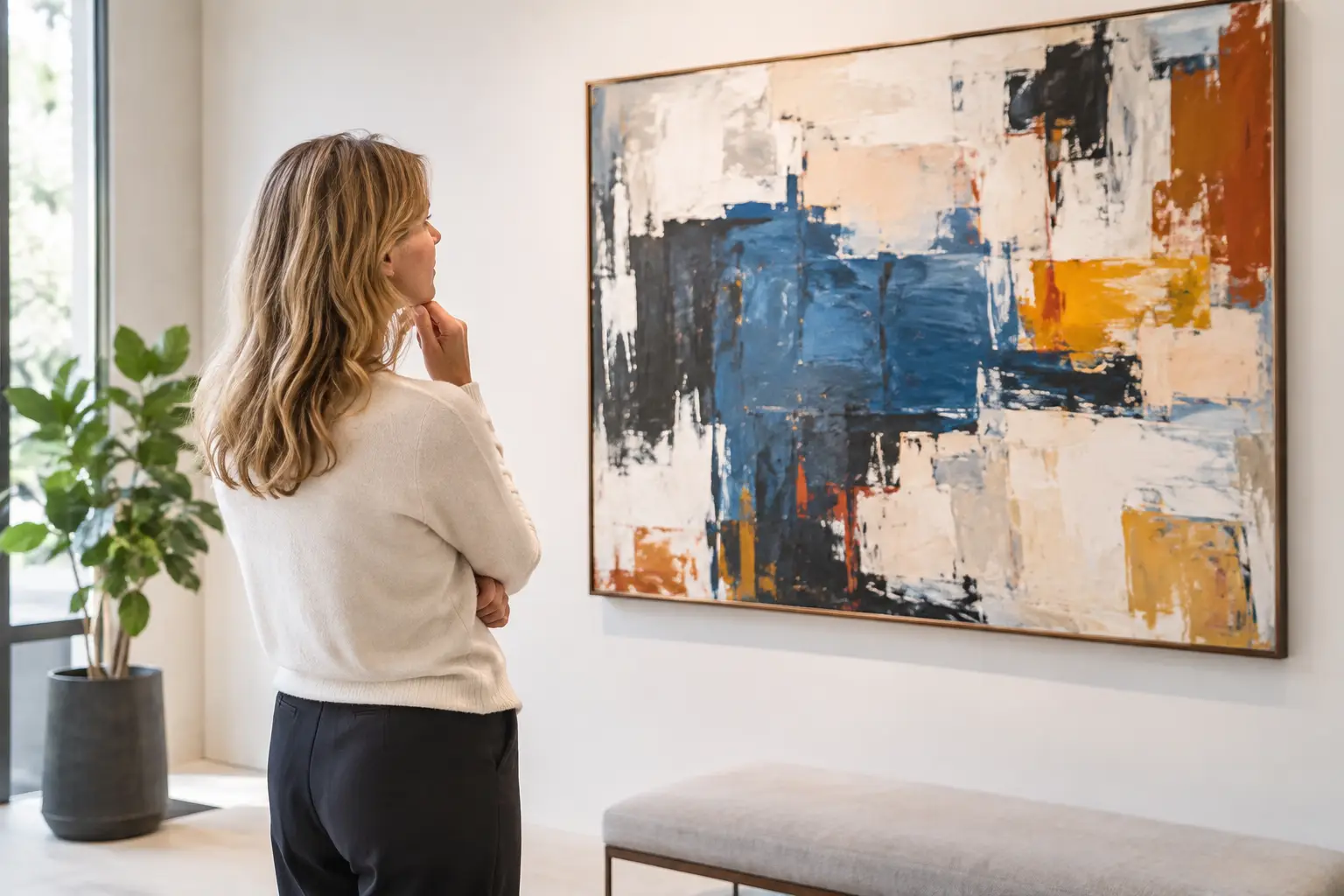
An abstract work can instantly give a space its character. Still, buying abstract art can feel nerve-wracking: what if the painting looks different at home than it did in the gallery, or what if you start to have second thoughts after a few weeks? These are perfectly normal questions. Precisely because abstract art leaves room for your own interpretation, choosing a piece doesn’t require prior knowledge of art history, but rather an awareness of what you see, feel, and want to experience every day.
Start with the feeling, not the explanation
In figurative art, a subject is often immediately recognizable. Abstract art works differently. Areas of color, lines, rhythm, texture, and composition all combine to create the piece’s overall effect. So you don’t need to know exactly what the artist intended right away. A work that continues to draw you in—even when you can’t immediately put it into words—deserves your attention.
Take your time and look at it for more than a few seconds. Does the artwork change when you take a step back? Do you see different layers, movement, or, on the contrary, stillness? A good abstract artwork doesn’t have to evoke the same feelings in everyone. Above all, it should add something to your own environment.
That doesn’t mean everything comes down purely to intuition. Feel free to ask about the artist, the technique used, and the edition size. That information provides context and helps you better understand the quality, the creative process, and the price. But never let a complicated story outweigh your own reaction to the work.
Buying abstract art: Consider the space first
A painting that looks perfect in a large, bright gallery may appear smaller, darker, or, conversely, much more prominent in a living room. Therefore, always use the space as your starting point. Take a photo of the wall where the artwork will be hung and note the available width and height. A photo of the seating area, floor, and existing furniture will also help you make comparisons.
Size Determines Impact
A common mistake is choosing a piece that’s too small for the wall. Above a sofa, sideboard, or dining table, art can often be chosen to be larger than you might initially expect. As a guideline, a piece of art should cover about two-thirds of the width of the piece of furniture. This isn’t a hard-and-fast rule, but it prevents a painting from looking a bit lost on the wall.
Do you have a tall, narrow wall, such as one next to a staircase or in a hallway? If so, a vertical piece can beautifully accentuate the height. Above a wide sofa or low cabinet, a landscape-oriented piece often creates a calmer atmosphere. A series of smaller works can also be striking, provided there is sufficient cohesion in color, size, or style.
Also keep the viewing distance in mind. A large painting with a coarse paint texture looks best when you can take a few steps back. In a compact space, a smaller work with refined details may offer more to discover.
The color doesn’t have to match exactly
Many people look for a piece of art that features the exact same color as their sofa, curtains, or rug. While this can create a harmonious look, it sometimes results in a space that’s too predictable. Art, on the other hand, should serve as an exciting accent.
Instead, consider the underlying tone of your interior. Does the space feel warm thanks to wood, sandy tones, and soft lighting? If so, deep reds, ochres, dark blue, or muted greens can complement it beautifully. In a cool, modern interior featuring white, gray, and steel, a bold pop of color can inject energy. Conversely, a piece in calm earth tones can provide balance if there’s already a lot of color and form in the space.
Also, pay attention to the lighting. Daylight changes throughout the day, while spotlights can enhance color and texture. Do not hang art in bright, prolonged sunlight without protection. Paper works and certain pigments, in particular, stay in better condition when properly protected.
Choose a technique that suits both your taste and your needs
Abstract art comes in many forms. A painting on canvas often has a direct, tangible presence. Brushstrokes, thick paint, or other textures catch the light and bring the work to life. On a large, empty wall, this can create exactly the desired effect.
Prints, screen prints, and other works on paper often have a more refined character. They lend themselves well to a wall display featuring multiple works and offer an accessible way to get to know an artist. For art on paper, careful framing is essential. The right frame, mat, and glass protect the work and bring out the colors more vividly.
Mixed media, photography, and objects can also introduce abstract elements into an interior. What works best depends on your taste and the function of the space. In a serene bedroom, a piece with soft layers might be pleasant. In a reception area or office, a graphic, powerful piece can make a bold statement.
Set your budget without limiting your options
A budget provides guidance, but it doesn’t have to limit your search to the first piece within a certain price range. Prices are determined by factors such as size, technique, reputation, edition size, and the stage of an artist’s career. A unique, large painting naturally commands a different price than a numbered print from a limited edition.
Also, consider what you expect from art. Are you looking for a single, striking piece that will bring you joy for years to come? If so, it might be wise to wait for the right piece. If you’re primarily looking to take the first step in building your own collection, a smaller original or a work on paper could be a great choice.
Renting can be a good solution if you’re still unsure about the style, size, or color. This allows you to experience how a piece of art works in your home or workplace without having to make a final decision right away. With an art lending service, you can often save up toward a purchase. That makes getting to know art simple, flexible, and straightforward.
Pay attention to origin, condition, and finish
You don’t buy a work of art with your eyes alone. Ask about the condition of the work, the signature, and, if applicable, the edition number. For works on paper, it’s a good idea to check for discoloration, stains, or damage. For paintings on canvas, pay attention to the corners, stretcher bars, and the painted surface.
The finish has a major impact on the overall look. A frame can enhance a piece, but it can also be too overpowering. In the case of an expressive painting without a frame, the edge of the canvas can actually be part of the image. A subtle shadow mount often lends a polished, spacious look without detracting from the artwork.
When it comes to works on paper, customization really makes a difference. The proportions of the mat, the color of the frame, and the choice of glass all work together to determine the sense of calm and depth the work conveys. Good framing is therefore not a minor detail, but an integral part of both the presentation and the protection of the work.
Give yourself time to compare
The best choice rarely comes from rushing. Compare several works and view them at different times. Some works of art make an immediate impression, while others grow on you as you keep discovering new details. Both reactions can be valuable.
When comparing options, don’t just ask yourself, “Does this fit with my interior?” Also ask, “Will I still want to look at this a year from now?” An interior changes, but a piece of art that truly suits you can evolve along with you. Sometimes it even becomes the starting point for new colors, furniture, or a different layout.
Personal advice can help alleviate a lot of uncertainty. Bring photos, measurements, and your preferences to the gallery, or ask us to help you visualize the piece, arrange delivery, and choose a frame. At Amersfoort Art, this guidance is central to our service, so that you not only choose a beautiful piece of art but also see how it comes to life in its best setting.
Abstract art doesn’t need to be explained right away. Give a piece a chance to surprise you, choose it carefully for your space, and trust your instincts about what you’ll want to look at again and again.


