
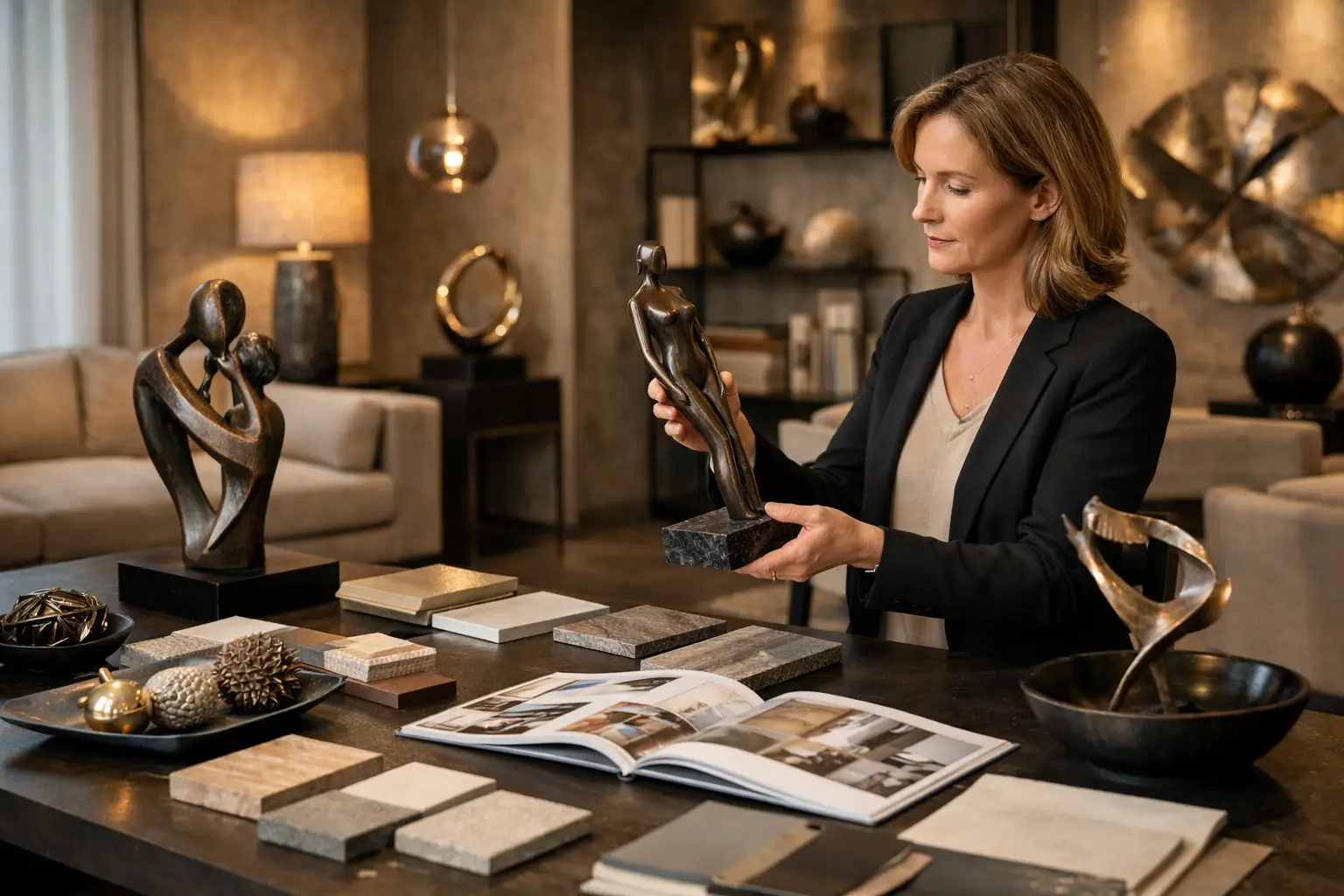
A room can be technically all right – nice sofa, good lighting, muted colors – and still be missing something. Often that is not another accessory, but an object with more presence. Bronze sculptures for interiors do just that. They bring weight, rhythm and personality to a room without making it unsettling.
That’s what makes bronze so interesting for the home. The material feels durable and rich, but can be understated at the same time. A small sculpture on a sideboard can become a quiet eye-catcher. A larger sculpture on a pedestal or low cabinet instantly gives a room more character. Precisely because bronze can look both classic and modern, it fits into more interiors than many people think.
Why bronze sculptures for interiors work so well
Bronze has a presence of its own that you are less likely to achieve with many other materials. It captures light in a soft way, gains depth through shadow and allows details to stand out beautifully. This keeps a sculpture interesting even if you have had it in your home for months or years.
In addition, bronze adds something tangible. In an interior where many surfaces are sleek, smooth or functional, a bronze sculpture brings relief and nuance. Think of the tension between a smooth wall and an organic sculpture, or between a modern table and a sculpture with hand-formed details. That contrast often makes an interior stronger.
Bronze is also attractive from a practical standpoint. It is sturdy, timeless and less trend-sensitive than many decorative home accessories. Whereas some objects feel dated after a season, a well-chosen bronze sculpture usually remains relevant for a long time. This is precisely why it is not only a decorative choice, but also an investment in atmosphere and charisma.
What type of bronze sculpture suits your interior?
That question begins not with the image itself, but with the space. A minimalist interior requires something different from a warm eclectic home. Yet the choice need not be literal. In a sleek interior, an expressive bronze sculpture can actually work very well because it breaks up the overall look. In a more classic interior, a simpler, abstract sculpture can again provide tranquility.
In a modern interior
With modern living styles, sculptures with clear forms often work best. Abstract sculptures, stylized human figures or animal figures with simplified lines complement a quiet base beautifully. The advantage is that such a sculpture does not compete with the space, but adds another layer to it.
In such a setting, look closely at the finish. Dark patinated bronze gives depth and strength. A lighter or greenish patina often feels softer and more artistic. Which one works best depends on the materials already present in the space, such as wood, natural stone, glass or black steel.
In a warm or classic interior
If your home has more texture, color and traditional elements, then a bronze sculpture may often be richer in detail. Think human figures, animals or more narrative sculptures. There is often movement and emotion in these, and that fits nicely with an interior that is already more layered.
It is important, however, that the sculpture does not become a set piece among other set pieces. Literally give it space. A strong image comes into its own better in a place where it can be seen, rather than among candles, vases and piles of books.
Format is more important than many people think
One of the most common mistakes is choosing too small. A bronze statue can be beautiful, but if it falls away against the cabinet or wall behind it, it lacks effect. Conversely, too large a sculpture can make a room unnecessarily heavy. So it’s not just about taste, but also about proportion.
On a narrow side table, a rounder image often works better than a wide, massive object. On a generous sideboard, a sculpture may actually have more volume. And in a high hallway or open living space, a larger sculptural work may be just what is needed to visually anchor the space.
When in doubt between two sizes, don’t just look at the dimensions on paper. Plot the spot at home with cardboard or a similarly sized box. That sounds simple, but it quickly gives insight into the right scale. Those who want to experience art in their own space before making a final decision are often much more confident in the final choice.
The best place for bronze sculptures at home
Bronze sculptures for interiors look best in places where daylight or directional lighting touches the surface. Not bright and harsh, but such that nuances become visible. A subtle spotlight, a wall lamp or incident sidelight can really bring a sculpture to life.
The living room is obvious, but it is certainly not the only good place. In a hallway, a bronze sculpture can immediately set the mood as you enter. In a study, it adds concentration and charisma. A smaller sculpture can also work surprisingly well in a bedroom, precisely because it is allowed to be quieter and more personal there.
Do pay attention to the surface. A sculpture must be stable and visually have something to land on. A console, pedestal, cabinet or sturdy shelf works better than a place that looks cluttered or has lots of loose items. A bronze sculpture does not require excess, but it does require attention.
Combine without crowding
A bronze sculpture does not have to be solo, but it does require balance. If you combine it with painting or graphics, look for rhythm and material effects. An expressive sculpture next to a very powerful painting can reinforce each other, but it can also compete. Sometimes a quieter artwork nearby actually works better.
The combination with frames, furniture and accessories also plays a role. Warm wood tones and bronze are often a natural match. With cool tones, such as white, gray or anthracite, bronze actually provides warmth. That contrast is often beautiful. Brass and gold accents are possible, but that requires a bit more feeling for dosage. Otherwise it quickly becomes too shiny or decorative.
Those looking for cohesion would do well to look not only at color, but also at form. An organic sculpture works well in interiors with soft lines. A more geometric sculpture often fits better with sleek furniture and architectural spaces.
Choose not only with your eyes, but also with your feelings
A bronze sculpture is rarely a purely functional purchase. You live with it. That’s why it’s smart to look beyond what “fits. The best choice is often a sculpture that evokes something – tranquility, strength, movement, recognition or just wonder.
That is also the difference between decoration and art. Decoration fills in. Art adds something to how a space feels. It doesn’t have to be heavy or complicated. Especially in the home, an image works best when it comes close naturally.
Some people immediately fall for a human figure because there is emotion in it. Others prefer an abstract work that leaves room for their own interpretation. Neither is better. It depends on your interior, but mostly on what you like to see on a daily basis.
Buy, try or seek advice first?
When it comes to art for interior design, it makes perfect sense not to take any chances overnight. A picture online or in a catalog tells a lot, but not everything. You only really experience scale, material effects and the relationship to your own furniture when you see a work closer.
This is why personal advice is often so valuable. Not to make the choice harder, but easier. An expert eye helps to see which sculpture in terms of size, style and placement really works in your home or workspace. Sometimes it then turns out that the sculpture you first thought of is too small. Or that an abstract work at home looks much warmer than expected.
For those who like to choose carefully, a gallery or art consultant with a wide selection and practical guidance is nice. Think of help with selection, placement and translating taste into a concrete proposal. At Amersfoort Art we often see that people make a good decision faster as soon as art does not remain abstract, but is connected to their own interior.
Bronze sculptures for interiors as a lasting addition
Trends come and go, but some choices hold their value because they are not only beautiful, but gain meaning in everyday use. A bronze sculpture is such a choice. It is not just there for the first impression, but grows with the space and the way you live.
Those who choose well notice that an image gives something back again and again – in light, in atmosphere and in attention. Not showy, but present. This is precisely why, for many enthusiasts, bronze sculptures for interiors are not an extra detail, but the element that completes a room.


