
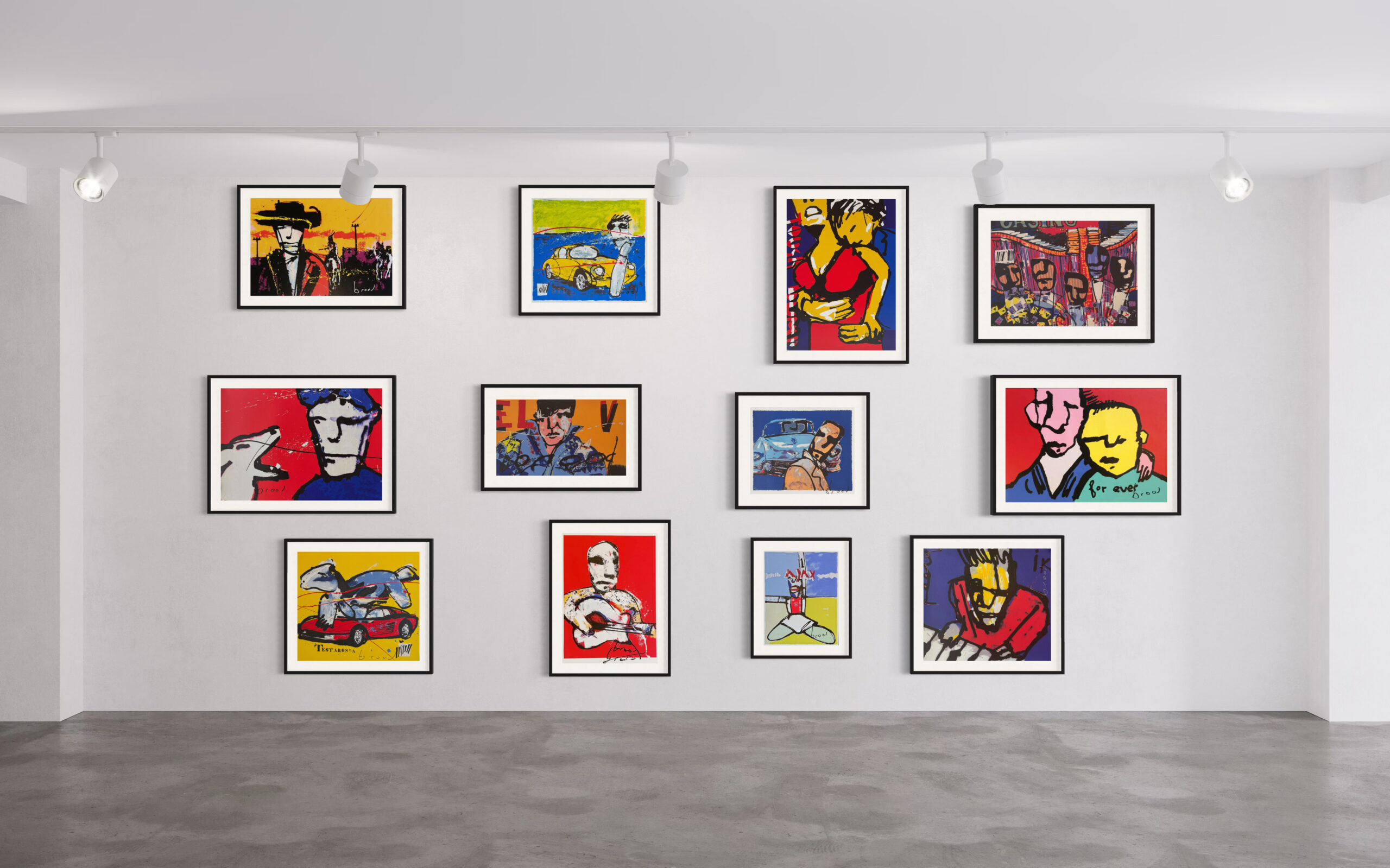
A Herman Brood on the wall immediately does something to a space. Not careful, not modest, but full of color, rhythm and personality. This is precisely why Herman Brood screen prints appeal to so many people – from seasoned collectors to enthusiasts seeking a first outspoken work of art for the home or office.
Why Herman Brood silkscreens are so beloved
Herman Brood’s appeal is not only in his fame as a musician and artist. His visual language is instantly recognizable. Bright colors, fast lines, playful figures and a raw energy make his work accessible without being flat. You don’t have to be an art historian to feel that there is life in it.
That’s exactly why his silkscreens work so well in interiors. They have presence. In a sleek modern living room, they bring tension and color. In a warm space, they actually enhance personal character. They often do well in business environments, too, because they liven up a wall without becoming distant.
Screen prints are also an attractive way for many buyers to collect work by a well-known artist. An original painting by Bread is a much bigger step for most people. A screen print makes his work more accessible, while you are still choosing a work of art with a distinct signature and collectible value.
What exactly is screen printing?
In screen printing, the image is applied layer by layer, with each color printed separately. That process creates powerful, saturated colors and a clear structure. This technique suits an artist like Brood especially well. His work leans on contrast, spontaneity and areas of color that are allowed to really pop.
Not every print is automatically the same. Within the range you will see differences in print run, size, paper type, color intensity and finish. Some works look graphic and sleek, while others are looser and more expressive. This also makes buying a screen print more personal than many people think beforehand.
What do you look for in Herman Brood screen printing?
Anyone considering a work by Brood often looks first at the sculpture itself. Logical, since you should want to enjoy looking at it daily. Yet there are a few practical points that are at least as important.
The first is authenticity and provenance. With screen prints by well-known artists, you want clarity about what you are buying. Consider a signature, numbering within the edition and information about the edition. Not every work is signed or numbered in exactly the same way, so context remains important. A reliable provider can provide clear information about this.
In addition, condition plays a big role. Paper is fragile. Discoloration by sunlight, stains, creases, acid on the back or old framing can affect the appearance and value. A work may still look fine on photo, while in reality it has traces of age or careless use. Therefore, always ask about the condition of the work and look for details beyond the image itself, such as edges and margins.
Size also deserves consideration. A small silkscreen can be surprisingly powerful in a niche, hallway or workspace. A larger work requires more space to really come into its own. Many buyers choose too small out of caution, while an outspoken Brood actually works better when given enough breathing room.
Choosing by taste and by space
You buy a work of art not only with your eyes, but also with the space in which it will hang. Herman Brood silkscreens often have a lot of energy. That’s their strength, but it also means that placement matters.
In a quiet interior, a colorful piece can be just the right counterpart. If you already have a lot of patterns, color accents or striking furniture in your home, it’s smart to look for a composition that has character but doesn’t get too busy visually. It’s not about bravado combining, it’s about balance.
Also consider the function of the space. In a living room, art may well open the conversation. In a study or reception room, you may want something that is lively but not restless. Brood has enough variety within his oeuvre to make an appropriate choice in this regard.
A practical tip: look not only at the size of the paper, but at the overall image after framing. A good frame and passe-partout can give a work more peace and make it visually stronger on the wall.
Framing makes more difference than many people think
With works on paper, framing is not a detail. It is protection, presentation and atmosphere all in one. Especially with Herman Brood screen prints, the right frame can make the difference between nice and truly convincing.
A frame that is too heavy or decorative can compress the work. An overly narrow, inexpensive frame often does not do justice to the quality. Usually a bright, calm framing works best, keeping the energy of the image central. Black, white or natural wood are safe choices, but what works best depends on the work itself and your interior.
In addition, preservation is important. UV-resistant glass or museum glass can help reduce discoloration, and acid-free materials are recommended for mounting and backing. Especially if you invest in a beloved work, you want it to still be beautiful years from now. That’s not an excessive luxury, just wise handling of art on paper.
Collective value – but not blind to numbers
Many people wonder if Herman Brood silkscreens are a good investment. An honest answer is: it depends. Renown, circulation, condition, popularity of the show and market demand all play into it. Some works remain in steady demand for years, while others depend more on taste and availability.
Yet it is rarely wise to buy solely on possible returns. Art lives most comfortably in the home if there is also a real click. Those who only look at price trends run the risk of choosing a work that sounds good on paper, but with which there is no connection at home.
The best purchase is often at the intersection of heart and head. You choose a work that you like, in a condition you have confidence in, at a price that suits edition, presentation and quality. That is sober and enjoyable buying.
Who are Herman Bread screen prints suitable for?
Bread appeals to a remarkably broad group. Of course, there are collectors who have been following his work for years. But there is also a large group of buyers who mainly fall for the directness of his style. People who are looking for art with spirit, that doesn’t just hang over the couch but really adds something.
Bread can also work particularly well as a gift, provided you know the recipient’s tastes. For an anniversary, business relationship or landmark interior project, it is a choice with personality. It feels more familiar and accessible than many other art names, without being ordinary.
Moreover, for those buying art for the first time, a screenprint by Brood is a pleasant entry point. You choose something with name, recognition and visual impact, without having to enter a complicated art market right away. That makes orienting a lot more pleasant.
Quiet orientation pays off
With an artist with such a strong signature, falling in love quickly is not difficult. Still, quiet looking is often the best approach. Compare several works, note the use of color, see how a piece feels from a distance and up close, and ask yourself a simple question: will I still enjoy looking at this in a few years?
Precisely because Brood’s work is so energetic, you often notice quickly whether a screenprint remains captivating or has mainly an initial wow effect. There’s nothing wrong with that, but it helps to make a choice that will make you happy for a long time.
Those who need personal advice, clear information about condition and help with presentation in the interior soon notice how much difference that makes. A gallery like Amersfoort Art can provide a lot of peace of mind in this – not by making things complicated, but rather by presenting art comprehensibly and appropriately.
Ultimately, you buy a good Herman Brood screen print not just because the name is familiar, but because the work releases something. When that feeling is right and the practical side is also in order, you don’t just have an image hanging on the wall, but a work that energizes every day.


