
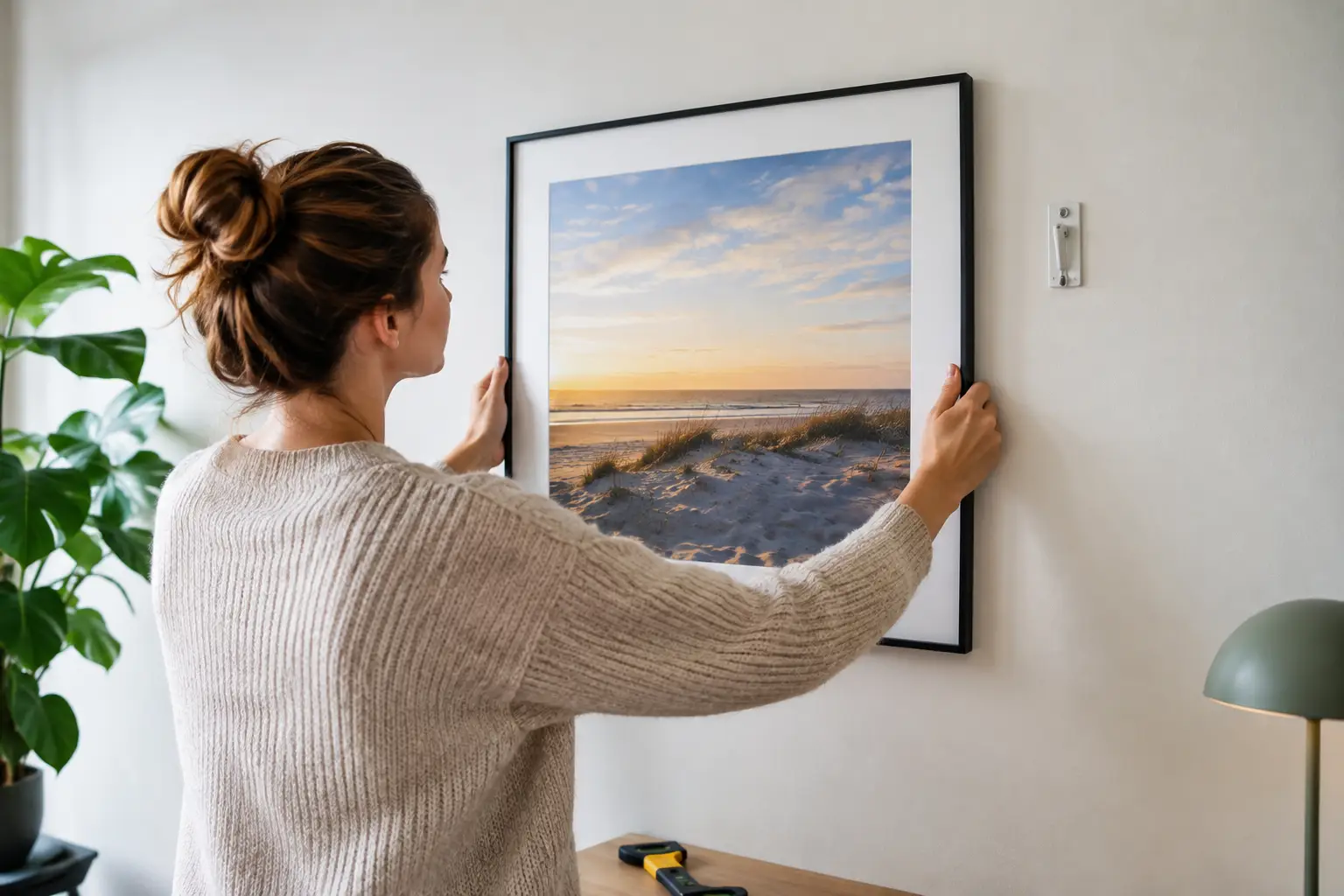
A picture that’s not quite straight is annoying. A painting that unexpectedly falls off the wall can cause much more damage—to the artwork, the floor, and even to yourself. If you’re looking for a guide on how to hang a painting safely, you’ll need more than just a nail and a hammer. It starts with a good assessment of the weight, the wall, and the hanging system.
A small work on paper requires a different approach than a large canvas in a heavy wooden frame. So take a moment before you drill. This will ensure a clean finish and give your artwork the place it deserves.
Hanging a painting safely starts with the wall
The right mounting method depends first and foremost on the material behind your wall. A solid concrete or brick wall can support a lot of weight, provided you use the appropriate anchor and screw. Don’t hammer or drill based on guesswork alone: plumbing and electrical lines may be located exactly where you least expect them. If in doubt, use a pipe and wire detector, and keep an eye on the power supply in the room in question.
A drywall or hollow wall requires extra care. A standard wall anchor often doesn’t provide enough hold, especially for a framed painting. Opt for a hollow-wall anchor, a toggle anchor, or a mounting bracket attached to a stud behind the wall. Not sure how the wall is constructed? Then it’s wiser to figure that out first rather than drilling blindly.
In new-construction homes, different types of walls often appear side by side. One wall might be concrete, while another is drywall. Therefore, don’t automatically assume the same approach applies to every room. When dealing with a project that has emotional or financial value, caution is never a luxury.
Weigh the artwork, including the frame and glass
The weight of a work of art is often underestimated. The frame, the glass, and any mat can make a small piece surprisingly heavy. Therefore, weigh the entire piece before you buy hooks, anchors, or screws. Then check the packaging of the hanging hardware for the maximum weight capacity and allow for a generous safety margin.
A hook that can handle exactly the specified weight is not an ideal choice. This is because the load on a screw changes when the work shifts slightly forward, when someone bumps into it, or when it’s hanging from a wire. It’s better to choose a material that can clearly support more weight than seems necessary.
For wide or heavy frames, mounting them at two points is usually the safest option. This distributes the weight more evenly and helps prevent the painting from tilting. This provides extra peace of mind, especially in a hallway, above a couch, or in a spot where people frequently walk by.
Check the painting’s hanging system
It’s not just the wall that needs to be strong enough. Take a critical look at the back of the artwork as well. Are the D-rings securely fastened? Is the wire frayed, stretched out, or too thin? And are the hanging points at the same height? A beautifully framed piece deserves sturdy hardware.
A steel wire or braided hanging cord is suitable for many frames, but not for every weight. For a heavy painting, two fixed hanging points on the back, attached directly to two wall hooks, may be better than a single wire. This ensures the artwork hangs more flush against the wall and reduces the chance of it coming loose unexpectedly.
Also check that the screws on the D-rings are long enough and securely fastened in the wood. With old frames, the wood may be brittle. For aluminum or plastic frames, different mounting methods apply. If you’re unsure, have an experienced framer assess the situation, especially if the artwork is cherished, fragile, or valuable.
Never use a picture hook alone on an unstable surface
A traditional picture hook with thin pins works well on some sturdy wooden walls, but is not intended for concrete, hollow walls, or very heavy artwork. It’s tempting to quickly hammer in a hook, but that’s only safe if the surface and the weight are suitable.
For a concrete wall, a screw anchor is generally more reliable. For drywall, choose fasteners specifically designed for hollow walls. If you can screw into a wooden stud, you often have a strong foundation, but always check to make sure the screw penetrates deep enough into the wood. The combination of the right surface, appropriate fasteners, and a good safety margin makes all the difference.
Determine the height before drilling
Hanging artwork safely is also about positioning it wisely. As a general guideline, the center of a painting is often hung at eye level, about 145 to 155 centimeters from the floor. This isn’t a hard-and-fast rule. Above a sideboard, sofa, or dining table, a piece may look better if hung lower or higher to maintain proper proportions.
As a general rule, leave about 15 to 25 centimeters of space above a piece of furniture. If the artwork is hung too high, it loses its connection to the interior design. If it’s too low, it’s less pleasant to look at and can sometimes increase the chance that someone will bump into it. In a stairwell, the walking path is more important than a standard measurement: make sure that protruding frames do not create an obstacle.
First, set up a test layout. Cut a sheet of paper to the size of the painting and secure it with painter’s tape in the desired spot. Step back a few meters, sit down, and view it from your usual vantage point. This way, you can quickly see if the composition is right without drilling any unnecessary holes.
Measure from the hanging point, not from the top edge
A common mistake is measuring from the top of the frame. However, the hanging point is usually lower, especially when a piece is hung on a wire. Measure the distance between the top edge of the painting and the highest point of the taut wire. As you do so, gently pull the wire upward, as if it were already hanging from the wall hook.
Next, determine where the center of the artwork should be. From there, calculate the actual drilling point. Use a level before drilling and mark the point lightly with a pencil. A long level is particularly useful when there are two mounting points. Measure both distances from the floor or from a horizontal line, not just from the ceiling, because ceilings aren’t always perfectly straight.
Protect art from light, moisture, and heat
A painting is safely displayed when it cannot fall, but also when the location protects the material. Direct sunlight can cause colors to fade, especially in works on paper, watercolors, or photographs. Therefore, it’s best to choose a wall that isn’t exposed to prolonged, bright sunlight, or to use window treatments that filter the light.
Avoid placing it directly above a radiator, fireplace, or stovetop. Fluctuations in temperature and humidity can cause fabric, paper, wood, and adhesive to warp. A humid bathroom is also rarely the best place for an original work of art. A well-ventilated room with conditions that are as stable as possible is better for art.
Don’t hang a painting directly against a cold exterior wall if there’s a risk of condensation. Small spacers at the bottom of the frame can help air circulate behind the artwork. They also prevent the frame from damaging the wall or hanging crookedly.
When is it best to leave the installation to a professional?
Some situations require more than just a steady hand. Think of a large piece involving glass, a fragile antique frame, a very heavy mirror, a work of art above a staircase, or a wall whose structure you’re unfamiliar with. Professional installation is also advisable for commercial spaces, lobbies, and public areas, where safety is a priority for multiple people.
A specialist can not only help you choose the right mounting, but also advise you on how to display the artwork. This is helpful when multiple pieces are arranged together to form a wall display or when you’re unsure about the correct height. At Amersfoort Art, that personal touch is an integral part of art: a piece should not only look its best, but also be able to remain on display with confidence.
After hanging the artwork, take one more minute to do a final check. Never pull hard on the frame; instead, gently check to make sure the artwork is hanging securely, is straight, and doesn’t shift. Check again after a few days to make sure the mounting and the wire are still secure. It’s precisely this little bit of care that ensures you can then do what art is meant for: enjoying it every day.


