
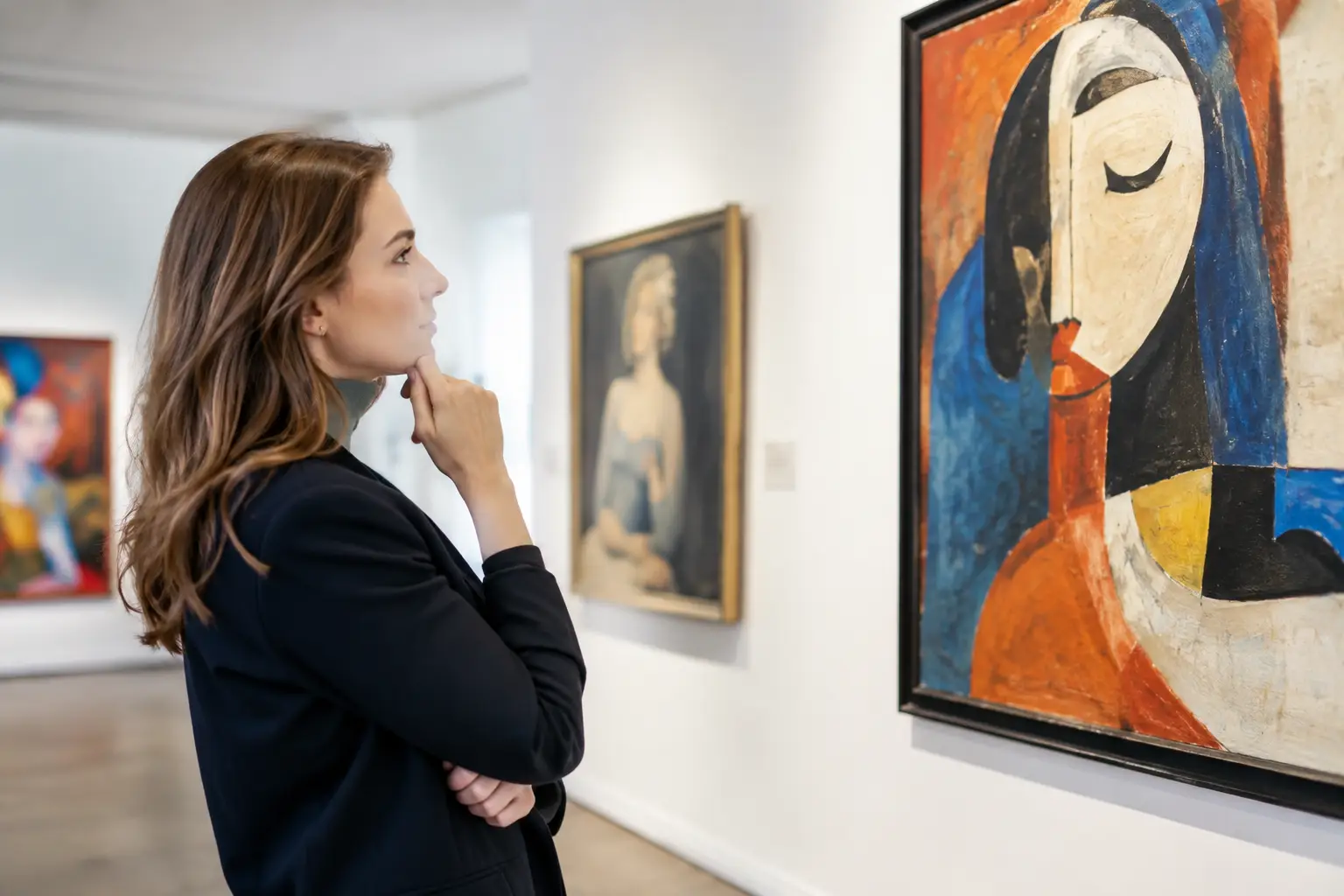
You rarely choose a work of art based solely on logic. It needs to make an impact in a space, suit your taste, and often continue to captivate you for years to come. Still, market conditions come into play whenever you buy, rent, or build a collection. An art market forecast doesn’t help you predict the perfect purchase, but it does allow you to take a more measured look at quality, price, and trends that influence your choice.
Looking ahead to 2026 and beyond, the art market seems to be shifting away from fleeting trends and toward recognizable quality, personal connection, and works that truly come into their own within an interior. That’s good news for those who want to experience art above all else. A carefully chosen work of art doesn’t have to wait for an auction record to be valuable.
Art Market Forecast: Quality Is Becoming More Important
The international art market remains dynamic. Economic uncertainty, changing buying habits, and a wide range of online offerings are making buyers more discerning. At the same time, there remains a strong desire to give a home, practice, or office its own unique character. For many people, art is not an unattainable luxury, but a personal part of how they want to live and work.
That is why the focus is shifting from fleeting name recognition to works with a clear narrative. Buyers look not only at the signature, but also at technique, edition size, condition, provenance, and whether a work will suit them in the long term. Contemporary art in particular—with its own visual language, high-quality execution, and a consistent artistic practice—is expected to hold their attention.
Less impulse, more focus
It’s perfectly fine for a purchasing decision to take time. Many art lovers first compare sizes, colors, and price ranges, and want to know how a piece will look on their own wall. That need for certainty is growing. Digital presentations are useful for the initial selection, but personal guidance and seeing the artwork in person remain decisive factors, especially for larger purchases.
For those who are unsure, renting offers a practical intermediate step. You’ll get to experience how art interacts with the light in your home, your furniture, and your daily routine. This isn’t putting off a decision—it’s a smart way to make a better choice.
Accessible art remains relevant
Demand for original art and prints in affordable price ranges is expected to continue to grow. Not everyone is willing or able to spend a large sum right away, but many people do want to avoid generic wall decor. A limited edition, a smaller original, or a carefully selected artwork on paper can be just the right way to get started.
The value lies not solely in a potential increase in price. Craftsmanship, beauty, emotional resonance, and effective presentation all add value every day. Moreover, anyone who buys solely for the sake of a return runs the risk of choosing a work that doesn’t resonate with them at home.
Where demand is likely to head
In an art market forecast for private buyers, a few trends stand out. Abstract art remains popular, but there is room for more complexity: bold colors, tactile materials, figurative art with a distinctive style, and works in which craftsmanship is allowed to shine through. Sculptures and objects are also receiving more attention, as they literally add a sense of space to an interior.
In addition, there is a growing demand for art that isn’t already on display everywhere. Buyers aren’t looking for a copy of a trendy interior design, but rather a piece that sparks its own conversation. This could be a powerful painting, a serene graphic work, or a sculpture that instantly adds character to a cabinet, pedestal, or conference table.
For commercial spaces, this trend is just as interesting. Art can make a reception area feel more welcoming, bring a sense of calm to a work environment, or subtly reinforce a brand story. The best choice isn’t necessarily the largest or most expensive piece. Scale, sightlines, light, and the people who use the space all work together to determine whether art truly works.
Sustainability is also a matter of quality
Sustainability is becoming an increasingly important factor, though this requires a nuanced approach. It’s not just about the use of materials or transportation. A work of art that remains on display for a long time, is well framed, and is carefully maintained is, in practice, often a more sustainable choice than a decorative item that is replaced after two seasons.
A suitable frame is more than just a finishing touch. It protects the artwork, brings out the colors more effectively, and connects the art to the interior. For works on paper, light-blocking glass, a good mat, and professional mounting are important considerations. This helps preserve not only the artwork’s appearance but also its condition.
What does the price forecast mean?
Price trends in the art market never move at the same pace everywhere. Well-known artists whose works are scarce can experience significant price fluctuations, while emerging talent often remains attractively priced to build a new audience. Even within a single artist’s body of work, there can be significant variations. Size, period, technique, edition size, and rarity all play a role.
It’s wise not to view price in isolation from quality and service. At a reputable gallery, you’ll receive context along with a piece of art: information about the artist, advice on placement, and support with presentation. That makes comparisons more fair than if you were to look only at the price listed beneath an online image.
Anyone who buys a work of art in the hope that its value will increase must be patient and accept uncertainty. Art is not a savings account. A work of art may increase in financial value, remain the same, or become less sought after. Therefore, first and foremost, buy something you’ll want to look at again and again. Any market value is then a potential added benefit, not a prerequisite for satisfaction.
How to Make Smart Choices in a Changing Art Market
Don’t start by asking which artist is the most popular; instead, start with the space where the artwork will be displayed. Measure the available wall space, assess how much natural light enters the room, and determine the distance from which you’ll primarily view the artwork. Art can be displayed generously above a sofa or sideboard. In a narrow hallway, however, a smaller, more refined piece may make a better impression.
Next, consider the technique. An original painting has a different character than a silkscreen print, etching, photograph, or handcrafted piece. None of these options is inherently better than the others. The differences lie in appearance, edition size, maintenance, and budget. Feel free to ask what an edition number means and how best to protect a piece.
Also, take the time to consider your initial reaction seriously. Sometimes a piece of art makes an immediate impact; other times, your appreciation for it grows after a second or third look. Both are good signs. If you’re unsure, that’s a good reason to view the work in a different setting, with different framing options, or at a different time.
At Amersfoort Art, you can put that exploration into practice by viewing art, asking for advice, and—when appropriate—renting a piece first. That way, your choice doesn’t have to be based on a photo or a fleeting trend, but on your own experience in the space where the artwork will come to life.
A choice that lasts longer than a trend
Ultimately, the most useful art market forecast is a personal one: choose work that exudes quality, is carefully presented, and adds something to your daily life. Trends can serve as inspiration, but your own perspective should be the deciding factor. A work of art that still sparks your curiosity months later has already proven itself to be worthwhile.


