
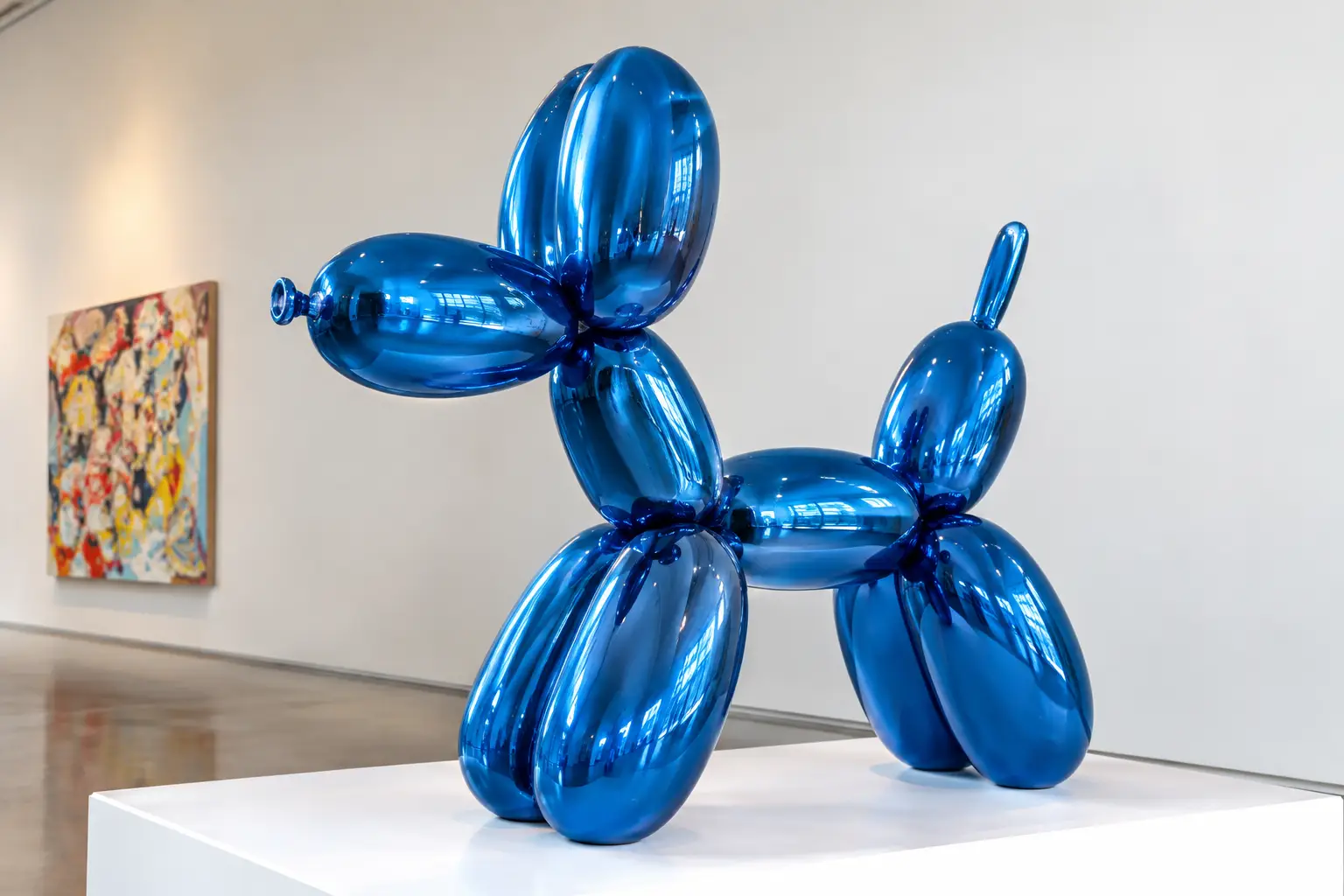
A tiny party balloon dog, but crafted from high-gloss steel and on a monumental scale: it is precisely this contrast that makes Jeff Koons’ *Balloon Dogs* so irresistible and so controversial. Many people recognize the sculpture immediately, even if they rarely visit a gallery. That’s no coincidence. Koons turned something ordinary into a work of art that feels at once cheerful, luxurious, childlike, and provocative.
“Balloon Dogs” by Jeff Koons: What Do You Actually See?
The famous Balloon Dog series is part of *Celebration*, a series of works that Jeff Koons created between 1994 and 2000. The series references birthdays, gifts, toys, and the visual world of childhood. The dog has the recognizable shape of a balloon figure that a party entertainer might twist into. However, it is not made of fragile rubber, but of polished stainless steel with a transparent coat of paint.
That material is essential. From a distance, the sculptures appear light, inflated, and almost ephemeral. Those who come closer see a hard, heavy object in which the space, the light, and the viewer themselves are reflected. As a result, the balloon dog changes along with its surroundings. In a white museum gallery, it looks sleek and spectacular. In an interior setting, it can pick up colors from a wall, window, or rug and make a space appear more vibrant.
The large Balloon Dogs come in five colors: blue, magenta, orange, red, and yellow. They are unique, large-scale sculptures—not identical mass-produced items. Koons also created smaller Balloon Dog editions and objects that made the motif more accessible. This is precisely where confusion sometimes arises: a recognizable image is not automatically an original work of art by the artist.
The technology behind the apparent simplicity
Folding a balloon dog seems simple. Creating a realistic balloon dog out of steel is anything but. The mirror-smooth surface must evoke the appearance of inflated rubber without any visible imperfections. The curves, knots, and joints are calculated and crafted with extreme precision. The finish is so perfect that the sculpture almost looks digital, even though it is the result of complex production and painstaking craftsmanship.
That tension between the simplicity of the subject and extreme craftsmanship is typical of Koons. He does not choose a symbol that is difficult to recognize, but rather a form that everyone understands. He then elevates that form to a scale, material, and finish normally associated with luxury objects and classical monuments.
Why are these sculptures so famous and valuable?
In 2013, *Balloon Dog (Orange) * fetched $58.4 million at auction. At the time, this made it the most expensive work of art by a living artist ever sold at auction. Such a sum says more than just the cost of materials or labor hours. It reflects Koons’s place in art history, the rarity of his large-scale works, and the global recognition of this specific sculpture.
Jeff Koons, born in 1955 in Pennsylvania, built his body of work around objects from consumer culture: toys, advertising images, porcelain figurines, household objects, and popular icons. In doing so, he poses a question that remains relevant today: why do we consider some things to be high art and others to be cheap, sentimental, or kitschy?
The Balloon Dog doesn’t offer a straightforward answer to that. Instead, the sculpture capitalizes on that very uncertainty. Is it playful or ostentatious? Moving or superficial? A clever critique of luxury and commerce, or itself the ultimate luxury product? Koons allows those interpretations to coexist. To one viewer, this is intellectually sharp. To another, it feels like a very expensive joke. Both reactions are part of the work’s power.
Popular imagery as serious art
Whereas older art traditions often kept their distance from everyday life, Koons brings the everyday into the museum. The balloon dog evokes memories of children’s parties and carefree fun. At the same time, the reflective surface alludes to luxury, desire, and self-image. You don’t just see a dog; you also see yourself in the dog.
The latter is more than just a visual effect. The sculpture draws attention, but it also makes the viewer part of the image. As you walk around it, you see a new reflection every time. As a result, the work is not only an object to look at, but also an experience within the space.
Art or kitsch? The debate is part of the work
The word “kitsch” is often used to describe art that is considered too saccharine, too glossy, too decorative, or too simplistic. With Koons, that association is never far off. He deliberately avoids modesty: bright colors, polished surfaces, and familiar forms are meant to entice. This can be liberating for those who believe that art doesn’t always have to be serious or subdued.
At the same time, hesitation is an understandable reaction. A Balloon Dog is visually dominant. In a quiet home, such a sculpture can serve as an energetic focal point, but in an already bold interior, it can quickly become too much. Its appeal, therefore, lies not only in the object itself but also in the way it is presented.
Anyone who appreciates a work with this kind of appeal doesn’t necessarily have to look for a balloon dog. An interesting starting point could also be the combination of humor, color, reflection, and form. A contemporary sculpture with rounded lines, a glossy surface, or an unexpected material can create the same lively energy, but may better suit your personal taste and space.
What does the Balloon Dog mean for your interior design?
The Balloon Dog clearly demonstrates that sculpture not only complements an interior but can also set its tone. A sculpture has volume and requires space around it. Placing it on a pedestal, a low cabinet, or an open spot on the floor determines whether a work of art can “breathe” freely. Light plays a role: with glossy materials, daylight and directed lighting can make the sculpture look different each time.
When choosing a sculpture, it’s wise not to rely solely on a product photo. Consider the dimensions in relation to the room, the viewing height, and the existing materials. A shiny sculpture placed next to a lot of glass and metal can look chic and bright, but it can also feel cold. Placing it next to wood, fabric, or a matte wall often creates more contrast and warmth.
Color also deserves attention. Koons doesn’t use color sparingly, but as a direct eye-catcher. If you’re looking for a similar accent, you can repeat a single bold color in a smaller detail within the space—such as a pillow, a vase, or a piece of art on the wall. This way, a sculpture becomes a cohesive part of the interior rather than a standalone statement.
For those who are still unsure, taking your time is often wiser than making an immediate decision. An art lending service offers the opportunity to discover how a piece truly looks in your home or office. Only when you walk past it every day will you notice whether the scale is right, whether the artwork continues to captivate you, and whether its energy suits you. At Amersfoort Art, personalized advice can help you make that transition from inspiration to a suitable work of art.
Original, reproduction, or decorative object: take a critical look
The popularity of the Balloon Dog has given rise to many decorative variations. That’s understandable: the shape is cheerful, approachable, and works well as a gift or interior accent. Still, it makes sense to distinguish between a standalone work of art, a signed and numbered edition, an official design object, and an unsigned decorative sculpture.
An original work by Koons comes with a clear provenance, documentation, and a specialized market. For an edition, the print run, numbering, signature, technique, and condition are important. You buy a decorative object primarily because you like its shape, color, or appearance. There’s nothing wrong with that, as long as the description is honest and the price matches what you’re buying.
When making a serious art purchase, always ask about the artist, the materials used, the dimensions, the edition size, and any accompanying documentation. Also take a close look at the finish. On glossy surfaces, small scratches and imperfections are easily noticeable. Careful maintenance with a soft, clean cloth is often wiser than vigorous polishing with household cleaners, especially on varnish layers and delicate coatings.
Why the Balloon Dog Continues to Work
After all these years, the Balloon Dog is still instantly recognizable, yet never grows old. The sculpture possesses a rare duality: it is accessible enough to evoke immediate enjoyment and layered enough to spark discussion. You can laugh at it, be annoyed by it, or admire it for its craftsmanship. Often, all of these happen at once.
Perhaps that is the most useful lesson Jeff Koons can offer to anyone looking for art for their home: don’t just choose something that fits neatly into your interior. Choose something that evokes a reaction and reveals new facets with repeated viewings. A good work of art doesn’t always have to be serene, but it should have a lasting effect on you.


