
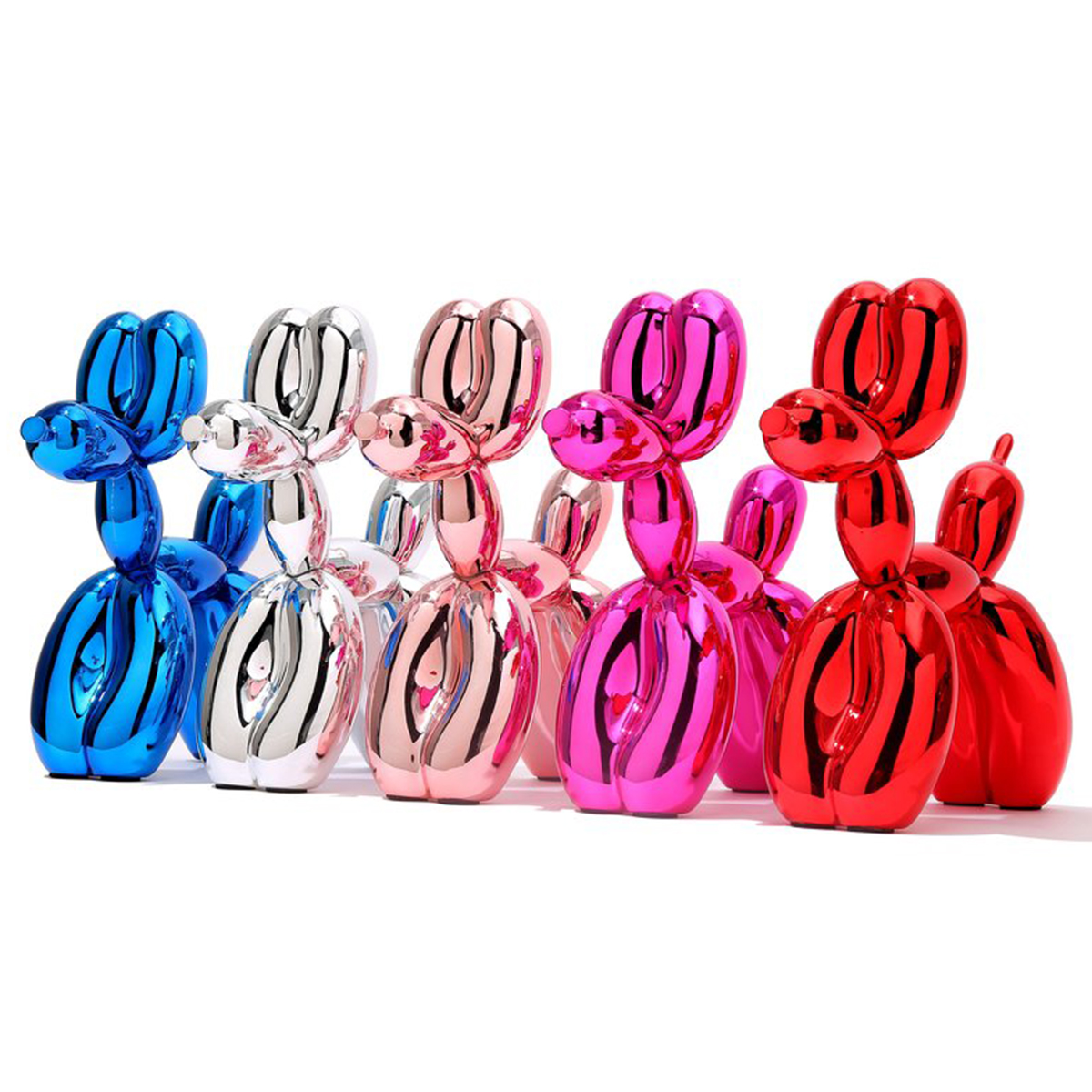
Anyone who sees a Balloon Dog Jeff Koons for the first time often thinks two things at once: how cheerful – and how exaggerated. That is precisely where the power of this sculpture lies. It looks playful and almost childlike, but meanwhile raises big questions about taste, status, art value and the way we look at objects.
With Balloon Dog, Jeff Koons has created a work that you don’t easily forget. Not because it is modest, but precisely because it is so emphatic. It shines, reflects, takes up space and behaves almost like a luxury item. This makes it fascinating to many people and irritating to others. Both reactions are understandable.
Why Balloon Dog Jeff Koons became so famous
Balloon Dog is among the most famous works of contemporary art. This has to do not only with form, but also with timing. Koons made his breakthrough at a time when art was becoming increasingly intertwined with media, the collector’s market and public attention. His work fitted in perfectly: instantly recognizable, large in gesture and suitable to be endlessly photographed and discussed.
The shape refers to a balloon dog as you know it from children’s parties or street acts. Only Koons is not turning it into a fragile, temporary object, but a monumental sculpture in high-gloss stainless steel. That difference is essential. He magnifies something fleeting into something permanent and precious. It is precisely this shift that makes the work more than a joke.
On top of that, Balloon Dog is not hidden behind complicated symbolism. You don’t have to be an art historian to like it. That’s an underrated quality. Accessible art is not automatically simple art. Sometimes the sharpness lies precisely in the fact that a work enters immediately and then continues to wring.
What makes this image artistically interesting?
Many people wonder why a steel version of a balloon figure is considered great art. That’s a fair question. The answer lies not in technical virtuosity alone, although the workmanship is impressive, but in the combination of material, scale and cultural charge.
Koons plays with opposites. Light versus heavy. Temporary versus permanent. Everyday versus exclusive. A balloon dog is normally cheap, airy and a moment later empty. In his hands, it becomes a perfectly polished object that seems almost untouchable. That reversal says something about consumer culture, about desire and about the way value is created.
At the same time, the work has a strong physical presence. Because of the mirrored surface, you see not only the sculpture, but also the space around it and yourself as an observer. This makes the experience more active than with many other sculptures. You are not just looking at the object – you are literally reflected back into it.
Playfulness with a serious carpet pad
Just because Balloon Dog looks cheerful does not mean it is superficial. It is precisely that festive look that makes it interesting. Art does not have to be heavy or dark to have meaning. A work may well seduce, amuse and shine. The question then is what lies beneath it.
With Koons, it’s often about attraction. Why do we want to touch, possess, display something? Why does shine feel luxurious? Why do we suddenly see something iconic in a familiar object as soon as it becomes large, perfect and scarce? Balloon Dog asks those questions without writing them out. That makes the work open and at the same time cleverly constructed.
Why work also evokes resistance
Not everyone loves Jeff Koons, and that makes sense. His work is expensive, spectacular and emphatically associated with the international art market. To some viewers, this makes Balloon Dog feel like a symbol of excess. Not as a poetic image, but as a trophy.
That criticism deserves to be taken seriously. The context of contemporary art plays into how a work is read. When a sculpture sells for astronomical sums, people look at it differently. Then it is no longer just about form and idea, but also about prestige, collectors and market mechanisms.
Yet that criticism does not automatically make the work less relevant. Rather the opposite. Balloon Dog is famous precisely because it sits at the intersection of art, design, commerce and media. Anyone who finds that uncomfortable is actually already reacting to exactly the terrain in which Koons operates.
Art, taste and status intermingle here
With much contemporary art, it is pretended that taste is purely personal. In reality, social meaning almost always comes into play. What someone finds beautiful also says something about identity, environment and aspiration. Balloon Dog exposes that mechanism quite well.
The image fits just as easily into a museum context as it does into a conversation about luxury interiors, branding or collecting culture. That makes it versatile, but also vulnerable to being accused of being too decorative. Whether you consider that a weakness depends on what you expect from art. Those who value only modesty are less likely to take offense to this. Those who also see art as a visual statement will understand better why this work is getting so much attention.
The impact on interior design and art perception
Balloon Dog has also been influential outside of museums. You see the aesthetic reflected in design objects, shiny sculptures, pop art-like sculptures and interiors where art plays a distinct role. Not as a modest accent, but as a focal point in the space.
For private collectors and interior design enthusiasts, this is interesting. Not because everyone wants a Koons on their wall or in their room, but because it shows how art sets mood. A playful image can soften a sleek interior. A reflective object can capture light and make a room feel more active. And a work with humor can actually be very stylish, provided it is placed properly.
There’s a nuance to that, though. Striking art requires tranquility around it. A visually energetic image comes into its own better when its surroundings are not competing. In a busy interior, the effect can quickly tilt from exciting to unsettling. Good art advice is therefore not a luxury, but often simply practical.
Looking for something in this sphere? Then pay attention to these choices
Those touched by Balloon Dog Jeff Koons are not always looking for a literal copy or reference. Often it is a combination of qualities: playfulness, recognizable form, strong workmanship and a work that immediately does something to the space.
Then it’s smart to look beyond name or hype. Pay attention to materials, scale and look. A small sculpture in resin can evoke the same airiness as a large metal object, but feel very different in a living room or office. Color also does a lot. Bright hues draw immediate attention, while chrome, white or black often look calmer and fancier.
In addition, it’s good to ask yourself what you expect from art. Do you want to spark conversation when people come in? Are you looking for an airy object that makes a sleek interior more accessible? Or do you want a sculpture with a wink, without becoming a gimmick? Those questions help better than just searching by style.
At Amersfoort Art we often find that people know what feeling they are looking for, but are not yet sure which work fits that feeling. Then it helps to look at art in a room, compare it and possibly experience it first. Especially with sculptures and statues, size makes much more difference in real life than on a screen.
Is Balloon Dog timeless or mostly hype?
That remains an interesting question. Part of Jeff Koons’ success is undeniably tied to media attention and market value. That makes it tempting to dismiss Balloon Dog as hype. But that’s too simplistic.
A hype usually disappears as soon as the attention wears off. Balloon Dog remains a topic of conversation because the image is instantly recognizable while having many layers. It is visually strong, technically impressive and culturally cleverly placed. Whether you like it is another thing. Timelessness does not mean that everyone admires it, but that a work remains relevant in changing contexts.
Perhaps that is the best way to look at Koons. Not as an artist who must necessarily be admired, but as a maker who reveals something about our times. About desire, about ostentation, about pleasure and about the thin line between artwork and icon.
And maybe that’s why Balloon Dog sticks around so much. You don’t have to want it in your home to feel that it touches something. Sometimes art begins not with recognition of style, but with a little friction – a work that at first smiles at you and then remains in your mind for a while anyway.


