
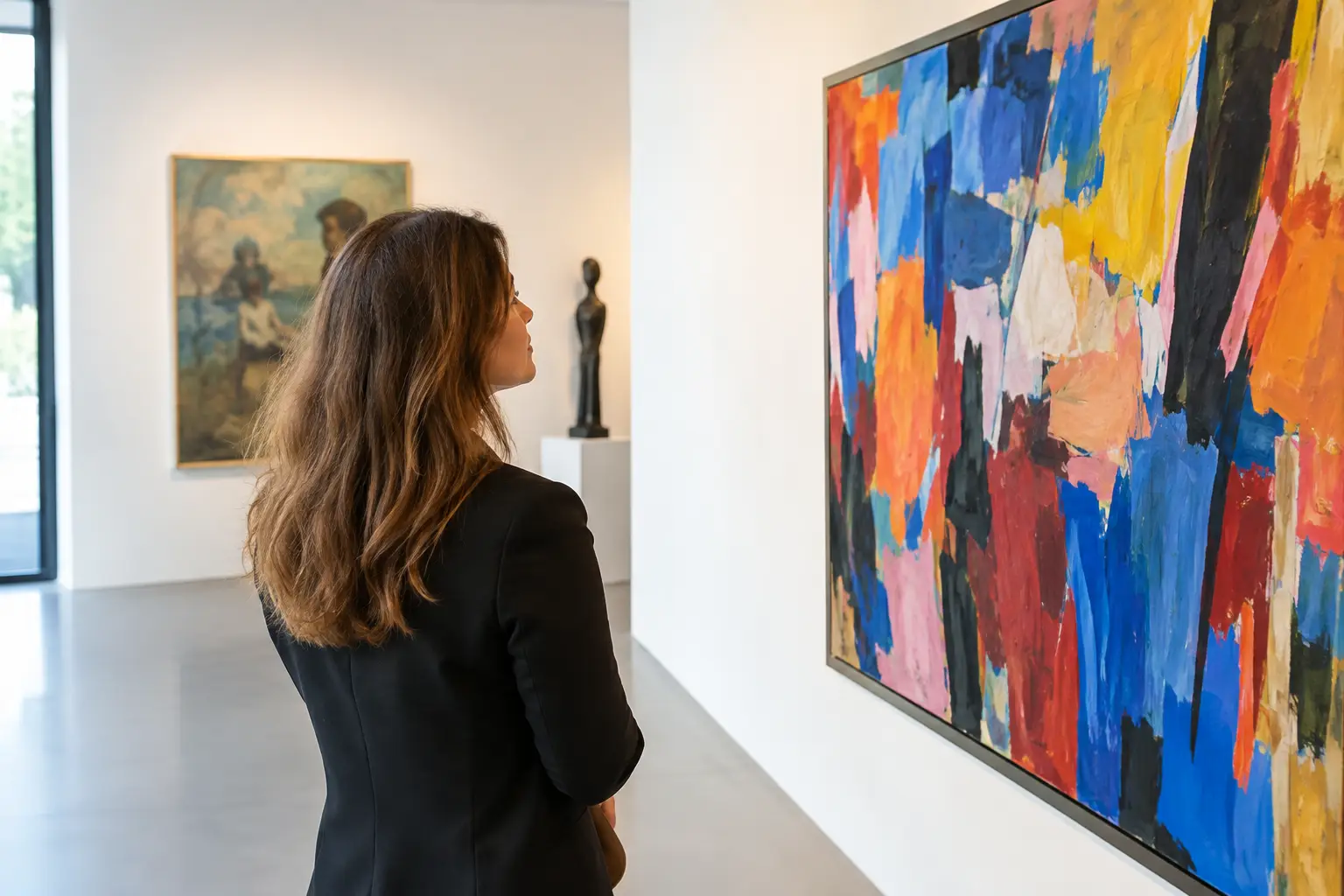
A brightly colored surface next to a tranquil landscape, a bronze sculpture opposite a graphic silkscreen print: in a gallery, everything sometimes seems possible at once. That is precisely the appeal of today’s art. You don’t have to be an art historian to recognize contemporary art styles. By looking closely at form, color, material, and mood, you’ll quickly discover which works appeal to you and why.
Contemporary art is not a fixed style, but a broad umbrella term for art created in our time. Artists draw freely from traditions, techniques, and personal stories. That’s why it makes more sense not to rush to label a piece, but to learn how to look at it first. These seven steps will help you do just that, whether you want to buy or rent a piece, or simply enjoy an exhibition more fully.
Recognizing contemporary art styles starts with looking
1. First, look at the design language
The artistic style is often the clearest starting point. Do you see recognizable people, landscapes, animals, or objects? If so, the artist is working in a figurative style. That doesn’t automatically mean the work is realistic. A portrait, for example, may be deliberately simplified, distorted, or painted in an exuberant style to emphasize character and emotion.
In abstract art, the focus is not on a recognizable subject, but on the interplay of lines, planes, rhythm, and composition. Sometimes the original subject is still visible, such as a horizon reduced to a few swaths of color. Sometimes the image is completely detached from reality. Geometric abstraction often uses clean forms, repetition, and clear proportions, while organic abstraction, on the other hand, features flowing, natural, or whimsical forms.
Also pay attention to the space within the work. A dense, layered image feels different from a composition with plenty of breathing room and empty spaces. That choice often says just as much about the style as the subject itself.
2. Think of color as a way to set the mood
Color is rarely just decoration. In expressive art, an artist can use stark contrasts, visible brushstrokes, and bold colors to convey energy, restlessness, or joy. A red area doesn’t have to represent a red wall or a red coat—its main purpose is to evoke a sense of excitement.
Works featuring soft grays, sandy tones, or muted blues often have a more subdued character. Minimalist art, on the other hand, sometimes uses color very sparingly. A single solid color or a subtle gradient can be enough, because the focus is on light, scale, material, and the surrounding space.
Don’t just ask yourself which colors you like, but also what effect they have on your interior. A large, colorful piece can liven up a quiet room. In a space where many patterns and materials already come together, a more subdued piece can sometimes create more balance. There’s no hard-and-fast rule: the right choice depends on the atmosphere you want to create in the room.
3. Look at the creator’s hand
Come closer, if you can. Visible brushstrokes, thick layers of paint, scratches, and drips point to a direct, physical approach. This is often characteristic of Expressionist or Art of the Matter painting, in which the creative process is part of what you see. The surface invites you to look longer, because the light and texture are constantly shifting.
In contrast, a work with a clean, painted or printed finish can have a more graphic look. Think of sharp contours, bright blocks of color, typography, or images that reference advertising, fashion, and popular culture. This often aligns with Pop Art or contemporary graphic art, although many artists incorporate such influences in their own unique ways.
Photography, collage, screen printing, and mixed media also have their own visual languages. A collage can be playful and narrative, but it can also be socially critical. A photograph can appear documentary, staged, or almost painterly. So while the technique does not entirely determine the style, it does provide valuable clues.
4. Recognize minimalism by the choices that have been left out
Minimalist art is sometimes mistakenly viewed as simple. In fact, a sober sculpture demands close observation. The artist deliberately limits the number of shapes, colors, and materials. As a result, proportion, repetition, shadow, and the relationship to the wall or floor take on added importance.
A minimalist painting or sculpture fits well in many interiors, but not just because it’s serene. It can also serve as a powerful focal point due to its scale or placement. Those who appreciate visual tranquility often find a natural match here. Those who, on the other hand, are looking for stories, movement, and detail may feel more at home with figurative or expressive art.
5. Look for the story, without pinning it down
Much contemporary art contains references to identity, nature, cities, memories, or social issues. However, a title isn’t always a user’s manual. An artist may deliberately leave room for your own associations. That makes a work more personal: what you see in it may change over time or depending on your mood.
When looking at figurative art, it helps to consider what is missing. Why is a face only partially visible? Why is a figure depicted in an empty setting? With abstract art, on the other hand, you can focus on rhythm and direction. Does your eye move quickly across the surface, or is it slowed down by repetition and stillness?
A meaningful conversation with a gallery can be very helpful in this regard. Information about the artist’s process, sources of inspiration, and edition size provides context without detracting from your own viewing experience. Especially when you’re considering purchasing an original artwork or print, this background information helps you make a more informed choice.
Recognizing art styles in the space where the artwork will be displayed
6. Assess scale, light, and distance
A work of art can look very different online or in a gallery than it does at home or in the office. Scale is the deciding factor here. A small, highly detailed piece needs to be viewed up close and looks stunning above a desk, in an entryway, or as part of a wall arrangement. A large, serene piece, on the other hand, needs space to breathe.
Light also changes the experience. Natural daylight makes colors appear differently than warm artificial light. Glossy photographs, resin, or framed works with glass can cause reflections, while relief and texture stand out more clearly with side lighting. Therefore, whenever possible, bring a photo of the wall and its dimensions with you during your site visit.
The frame is not a mere afterthought. A slender, modern frame can enhance a graphic work, while a carefully chosen box frame gives a painting on canvas room to breathe. For a work on paper, the combination of a mat, glass, and frame both protects the artwork and defines its appearance. Custom framing is especially valuable when the work is given a permanent home.
7. Don’t just choose a style; choose a work that continues to speak to you
Recognizing styles helps you find your bearings, but it shouldn’t limit your choices. An abstract piece can work surprisingly well alongside classic furniture. An expressive portrait can add warmth to a sleek, modern home. It’s precisely the contrast between art and interior design that gives a space its unique character.
So pay attention to your initial reaction, but also give a work some time. Do you keep coming back to it? Do you discover new details? Can you imagine it still resonating with you on a regular Tuesday night? If so, that’s often a better sign than whether it fits a particular trend exactly.
It’s perfectly normal to have doubts, especially when it comes to a larger piece. Renting can be a convenient interim step in such cases. You’ll get to see how the color, size, and atmosphere of the artwork come across in your own space, without having to make a final decision right away. At Amersfoort Art, we offer this option along with personalized advice on display and framing.
Choosing art doesn’t have to be a test. Take your curiosity seriously, look closely, and trust what a piece of art does for you and your space. The artwork that’s right for you is often not the one you can name right away, but the one you want to look at again and again.


