
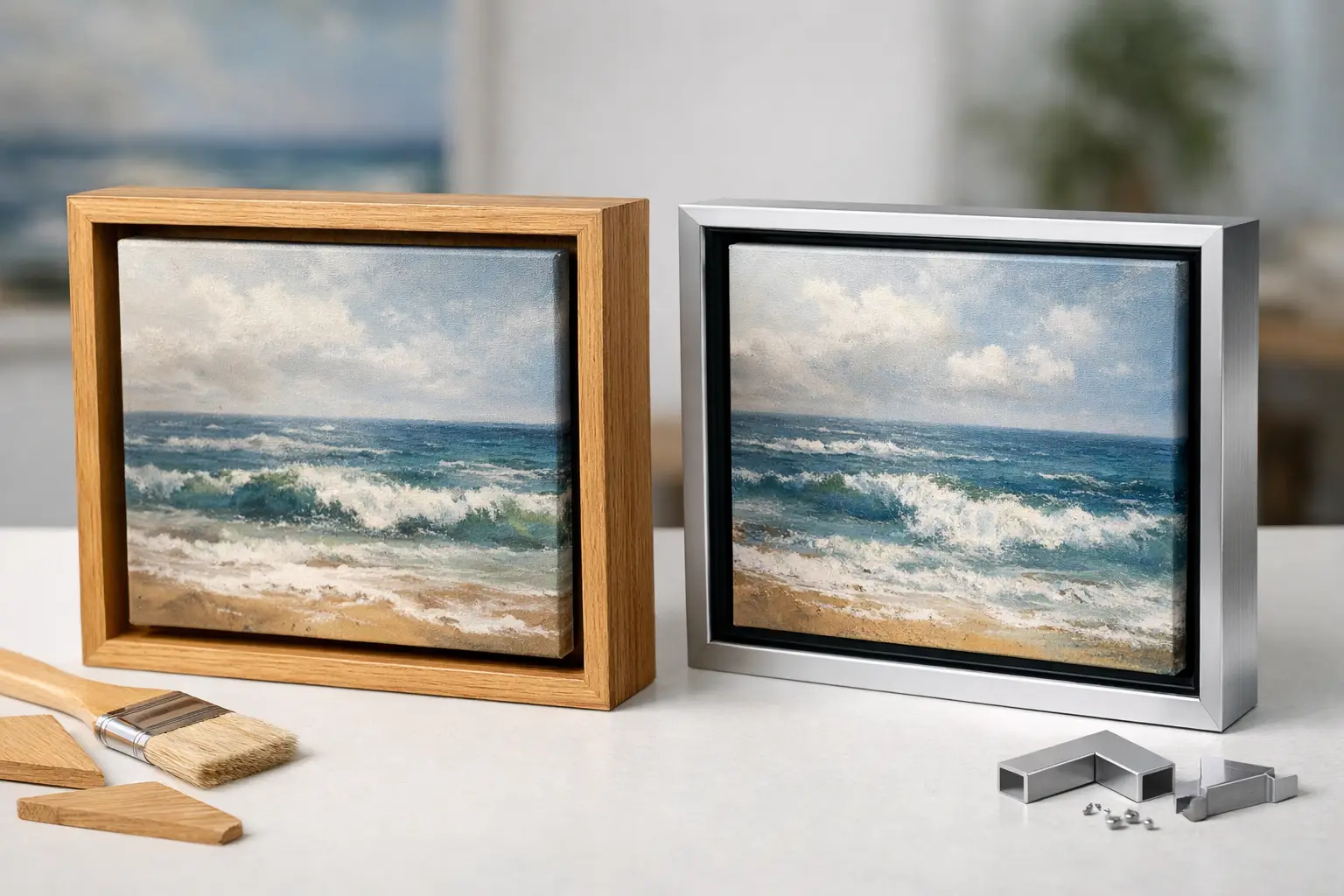
You’ve found a piece of art that’s just right in terms of color, size, and atmosphere—and then the next question arises: which frame truly does the artwork justice? When choosing between a shadow box frame and an aluminum frame, it’s not just a matter of taste. The frame determines how a piece of art appears on the wall, how much calm or, conversely, sharpness it conveys, and how well it remains protected in everyday use.
Anyone who has a painting, canvas, or modern print framed will quickly notice that these two options are often at odds with each other. That makes sense, because a shadow box frame and an aluminum frame create completely different effects. One adds space and visual impact, while the other provides clean lines and a understated finish. Which is better, therefore, depends less on what’s popular and more on the artwork itself, the space, and your personal preference.
Wooden trim vs. aluminum trim: the difference in appearance
You’ll notice the biggest difference right away. A box frame is mainly used for stretched canvases, such as paintings on canvas. The canvas sits, as it were, freely within the frame, with a small space between the painting and the edge. This makes the artwork appear to float. It creates a polished, gallery-like effect, without the frame confining the artwork.
An aluminum frame works differently. It encloses the artwork tightly and precisely. This creates a clean, modern line around the image. Especially with prints, photographs, posters, or framed art on paper, this creates a sense of calm and clarity. Aluminum generally draws less attention to itself than wood with a distinct grain or profile. For many interiors, that’s an advantage.
Still, it’s not as simple as “warm” versus “sleek.” A picture frame can also be very minimalist—for example, in matte black or white. And an aluminum frame can actually make a striking statement if you choose a wider, darker border. So while the material says a lot, the design is just as important.
When should you choose a frame?
In most cases, a box frame is the natural choice for a stretched canvas. Not only because it fits well from a technical standpoint, but also because the sides of the artwork can remain visible without looking unfinished. The artwork literally gains breathing room around the picture plane, allowing brushstrokes, texture, and depth to stand out more prominently.
This makes a box frame particularly well-suited for paintings, abstract works, and contemporary art on canvas. Larger formats also often benefit from this type of frame. A large, unframed canvas can sometimes look a bit loose or unfinished on the wall. A box frame gives the piece more presence without making it look heavy.
In addition, a picture frame fits well in interiors where warmth is welcome. Wood—or a wood-look finish—complements living rooms, reception areas, and offices where materials are meant to complement one another. Think of a space with natural tones, soft fabrics, or a mix of modern and organic elements.
There is, however, one point to keep in mind. A box frame isn’t suitable for every piece of art. Art on paper usually requires glass and a different type of frame. Very small works can also get lost in a box frame that’s too large, unless that contrast is intentionally chosen.
The Power of Space Around Work
What appeals to many people about a recessed frame is the sense of breathing room it provides. The artwork isn’t rigidly confined, but rather subtly presented. This enhances the viewing experience, especially with paintings that feature texture, visible brushstrokes, or bold use of color. The frame supports the artwork without overwhelming it.
When should you choose an aluminum frame?
An aluminum frame is often the best choice for works on paper, photographs, screen prints, and other flat art forms. Its sleek design is ideal for glass, mat boards, and a precise finish. This creates a polished and timeless look that fits easily into many spaces.
Anyone who loves minimalism, architectural lines, or a serene interior often naturally turns to aluminum. The material has a modern, clean, and understated feel. It’s a particularly logical choice for offices, new-construction homes, or interiors featuring lots of white, black, gray, or steel.
Aluminum also has practical advantages. The material is lightweight, dimensionally stable, and relatively resistant to warping. This can be appealing for larger frames or projects in commercial settings. Especially when consistency is important—for example, when displaying multiple works on a single wall—aluminum offers a clean and uniform look.
That doesn’t mean aluminum always looks cooler. In a sleek, narrow design, it can actually be very elegant. In photography or graphic art, that understated look is often exactly what’s needed. The focus remains on the image, not the frame.
Minimalist, but not cold
Some people are hesitant because aluminum might seem too technical or business-like. That may be true, but it doesn’t have to be. With the right color, a suitable mat, and well-chosen glass, you can actually create a calm, luxurious presentation. The effect, therefore, depends heavily on the combination.
Wooden Frames vs. Aluminum Frames for Various Works of Art
When choosing between a wooden frame and an aluminum frame, the type of artwork is often the deciding factor. A painting on canvas usually calls for a different approach than an etching, photograph, or poster. That may seem obvious, but in practice, people often look at the interior first and only then at the artwork. That usually doesn’t work out very well.
With canvas, a shadow box frame is often preferred because the material and the presentation are well-matched. The canvas remains visible as an object and gains more depth. An aluminum frame is less commonly used for this purpose, unless it involves a specially stretched panel or a very contemporary presentation.
With art on paper, it’s almost the opposite. In that case, an aluminum frame often makes more sense, because glass and a backing board are essential for protection and stability. Of course, a wooden frame can also be beautiful, but a classic box frame is usually not the right solution.
Mixed media, small panels, or modern sculptural works are the exceptions. In those cases, a custom approach is important. With contemporary art in particular, it pays to look not only at the standard rules, but also at the relationship between the artwork, its edges, its depth, and the wall color.
Which one goes better with your interior?
A frame should enhance the artwork, but it also coexists with the space. That’s why it’s a good idea to take your interior design into account. In a warm, layered interior featuring wood, earth tones, and soft materials, a box frame often feels like a natural choice. It brings a sense of connection and softness.
In a minimalist interior with clean lines, designer furniture, and less visual clutter, aluminum can actually work better. A frame like this keeps the presentation calm and modern. That’s nice when the artwork itself already has a strong presence.
Still, you don’t have to stick strictly to style rules. Contrast, in fact, can be exciting. An expressive painting in a sleek frame can look stunning in a modern interior. And a subtle photograph in a black aluminum frame can bring just the right touch of freshness to a more classic space.
Practical differences in maintenance and durability
In addition to appearance, usage and maintenance are also important factors. Aluminum is lightweight, strong, and stable. This makes it a practical choice for larger production runs, commercial applications, or spaces where items are frequently moved. The profile usually retains its sleek appearance and is easy to keep clean.
A picture frame, often made of wood, has a different kind of charm. Wood feels richer and more natural, but it’s also slightly more susceptible to dents, warping, or minor signs of wear. That’s rarely a reason not to choose it, but it’s something to keep in mind if the artwork is hanging in a high-traffic area.
The finish matters, too. A high-quality frame—whether made of wood or aluminum—will retain its beauty longer and better showcase the artwork. Especially when it comes to valuable art, craftsmanship is not just a minor detail, but an integral part of the presentation and protection.
Are you trying to decide between a wooden frame and an aluminum frame?
In that case, one simple question often helps: do you want the artwork to speak for itself as an object, or would you prefer to frame it tightly as an image? In the first case, you’ll often end up choosing a box frame. In the second case, aluminum is the more obvious choice.
In addition, consider three things at once: the material of the artwork, the atmosphere of the room, and the desired appearance from a distance. After all, you don’t evaluate a frame just up close. It’s precisely when it’s on the wall that the whole look has to come together. That’s why personal advice is often helpful. At Amersfoort Art, we regularly find that the best choice only becomes clear when the artwork, frame, and space are viewed together.
Sometimes the best solution isn’t the most obvious one, but the one that brings a sense of calm. If a frame makes the artwork feel like a natural fit in your home or workspace, you’re usually on the right track.


