
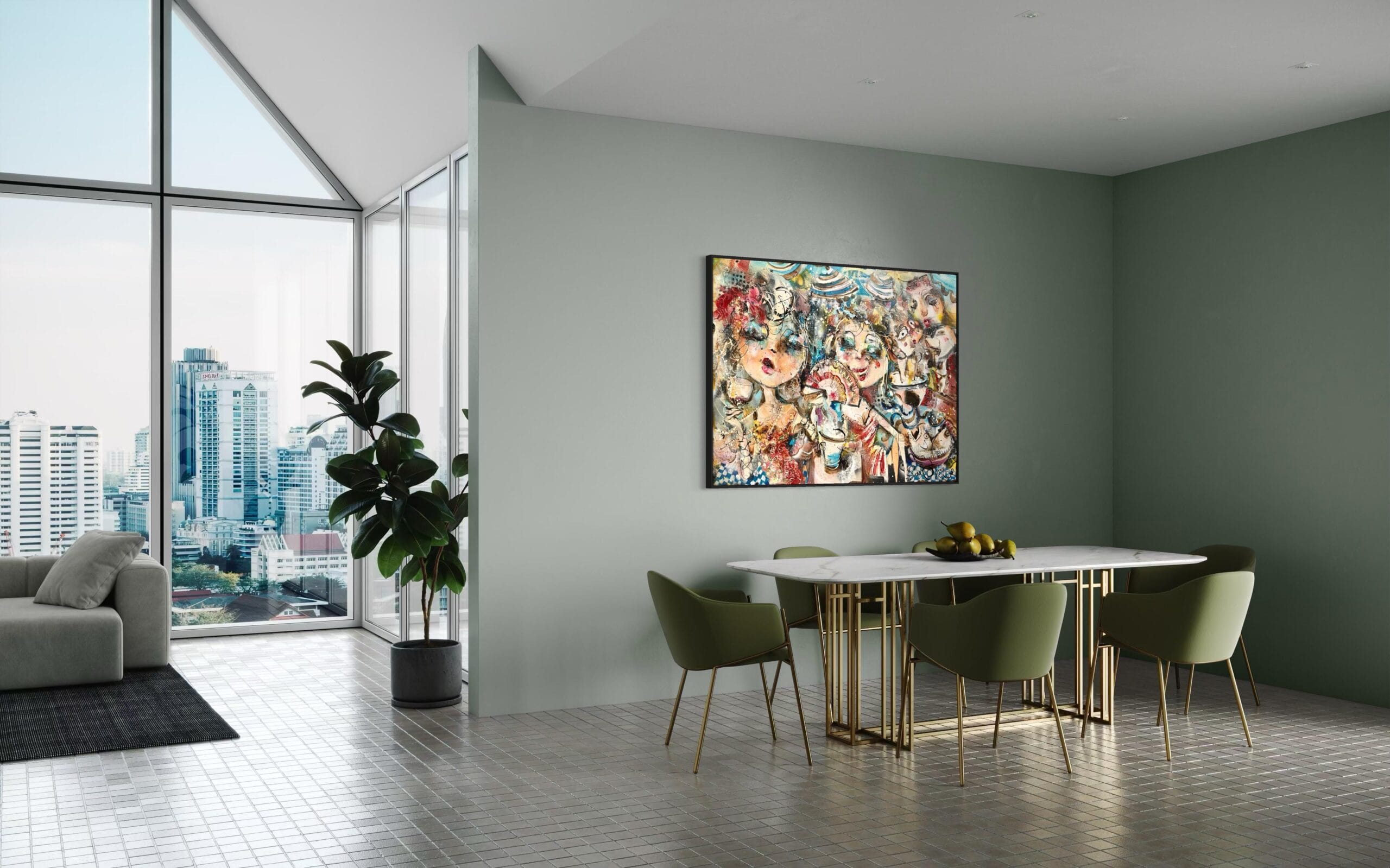
A large work of art does something that small works can rarely do: it immediately sets the mood of a room. This is exactly why buying large works of art is so appealing, but can also feel exciting. You’re not just choosing an image that you love, you’re choosing something that has a daily presence and sets the tone in your home or office.
Those who fall for a great work often find that it is no ordinary purchase. It is about charisma, scale, tranquility, character and sometimes guts. At the same time, it doesn’t have to be complicated or distant at all. In fact, with good advice and a keen eye for space, a large work of art becomes a very logical choice.
Why buying great artwork has so much impact
A great work does not simply fill an empty wall. It brings balance to a space where furniture, light and materials sometimes still don’t quite find each other. Especially in interiors with high ceilings, wide sightlines or quiet walls, a generous size can do much more than several small pieces next to each other.
This does not mean that bigger is always better. A work should add something to the space, not dominate everything. The power is often in the proportion. A large painting above a sofa, a generous photographic work in a hallway or a monumental abstract piece in a conference room can be exactly the anchor point an interior demands.
For business environments, something else comes into play. Great art can exude professionalism and individuality without making a space feel cold or standard. In a reception area, executive office or conference room, a carefully chosen work shows attention to atmosphere and detail.
Looking at the wall first, then at the artwork
A common mistake is to start with the work and only then think about the space. In practice, it often works better to look closely at the space first. How wide is the wall? What is in front of it? How is the daylight coming in? And from what distance do you usually view the work?
A large work of art that looks perfect in a gallery may look smaller than expected at home. This is because of the scale of the room and the furniture around it. Conversely, a powerful work can become too dominant in a compact room if it hangs too low or is too close to other elements.
Therefore, it is smart to assess not only the exterior size, but also the visual mass. A light, open work with lots of white or quiet areas of color behaves differently than a dark, dense and expressive piece of the exact same size. So buying large works of art is not only a matter of inches, but also of visual mass.
Format must match function
In a living room, you often seek peace and coherence. Then a work works that is wide enough to take the wall seriously, but keeps enough breathing room on the sides. In a workspace, a work of art may sometimes have a more direct presence, especially if it is meant to impress or convey an identity.
A hallway or entrance requires something different again. There you usually see a work in motion and from different angles. Then a clear image, strong composition or pronounced use of color is often more effective than a subtle work that lives mainly up close.
What style really suits your space?
Many people automatically think of abstract art when they think of a great work of art, and that is understandable. Abstract work often blends well with different interiors and can bring a lot of atmosphere without literally depicting anything. But it is certainly not the only route.
Photography, figurative art, landscapes, mixed media or graphic work can be at least as strong in a large format. It depends on what you want to feel when you enter the space. For example, a subdued work gives tranquility, while a colorful and layered canvas evokes energy and conversation.
The main rule here is: choose not only based on what fits into your interior now, but also based on what you want to continue to see for a long time. A great work should not just match a sofa or wall color of the moment. It should continue to appeal to you as the space changes later.
Trend or personal preference?
Calm earth tones, organic shapes and minimalist compositions are popular, but popularity does not guarantee a good choice. What is widely shared online does not automatically feel right at home. Especially with larger sizes, personal preference becomes more important than trendiness.
A distinct work can still be convincing years later if it really triggers something in you. On the other hand, a securely chosen piece that only fits neatly into the interior can get boring faster. Buying large works of art therefore requires a practical view and an honest feeling.
Budget, value and the question of what is reasonable
With large format, the price often rises, but not only because of the size. The artist, technique, edition, material, finish and framing also come into play. A large original painting is in a different price range than a work on paper or a limited print, even if the size is similar.
That sometimes makes comparison difficult. Still, it helps to look not only at the purchase price, but at the overall value in your space. A large work sometimes replaces several decorative elements and adds character to an interior at once. Then a higher budget can suddenly make a lot of sense.
At the same time, a generous work of art doesn’t have to be a definitive big step right away. Especially if you are unsure about style, size or impact, flexibility is nice. Consider first experiencing how a work falls into the space, or quietly building up to purchase. For many people, that lowers the threshold considerably.
Buying great works of art for your home
At home, art should not only be beautiful, but also pleasant to live with. That sounds simple, but that’s often where the difference lies between an impulsive purchase and a work that really falls into place. In a home, softness, daily rhythm, sight lines and materials play a bigger role than in a white gallery wall.
Therefore, look at the moments when you see the work. From the dining table, from the armchair, when entering the house or just as a backdrop to everyday life. A large work can be impressive, but should not tire. Especially in rooms where you spend a lot of time, balance is more important than spectacle.
Finishing also deserves attention. The right frame or presentation makes a big difference, especially with larger formats. An appropriate framing can give a work more tranquility, detach it more strongly from the wall or, on the contrary, make it fit in better with the interior.
Buy large works of art for office or project space
In business settings, art is rarely just personal. The work must fit the look and feel of the company, visitors, employees and the function of the space. A reception area often requires something immediately convincing. A workplace is more likely to require concentration and atmosphere. In a boardroom, art may well have authority, but preferably without becoming harsh or unapproachable.
Therefore, context is even more important here. A spectacularly large work may be perfect in an open entryway, but too unsettling for a space where a lot of deliberation takes place. Conversely, subdued art in a representative space may have too little presence.
It helps if you look not only at taste, but also at use. Who walks by? How long do people stay in the space? What impression do you want to leave? So buying great artwork for a business environment is part aesthetic and part strategy.
Doubt is normal – and often even wise
With a large format, hesitation often feels stronger than with smaller art. This is not awkward, but rather healthy. You look more critically, think about size, color, placement and budget. Precisely that prevents a mis-buy.
Good guidance makes a lot of difference here. Not to choose for you, but to ask the right questions. Does this work fit the scale of the space? Does it stand out both during the day and at night? Does it have enough presence without pushing everything else away? And is this a work you still enjoy looking at after six months?
At Amersfoort Art, we often see that people come to a good choice faster once the process is made concrete. Not talking abstractly about art, but looking together at wall, format, style and presentation. Then a large purchase suddenly becomes clear.
What a good choice ultimately comes down to
Buying great works of art is not a test of art knowledge. It is a search for a work that is right in scale, look and feel. Sometimes that’s a bold statement, sometimes just a quiet, spacious image that lets the whole space breathe.
If you take the time to look closely at the place, listen honestly to your tastes and be open to advice, buying large often becomes surprisingly natural. And that’s exactly what makes it beautiful: a great work of art doesn’t have to be complicated, as long as it truly suits you and your space.


