
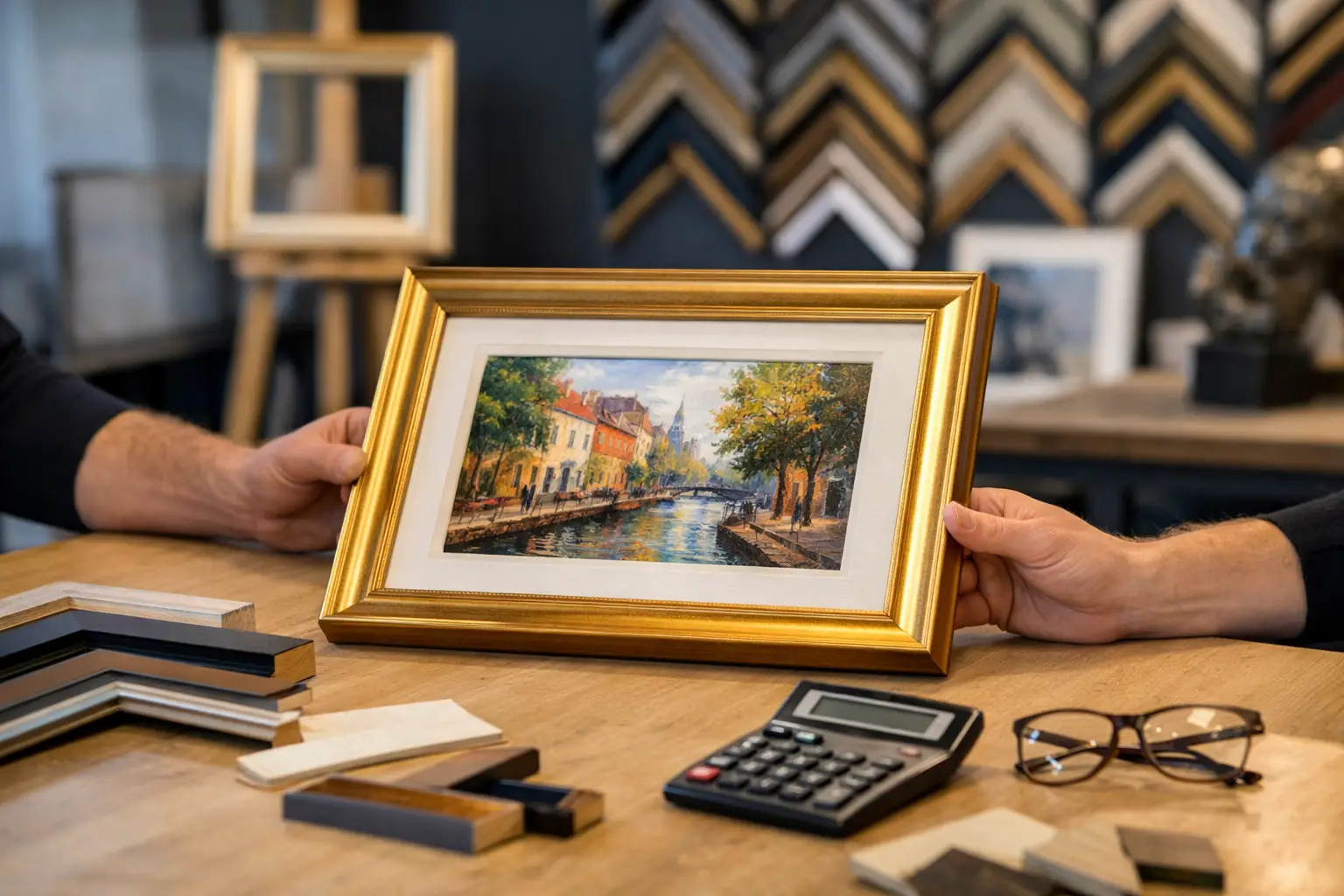
A 30 x 40 cm poster in a standard frame costs something very different from a framed etching, silkscreen or original custom painting. Those who ask themselves what does it cost to have art framed quickly realize that there is no set price per work of art. The final cost depends on the material, size, finish and especially on what the work of art needs in order to be beautifully and durably presented.
Right there is the difference between just buying a frame and having art professionally framed. Good framing does more than frame something. It supports the work, protects it from light, dust and warping, and makes it really stand out in the home or office.
What does having art framed cost on average?
For a simple framing of smaller work, the cost often starts at a few tens to around a hundred euros. Think of a modest size with a fairly standard profile and ordinary glass. Once you opt for custom work, museum glass, a passe-partout or a larger format, the price rises toward several hundred euros.
For many art lovers, that takes some shifting. Yet it makes sense. A frame is not a separate accessory, but part of the presentation of the work. In the case of a valuable lithograph, photograph or original drawing, the framing is often just as decisive for its appearance as the art itself.
What choices determine the price?
The format of the artwork
The larger the work, the higher the price usually is. This is due not only to more material, but also to technical requirements. A large work requires a sturdier frame, thicker glass or more stable mounting. Custom work also becomes necessary more quickly with wide formats or deviating sizes.
A small graphic work can often be framed relatively compactly and affordably. A large work of art above the sofa or in a reception area requires a different approach – and therefore a different budget.
The list itself
The frame chosen has a lot of influence on the price. A narrow, simple wood or aluminum frame is usually more economical than a heavy wood profile with more depth, texture or a special finish. Color and style also come into play.
The right choice is not always the most expensive. For minimalist photography, a slim aluminum frame often works beautifully. For a warm, expressive painting, on the other hand, a wooden profile can provide just the right amount of tranquility. Good framing is therefore not a matter of adding as much as possible, but of matching it well.
Glass or acrylic
The type of glass also makes a difference. Standard glass is the most affordable, but is often highly reflective. Brighter glass or anti-reflective glass gives a quieter image. Museum glass is in the higher end because it greatly reduces reflections and often provides better UV protection.
For larger works or fragile applications, acrylic can be of interest. It is lighter than glass and therefore more practical to transport and hang. The disadvantage is that it can be more sensitive to scratches. So the best choice depends on the work, the place and how important optical peace is to you.
Passe-partout and back panel
A passe-partout literally adds space around the artwork. This can give a print, photograph or drawing more attention and prevents the work from lying directly against the glass. Especially with paper works, this is often desirable. The quality of the cardboard is important here. Acid-free materials help prevent discoloration and deterioration.
The back wall also counts in the price. Professional framing looks at sturdiness and preservation, not just front appearance. You may not notice this immediately, but you will in the long run.
Assembly and conservation
Not every work of art may be attached in the same way. A photograph, watercolor, silkscreen or embroidery each requires an appropriate technique. Sometimes a simple mounting is sufficient, sometimes conservative framing is necessary to avoid damaging the work.
This affects the price as well as the value of the work. Especially with original art or work with emotional significance, cheap confirmation is often ultimately more expensive if the paper undulates, tears or discolors.
When does framing really get more expensive?
The price usually increases as soon as customization and higher protection requirements are involved. This applies, for example, to antique prints, works of art on fragile paper, special sizes or works that will be hung in bright light. Object framings, such as textiles, relief work or three-dimensional pieces, also require more time and materials.
Another price difference is in appearance. If you want to present a work of art professionally in a living room, entrance or meeting room, you often consciously choose a finish that exudes tranquility and quality. Then you pay not only for materials, but also for advice and craftsmanship.
Cheap or good fit?
When asking what does it cost to have art framed, the lowest price is rarely the best indicator. A cheap frame from standard stock may work fine for a poster or decorative print. But for art that you love, want to keep or possibly someday resell, appropriate custom work is usually wiser.
This is not about luxury for the sake of luxury. Good framing prevents a work from visually disappearing, looking crooked or being damaged over time. It makes the difference between hanging something on the wall and letting a work of art truly speak for itself.
What does art framing cost by type of work?
Posters and decorative prints
This is usually the most economical category. With a standard format, simple profile and basic glass, the costs remain manageable. Those primarily looking for a neat presentation often do not have to make complicated choices here.
Photographs and art prints
This is where appearance plays a stronger role. The right glass and a well-chosen passe-partout often make a big difference. The price is therefore usually slightly higher, especially if color reproduction and reflection are important.
Etchings, screen prints and drawings
Paperwork requires more attention. Distance from the glass, acid-free materials and neat assembly are important here. This puts you more quickly in the middle or high end, depending on size and finish.
Original art and valuable works
With original art, conservation is often leading. Then a framer not only looks at beautiful, but also at safe and future-proof. The price is higher, but that is usually well justified with the value of the work.
Why advice on framing is worth money
Many clients come in with a clear question about color or size, but find while choosing that what matters most is balance. Which frame supports the work without being overpowering? Is a passe-partout necessary or not? Does clear glass fit better than anti-reflective glass in this space?
That kind of choice makes a big difference in the end result. An experienced framer looks not only at the frame in itself, but also at the style of the artwork, the place where it will hang and the atmosphere of the interior. This is precisely why you can avoid a mis-buy.
At Amersfoort Art, that consideration is approached very practically. Not complicated, but careful. That suits buying, renting and framing art the way many people like it: with expert advice, but without a threshold.
How do you determine a realistic budget?
A useful starting point is to first consider the value of the work – financial or emotional. You probably want to invest differently for a temporary poster than for a treasured photograph, a work of art from the gallery or a print that has lasted for years.
Next, consider three questions. How important is protection? How visible will the work be in the space? And do you want primarily a functional solution, or a finish that really becomes part of the interior? With that consideration, a budget range that feels logical usually emerges naturally.
When in doubt, you would do well to look at examples side by side. The difference between standard glass and museum glass, or between a simple frame and a carefully chosen custom profile, is often immediately apparent in real life. Then it also becomes clear where the price comes from.
A good frame lets the artwork live better
So the question of what does art framing cost is less a question of one amount and more a question of the right combination of choices. Format, material, glass, passe-partout and mounting together determine the price as well as the look and longevity of the work.
A good framing does not have to be overly luxurious. It has to match the artwork, the space and what you think is important. If that balance is right, the frame won’t become an expense that you later question, but an investment that you enjoy looking at every day.


