
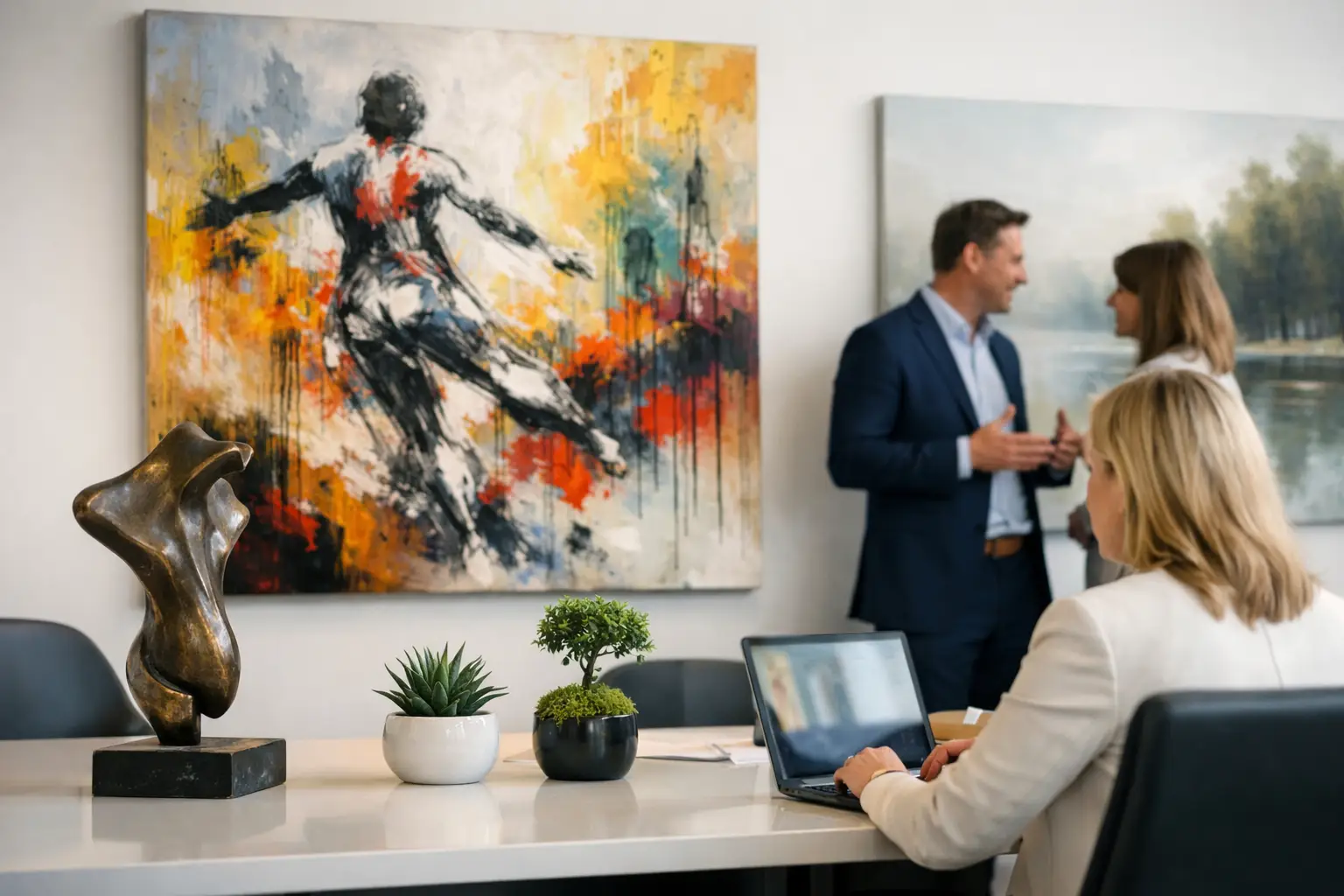
A bare meeting room says more than you care. Not only to employees, but also to clients, applicants and relations. Anyone who chooses to rent a work of art for office design, therefore, is not only choosing something beautiful on the wall, but a workplace with character, tranquility and a professional appearance.
Art in the office is sometimes still seen as an extra. Something for later, when the interior is already finished. In practice it often works differently. Art in particular completes a space. It connects colors, softens clean lines and gives an office its own face. And renting makes that step a lot more accessible than many companies think.
Why renting artwork for office design works
An office has several functions at once. One must be able to concentrate, consult pleasantly, receive professional and sometimes creative thinking. The interior plays a greater role in this than is often assumed. Furniture and lighting lay the foundation, but it is often the walls that bring atmosphere or lack of atmosphere.
With art, you add something that is not purely functional but has an immediate effect. A well-chosen work can make an entryway warmer, a boardroom more stature or an open office more peaceful. This does not have to be garish or complicated. On the contrary, a carefully chosen modern or contemporary work can do a lot without dominating the space.
Renting has a practical advantage in this regard. You don’t have to make a final purchase right away. This is nice if you are still searching for the right style, if your office is developing or if you want to experience how a work lives in the space. After all, art looks different in a gallery or on a screen than it does on your own wall, with your light, your floor and your furniture.
Not only beautiful, but also smart and flexible
For many companies, flexibility is a decisive reason to rent art. An office changes with the organization. Teams grow, spaces get a different function, a renovation creates a new color palette. Then it’s nice if the art collection can move with it.
A rental structure makes it possible to change when a space demands it. This is interesting for reception areas and boardrooms, but also for places where many people congregate. Think of a waiting room, consultation area or company restaurant. It is okay for art to stir something up there, as long as it suits the atmosphere of the company.
In addition, hiring prevents you from being stuck with a choice made primarily under time pressure. A painting or graphic work should not only feel right on the first day, but also still be right six months from now. Renting creates space to try, compare and gradually see more clearly what really fits.
What art fits your office?
That question is less abstract than it sounds. It usually begins not with art movements or artists’ names, but with the space itself. How big is the wall? How does the light fall? Is the environment quiet or vibrant? And who uses the space on a daily basis?
In a representative entrance, art often works best when it is directly present. Not cluttered, but a work with clarity, quality and charisma. In workspaces, the situation is different. There, balance is more important. Art may inspire, but does not have to constantly demand attention. Soft color fields, graphic compositions or photography can work well there.
For meeting rooms, nuance is important. Too exuberant can create unrest, too safe can make the room anonymous. This is precisely where personal advice pays off. Not to make it complicated, but to ensure that the work fits the function of the space as well as the identity of your organization.
Those who want to decorate several spaces at once often find that consistency is more important than uniformity. Not the same everywhere, but a clear line. This can be in color, material, size or atmosphere. This creates an office that feels cared for, without becoming sterile.
Artwork rental for office design without large investment
One of the misconceptions surrounding art in the office is that it always has to be a hefty expense. It doesn’t have to be. This is precisely why artwork rental for office design is an attractive solution for many companies. You spread the cost and keep room to adjust choices later.
This also makes it easier to choose quality. Instead of quickly purchasing decorative wall filler, you can invest in real art with a stronger look. You can see that difference. Employees notice it, visitors do, too.
For some organizations, another factor is that renting lowers the barrier to starting art in the first place. First one space, then maybe more. First a modest size, later a more striking work. That way, art grows with the organization, rather than having to decide everything at once.
The added value of advice, placement and presentation
A good work of art can disappoint if it hangs incorrectly. Too high, too small, poorly lit or in the wrong frame – these are details that make a lot of difference. That is why it is nice when you not only choose a work, but also receive guidance on presentation and placement.
This is not a luxury, but part of the result. A work of art must come into its own on the wall. Sometimes that means a larger size than you would choose for yourself. Sometimes it means more rest around the work. And sometimes a series of smaller works prove stronger than one large canvas.
Framing also plays a role, especially with graphics, photography or works on paper. The right frame supports the work and ensures that it matches the interior. In a sleek office, this often requires a different finish than in a warm, homey reception area.
Those who choose a full-service partner for this have the advantage of a single point of contact for selection, advice, delivery and presentation. That saves time and prevents separate decisions that don’t come together nicely later. Amersfoort Art deliberately plays into this with a combination of gallery, art lending, advice and custom framing.
What art does for employees and visitors
The value of art in the office cannot be captured only in style or appearance. Art also influences how a space is perceived. A well-appointed office feels more welcoming, more human and more attentive. This may seem subtle, but the effect is noticeable.
For employees, that often means more commitment to the workplace. A space decorated with care feels less temporary and less generic. For visitors, it works the same way. Art makes a first impression more personal. It shows that an organization pays attention to environment, detail and experience.
That doesn’t mean every office has to have a distinctly artistic identity. Sometimes a quiet, elegant selection is just right. Sometimes it may be a little more powerful or colorful. It depends on the industry, the culture and the type of client you receive. A law firm usually requires something different than a creative agency or a medical practice. There is no right or wrong in that, only appropriate or less appropriate.
What do you look for when renting art for the office?
Consider the space first and only then personal preference. What works beautifully at home is not automatically appropriate for a reception area or meeting room. Next, think about the desired look. Do you want tranquility, energy, sophistication or just a pronounced eye-catcher?
In addition, it’s smart to stay practical. How long do you want a work to hang? Is switching desirable? Is it one location or several floors? And do you only want to rent, or also keep open the possibility of purchasing later? Such questions do not make the process of choosing heavier, but rather clearer.
Finally, get advice from someone who not only looks at the artwork, but also at the space it will be in. This will prevent you from choosing on loose taste, when what matters in the end is the overall look.
Art in the office doesn’t have to be complicated, distant or unattainable. If done right, it actually feels logical. Like the space is finally finished. And perhaps that’s the best reason to start with it: not because it should be, but because a workspace with attention is simply more pleasant to be in.


