
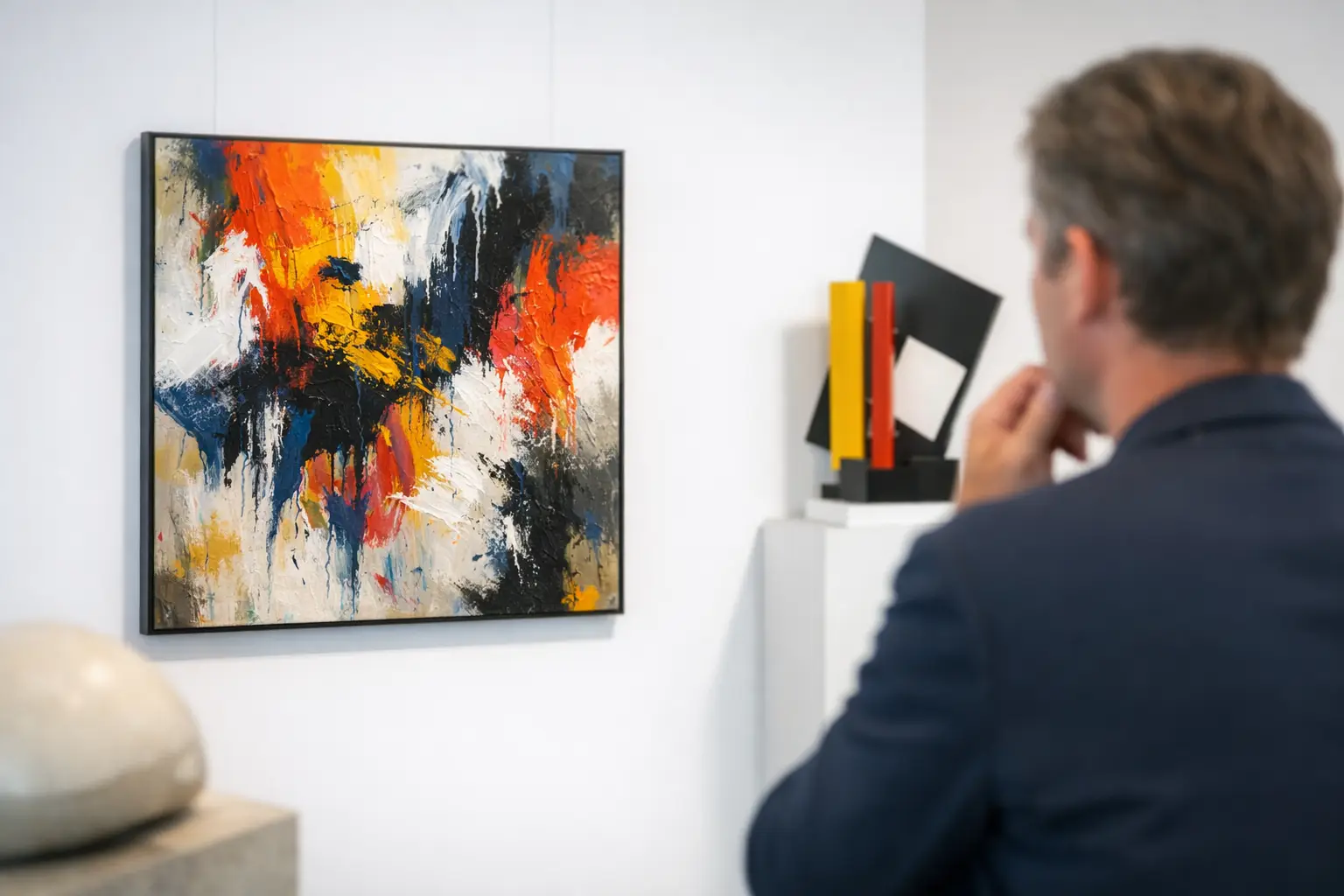
A large empty surface above the sofa, a hallway that remains somewhat bare, or an office space that is neatly furnished but lacks character – often the search for modern art begins precisely there. Not from theory, but from a feeling: something may come here that makes the space stronger. Yet many people give up as soon as they think they have to “understand” it. That’s a shame, because choosing good art rarely begins with art historical knowledge. It starts with looking, comparing and noticing what a work does to you.
What modern art actually means
The term modern art is often used as a collective term for art that feels contemporary, sleek, expressive or innovative. Strictly speaking, modern art historically refers to a specific period, roughly from the late nineteenth century into the twentieth century. In practice, many people mean something different by it: art that fits into a modern interior and deviates from classical, traditional representations.
That difference is good to know, but it doesn’t have to complicate the choice. If you’re looking for a work for your home or office, it’s usually not about the right label, but about charisma. Does an abstract painting appeal to you because it brings tranquility? Does a powerful graphic work fit better with a minimalist interior? Then you are already asking the right questions.
Why modern art works so well in interiors and workspaces
A good piece of art does more than fill a blank wall. It brings rhythm, color, tension or just tranquility to a space. Modern art is often particularly suitable for this, because it does not always have to literally tell you what you see. Abstraction, stratification or its own language of form create room for atmosphere and interpretation.
In the home, this often means that a work makes a room more personal. A living room becomes less predictable, a dining room gains warmth and a study feels less functional. In business spaces, it works the same way. Art can make a reception area more inviting, give a meeting room more character and make an office environment feel less anonymous.
In doing so, there is no one right style. Where one chooses powerful colors and grand gestures, another feels more comfortable with hushed compositions or subtle line play. Modern art is broad enough to accommodate both preferences.
Choosing modern art begins not with the wall, but with yourself
Those looking for a piece of art often look first at dimensions, colors or its location on the wall. Logical, but the best choice usually begins earlier. What atmosphere do you want to create? Do you want a work to stand out as soon as someone enters, or do you want it to grow slowly in the room? Are you looking for energy, tranquility, softness, contrast or depth?
That sounds personal, and it is. Art only really lives when it connects to the way you live or work. A large expressive work can be beautiful, but feels less natural in a space that is just sober and lightly decorated. Conversely, a subtle work can fall away if the environment calls for more presence.
It helps to take an honest look at your own tastes. Not at what you think “belongs,” but at what continues to captivate you. What works draw your attention again and again? What colors or shapes do your eyes linger on? Those are often better signposts than trends.
The role of size and placement
Format is still often underestimated. A work can be strong on its own and still not look right if it is too small or just too dominant for the space. Above a sofa, dresser or long conference table, art may often be larger than people think beforehand. On the other hand, a smaller work need not be lost, as long as it is deliberately placed and given enough peace around it.
Height also does a lot. If a work hangs too high, it loses contact with the space. If it hangs well, it feels as if it naturally belongs in the interior. Therefore, advice on placement is often as valuable as the work itself.
Color does not have to match
Many people look for art that exactly matches their interior colors. Sometimes that works well, but it is not a law. Modern art is also allowed to add excitement. An unexpected color can actually bring life to a quiet space. A work does not have to repeat everything that is already there. Sometimes contrast is exactly what an interior needs.
However, balance is important. A colorful work in an already busy interior requires care. A hushed work in an austere space can be beautiful, but may have sufficient presence. So it depends on the space, the light and the role you want to give the work.
Buy or experience first – it depends on what you need
Not everyone wants to make a final choice right away. Especially with modern art, this is understandable. A work can be immediately convincing in the gallery, but feel different at home due to light, use of color or the scale of the room. That’s why many people like flexibility.
Buying makes sense when you know immediately: this is it. You consciously choose a work you want to keep seeing and live with for a long time. But there are also situations when experiencing first is smarter. For example, if you are in doubt between styles, if a work will be given a prominent place or if you still want to feel how it relates to your interior.
Just then, art lending can be a peaceful route. Not as an interim solution out of uncertainty, but as a practical way to choose with attention. For many individuals and companies this lowers the threshold considerably. Art then becomes not a big leap, but a process in which taste and space are allowed to find each other.
What to look out for when buying modern art
A good purchase is rarely just a matter of liking it. Of course, a work must appeal to you, but in addition, material, finish, provenance and presentation play a role. How is the work constructed? Does it look best behind glass, on aluminum, on canvas or in a sober frame? These choices will help determine how professional and durable the result will be.
Again, there is no standard answer. A graphic work often requires different framing than a painting with lots of texture. A subdued drawing can be given more power by the right frame without losing its subtlety. A large painting sometimes needs no frame at all, otherwise the work loses its directness.
That’s why guidance is valuable. Not to take the choice from you, but to help you see what works. An expert eye makes the difference between a nice piece on the wall and a work of art that truly becomes part of the space.
Modern art for business spaces requires a different look
For businesses, function plays a role in addition to taste. An entrance, waiting room or boardroom has different requirements than a living room. Art must fit the image of the organization, but should not become too slick or impersonal. Modern art in particular can add a lot there, because it looks professional and gives character at the same time.
The trade-off is often in nuance. Work that is too pronounced may not be appropriate in every setting, while choices that are too safe may have little impact. Again, it helps to consider target audience, use of space and desired look. A notary’s office requires something different than an architecture firm or healthcare environment.
Practical issues also come into play, such as changeability, maintenance and presentation. A flexible solution is often more attractive than purchasing an entire collection right away. For organizations that want to furnish their spaces with care and distinction, without unnecessary risk, this is a pleasant thought.
Art may feel close
What sometimes holds people back is the idea that art is only for connoisseurs. As if you have to learn the right words before you can choose something. In reality, it works differently. Art does not need to be explained before it can mean something to you. You may be touched by color, tranquility, movement or composition without immediately attaching a theoretical story to it.
This does not mean that background or quality are unimportant. Quite the contrary. But expertise is especially valuable when it helps you choose with more confidence. Not to create distance, but rather to bring art closer. This is also why an accessible gallery or art partner makes such a difference. When you can look around calmly, ask questions and get honest advice, it creates space to make a choice that really suits you.
At Amersfoort Art, that approach revolves around exactly that balance: taking quality seriously, without making art unnecessarily complicated. That makes it easier to find not only a beautiful work, but also one that continues to make sense in your everyday life.
A good choice does not feel like a gamble
The best modern art is not necessarily the most expensive work, the largest size or the name you already know. It is the work that adds something to the space and that you continue to see over time. Not fleeting, but real. Sometimes quietly in the background, sometimes as a clear focal point.
Therefore, allow yourself some time to look. Compare different styles, pay attention to what appeals to you and don’t be afraid to ask for advice on size, framing or placement. Choosing art does not have to be a test you have to pass. It should be an enjoyable process in which taste, space and feeling slowly come together.
And if a work continues to attract you, that is often already a much better signal than any trend or rule.


