
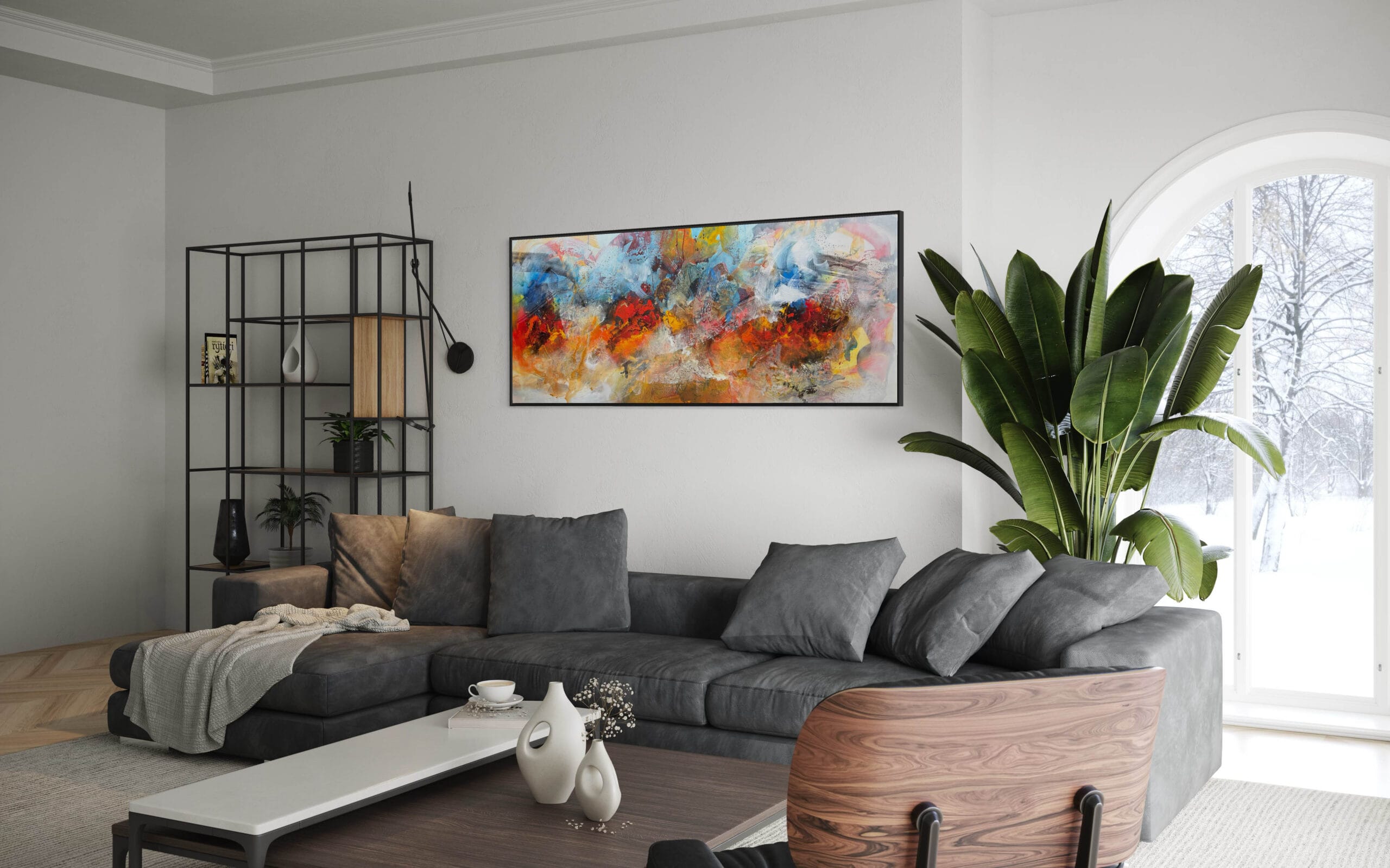
A big blank wall can make a space quiet. Not quiet, but unfinished. This is precisely where buying art for interior design often begins: at the moment when a room is technically correct, but still lacks its own character. A work of art brings not only color or contrast, but also rhythm, atmosphere and personality into the home.
Why art in an interior does more than fill in
Art is not a closing item in interior design. It often determines how a space feels. A painting with soft tones can make a living room lighter and calmer, while a graphic work adds tension and energy. This effect is created not only by the image itself, but also by size, material, frame and place on the wall.
Many people choose furniture, lighting and upholstery first, and only then start looking at art. That makes sense, but it doesn’t have to mean that art just “has to fit.” It often works stronger to choose a work of art that adds something that is still missing. A sleek interior gets warmth from expressive art. A colorful space can actually benefit from a subdued work that brings balance.
Therein lies immediately the most important nuance: appropriate does not mean the same as obedient. The best result usually occurs when a work fits the space but also has enough individuality to stand out.
Buying art for interiors starts with reading the space
Those looking for art for the home need not start with the artist or technique. Look first at the space itself. How does daylight come in? What colors do you already see a lot of? Where does the eye automatically fall on as soon as you enter? Those are often where art makes the most difference.
In a living room, scale plays a big role. Above a sofa or dresser, art is allowed to be generous. Work that is too small on a wide wall quickly looks lost, no matter how beautiful the piece is on its own. In a hallway or landing, on the other hand, a more compact size often works better because the viewing distance is shorter and the space becomes crowded more quickly.
The function of the space also counts. In a bedroom, many people choose hushed works, with a quiet color palette or soft composition. In a dining room, on the other hand, art can be slightly looser, more powerful or more pronounced. There is no set rule, but the space usually clearly indicates how much stimulus feels comfortable.
Which style suits your interior – and when exactly not
When buying art for interiors, style is often the first thing people select for. Modern, abstract, figurative, colorful or minimalist – these are recognizable inputs. Yet style is rarely the only criterion that determines a good choice.
In a modern interior, abstract works often do well because they enhance the lines and tranquility of the space. But a figurative work can also work beautifully in it, precisely because it adds more humanity or story. Conversely, a more classic home can respond surprisingly strongly to contemporary art because it adds tension without causing the interior to lose its warmth.
Those who search only on “it must match the sofa” usually make the choice too small. Art does not have to literally repeat the same colors or shapes. Sometimes a contrast is much more convincing. For example, a subdued beige interior can actually be given more depth by one powerful work with dark blue, red or black.
If you hesitate between safe and outspoken, that is usually a good sign. Art may do something to you. If a work feels immediately familiar but also evokes a little excitement, chances are it will remain interesting in the long run.
Format, placement and frame make the difference
A good work can still come across as weaker if the format is not right. This often happens. People fall in love with a work of art in a gallery or online presentation, but forget to translate it to their own wall. As a result, a piece at home turns out smaller, busier or just heavier than expected.
A practical guideline is that art above a piece of furniture should visually occupy about two-thirds of the width of that furniture. This is not a law, but it helps keep proportions pleasing. On a loose wall, on the contrary, one large work can look calmer than several small pieces next to each other.
In this regard, the frame deserves more attention than many people think. A frame is not an edge, but part of the presentation. A narrow, clean frame can give contemporary art more clarity. Wood adds warmth. A tray frame gives space and often allows a painting to breathe more strongly. What works depends on the work itself as well as on the materials already present in your interior.
This is precisely why custom work is valuable. A good framing completes a work of art and makes it more naturally part of the space, without losing its individual character.
Choosing color without it feeling sought after
Color is often the biggest barrier. Many buyers want art to “recur” in pillows, rugs or accessories. That can be beautiful, but if everything matches too literally, it quickly becomes predictable. Art may well rhyme with the interior, but it does not have to sing the same refrain.
There are roughly three ways color can work well. You can choose connection, in which shades from the interior subtly recur in the work. You can choose contrast, making the artwork a clear focal point. Or you can choose bridge color: a hue that is not yet dominant, but does connect different elements in the space.
For many interiors, the latter option works surprisingly well. A work with rust, moss green or deep blue, for example, can make a room feel more cohesive without seeming like everything has been thought out in advance. This makes an interior feel alive rather than styled.
Experience first, then decide
Not everyone wants to make a final choice right away. That’s understandable. Art looks different in a showroom than it does at home on your own wall, with your own light, floor and furniture. This is precisely why flexibility is so nice in the buying process.
For many people, renting or saving is an approachable way to experience art first. Only then do you really notice whether a work brings the right atmosphere, whether the format is right and whether you still enjoy looking at it after a few weeks. That takes pressure off the decision and often makes the choice better, not more prudent.
That approach also fits with how people live today. Interiors change with life stages, moves and new layouts. Art doesn’t have to be rigid in that. It is allowed to grow with your taste and space.
Personal advice makes buying art for interiors easier
Online orientation is pleasant, but art remains something you have to see and feel in relation to a space. That is why personal advice helps enormously, especially if you are unsure about several works or do not know which format is suitable. A fresh, expert view prevents mis-purchases and often reveals possibilities you did not immediately think of yourself.
That advice doesn’t have to be complicated or heavy. In fact, an accessible approach works best: looking at the wall with me, thinking about style, format and presentation, and saying honestly when something turns out too small, too busy or too flat. Good guidance doesn’t feel steering, but enlightening.
With a full-service art partner like Amersfoort Art, there’s something more important: you’re not just looking at the artwork, you’re looking at the total picture. From orientation and art lending to framing, presentation and delivery – that makes the step from great idea to good choice a lot easier.
What a good purchase ultimately determines
A good piece of art for your interior rarely meets one checklist. It’s not just the right size, not just the right color, nor just a familiar name. It is the combination of look, placement and feel. You should notice that a space becomes stronger once the work hangs.
This also means that price does not have to be the only decision point. Cheaper art that just doesn’t work is ultimately less successful than a work that you can enjoy for years. At the same time, the reverse is also true: more expensive is not automatically better. The value is in the relationship between the work and your daily life.
That’s why it pays to choose quietly. Look not only at what looks beautiful today, but also at what will continue to fascinate over time. A work of art lives with seasons, with different light and with changing furniture. If it still rings true then, you haven’t just hung something on the wall, but added something that makes your home more individual.
So when you buy art for the interior, you are not just buying decoration. You choose atmosphere, character and an eye-catcher that gives something back every day. Start small or go straight ahead, but above all give yourself the space to look, compare and experience what really suits you.


