
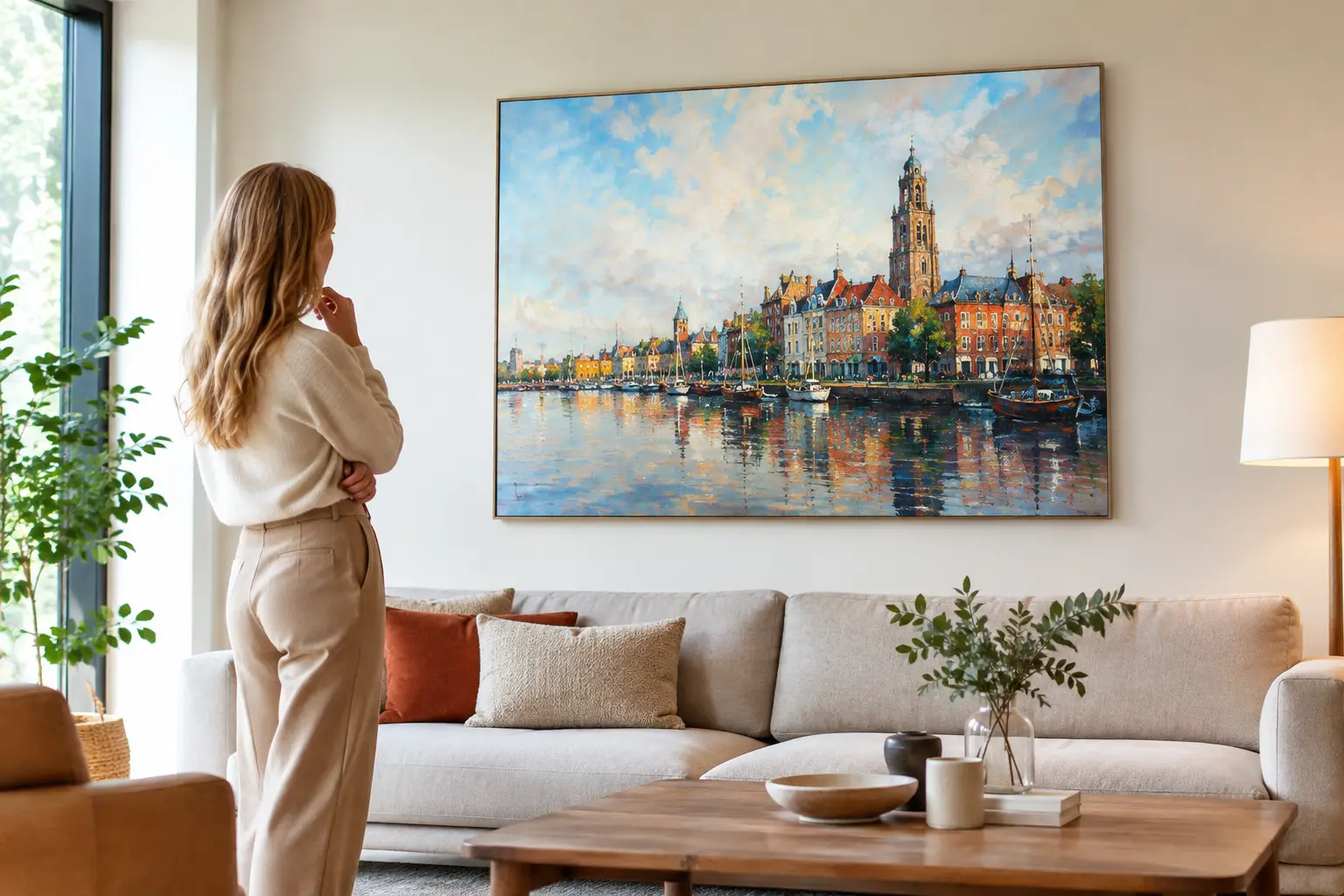
An empty wall doesn’t always call for more furniture or a new coat of paint. Sometimes, all that’s missing is a piece with character: something that adds a personal touch to the space and catches your eye every day. That’s why buying beautiful paintings isn’t just about color or size. It’s about finding art that speaks to you and complements your interior.
It doesn’t have to be complicated. You don’t need to be an art historian to choose a good painting. It does help, however, to look at it calmly, take your space seriously, and give yourself the freedom to experience a work first. A painting that immediately resonates with you in the gallery can have an even stronger impact at home. But the opposite can also happen—and that’s precisely why personal advice or a flexible art lending service is so valuable.
Buying beautiful paintings starts with looking, not measuring
Your first reaction to a work of art is often the most honest. Will you pause for a moment? Does a color draw you in, or does the image trigger a memory? Give that feeling room to unfold. Art doesn’t have to be fully explained to be valuable. An abstract painting, for example, can bring a sense of calm without you having to put into words exactly what you see. A figurative work, on the other hand, can evoke a story, a place, or an atmosphere that resonates with you.
Next, look beyond a single style. If you think you only like serene landscapes, you might be surprised by a powerful abstract piece. And if you have a modern interior, you don’t automatically have to choose minimalist art. In fact, an expressive painting, a layered cityscape, or a colorful piece can add warmth to a sleek space.
Also, take the time to compare different artists side by side. Do you recognize a style, use of color, or subject that keeps coming up in your preferences? That’s how your own taste gradually develops. It’s much more important than a fleeting interior design trend.
Look at the wall, but don’t let the wall dictate everything
Size has a major impact on the appearance of a painting. A piece that’s too small on a wide wall can look lost, while a large painting in the right spot can create a sense of calm. Many people play it safe and choose a smaller size than necessary. That’s understandable, but it’s not always the best choice.
Measure the available wall space and take into account furniture, lamps, and walking space. A painting often looks good above a sofa or sideboard when it covers about two-thirds of the piece’s width. Don’t hang the artwork too high: in a living space, the focal point is usually best placed at eye level. Above a piece of furniture, it can be hung slightly lower so that the art and the interior blend seamlessly.
Still, these aren’t hard-and-fast rules. A small painting can make a strong impact on a narrow partition wall, next to a bookcase, or as part of a collection. A large vertical piece can visually connect a tall hallway. The question isn’t just how much wall space you have, but where the painting should draw attention.
Light changes more than you think
It’s best to view a work of art under different lighting conditions. Daylight brings out colors differently than evening light, and a spotlight can make the texture of the paint or relief stand out even more. This makes a particular difference in works with subtle shades, sheen, or a lot of texture.
Also be mindful of direct sunlight. Prolonged, intense sunlight isn’t ideal for many works of art. A spot across from a window can be beautiful, as long as the artwork isn’t exposed to direct sunlight for hours on end. With appropriate lighting and high-quality glass for framed art, you’ll also be able to enjoy the colors and materials for longer.
Choose color as a connection, not as a rule
A painting doesn’t have to have exactly the same colors as your pillows, rug, or curtains. In fact, if everything is too closely coordinated, an interior can end up looking flat. Instead, look for connections. This could be a recurring warm undertone, an accent color that reappears in an unexpected way, or a shared sense of calm, energy, or contrast.
Does your home feature lots of natural materials and soft colors? If so, a piece featuring earth tones, deep blues, or organic shapes could be a great fit. In a bold interior, art can actually provide a contrasting element. A brightly colored composition against a neutral wall brings a space to life without requiring you to change your entire decor.
Are you torn between two pieces? Then ask yourself not only which painting is the best fit, but also which one you’ll still want to see in a few years. A good purchase doesn’t have to be safe. A little bit of tension keeps a space interesting.
Original painting, print, or art reproduction?
The choice of art is often linked to budget, but also to personal preference and intended use. An original painting is one-of-a-kind. You can see the brushstrokes, the layering of the paint, and sometimes the small irregularities that give the work its unique character. For many art lovers, this holds a special appeal.
Prints, such as screen prints, etchings, or lithographs, are also original works of art, but they are produced in a limited edition. Each copy is often numbered and signed. This offers the opportunity to purchase work by a favorite artist at a different price point. A high-quality art print can also be beautiful, provided that the paper, colors, and finish have been carefully selected.
So there is no automatic winner. An original work is a great choice if you’re looking for a unique focal point in your home. A print or art reproduction can be ideal if you want to enhance multiple walls, are just starting a collection, or can’t stop thinking about a specific piece. The most important thing is that you know what you’re buying and that the quality meets your expectations.
The list is part of the artwork
A frame is not just a minor detail. The right frame can enhance a painting, protect it, and help it blend better into the space. For a canvas on a stretcher frame, for example, a box frame can add extra depth. A graphic work often looks its best with a mat and glass. For a modern, colorful piece, a slim black or natural wood frame may be just enough, while a wider frame lends more weight to a classic or serene image.
Don’t let yourself be guided by the frame you happen to have hanging at home at the moment. Artworks can form a cohesive group without being framed identically. By subtly repeating elements such as material, color tone, or profile, you create cohesion without making everything uniform. A custom frame is especially worthwhile when size, protection, and presentation truly make a difference.
Trying it out at home first leads to better choices
When you view a piece of art in a gallery, you’re in a different setting than at home. The wall, the lighting, the sofa, and even the distance from which you’re viewing it all change your experience. That’s why renting art is a great option for those who aren’t ready to buy right away. You can find out whether the painting continues to captivate you and whether its size really works in the space.
This isn’t just useful when you’re unsure. Even if your taste is still evolving, renting gives you the opportunity to explore different artists and styles. Those who decide to buy later often do so with greater confidence. For an office, practice, or reception area, rotating artwork is also an easy way to keep the space feeling fresh and well-maintained.
Personalized advice can save you a lot of time. A photo of your wall, the room’s dimensions, and a sense of your interior design provide enough information to help you narrow down your search. At Amersfoort Art, you can view, rent, or buy art and get advice on display and framing. This way, choosing isn’t a gamble, but an enjoyable process.
Buying Art for Your Home or Workspace
At home, a painting can be personal. It doesn’t have to appeal to everyone. It is precisely a work that evokes a memory, captures a mood, or continues to fascinate in unexpected ways that takes on meaning in everyday life. In a workspace, the considerations are sometimes different. There, art must appeal to visitors, employees, and the function of the space, without becoming bland.
For a reception area, an accessible, striking piece of art often works better than something that requires a lot of explanation. In a meeting room, art can actually help make the atmosphere less formal. Calm works promote concentration, while bold colors can energize a creative environment. Here, too, the right choice depends on the people who use the space.
A work of art doesn’t have to be a final decision right away. Tastes change, spaces change, and sometimes a painting simply moves to another room. When you choose quality and a piece that truly speaks to you, art continues to evolve alongside your life.
So give yourself time to look—not at what the rules say should fit, but at the artwork that makes your wall feel less empty and your space feel more like your own.


