
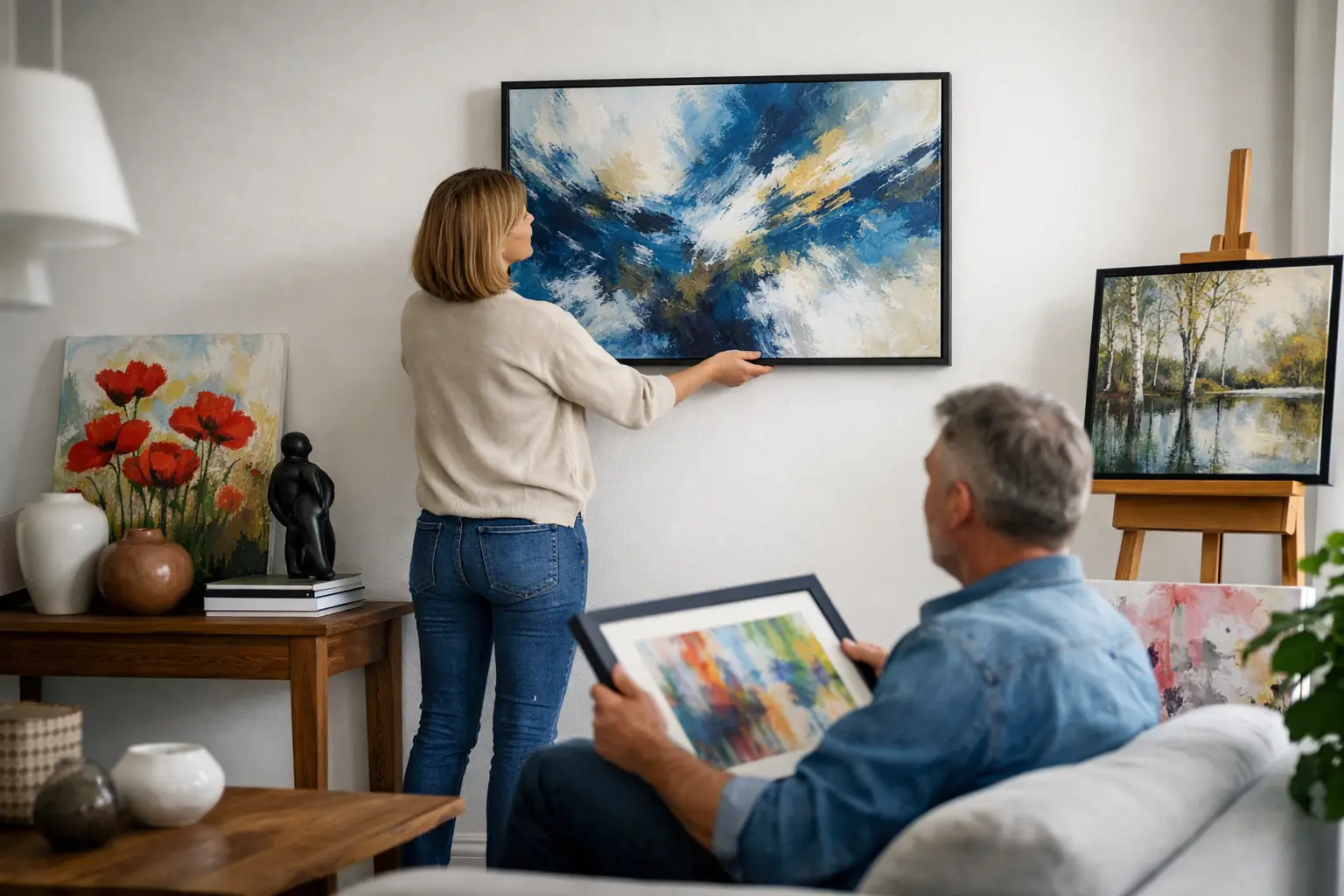
A bare wall above the sofa, dining table, or sideboard doesn’t always call for a quick purchase. It’s precisely in that spot that you realize just how much art can shape the atmosphere in your home. With an art lending guide for individuals, you’ll discover an accessible way to choose art: first experience it in your own home, then decide whether you want to swap it out, extend the rental, or buy it.
Art rental is for people who want quality on their walls but also like to leave room for discovery. Perhaps a colorful silkscreen print immediately catches your eye in the gallery, while at home a more subdued painting turns out to work better. You can’t fully get that experience from a photo, dimensions, or a brief description. The way light falls, the wall color, the furniture, and the distance from which you view a piece all make a difference.
What does an art lending program for individuals entail?
With an art lending service, you rent an original work of art or a limited-edition piece for an agreed-upon period and for a fixed monthly fee. You choose a piece that suits you and hang it in your home. Do you like it? Then you can keep it longer. If you’re ready for something new—perhaps because of a change of season, a renovation, or simply a shift in taste—you can exchange the piece.
Many art lending services also offer a savings plan. A portion of your monthly payment is set aside as credit toward a future purchase. This way, renting not only provides variety, but can also be a gradual path to owning art. The exact terms vary by art lending service. Therefore, always ask what portion of your monthly payment is set aside as savings, how long the credit is valid, and which artworks you can use it for.
This approach works well if you don’t want to rush into buying a piece of art. Even if you already know you love art but aren’t yet sure which artist, medium, or color will complement your home in the long run, renting offers flexibility without being a commitment.
Why experiencing it at home first is so valuable
A work of art never stands alone. In an exhibition, it is often hung against a plain wall with carefully directed lighting. At home, the same work takes on a different role. It must relate to your floor, sofa, lamps, heirlooms, and daily life. A work that seems small in a spacious gallery can, when placed above a narrow side table, create exactly the right sense of tension.
So don’t just focus on what you like at first glance. Also ask yourself what a piece of art does to the space. Does it add energy to a bright living room? Does it bring calm to a busy interior? Or does it create a surprising contrast with minimalist furniture? A good piece of art doesn’t have to match every color perfectly. Often, the most beautiful combination arises precisely when an accent color is repeated or when the artwork adds a new visual focal point.
The time of day you view it also matters. Look at the artwork in daylight, in the evening, and on a gray day. Walk past it on an ordinary morning, and set aside some time to really take it in while enjoying a cup of coffee. Art that still evokes something after a few weeks often deserves serious attention.
How to Choose a Piece of Art That Fits Your Home
Don’t start by asking which piece of art “belongs” in your home. Start with what you like to see. An art lending library is the perfect place to broaden your taste without immediately committing to a single choice. Perhaps you consider yourself a lover of figurative art, but you might find that an abstract piece with bold blocks of color feels surprisingly at home in your space.
Next, measure the available wall space. Consider not only the open space but also the furniture below it. Above a sofa, a larger piece often makes a stronger statement than several small pieces, which can look cluttered. In a hallway or next to a bookcase, a compact piece can actually add a lot of character. Leave enough breathing room around the artwork so it doesn’t get lost among accessories, shelves, or lamps.
Also consider the technique and materials. A painting has a different presence than a photograph, a print, or a relief. A work on paper often requires a suitable frame, possibly with a mat. For a colorful work, a subdued frame can support the composition, while a subtle print can sometimes gain more impact with a carefully chosen frame. A framer can offer practical advice on this, ensuring that the frame does not overshadow the artwork.
Don’t choose based on color alone
Color is an understandable starting point, but rarely the best—or only—reason to choose a piece of art. A blue detail might complement an armchair beautifully, but a work of art should continue to appeal to you even if that armchair is eventually gone. So consider the imagery, composition, materials, and emotion. What do you see time and again? Where does your gaze linger?
A safe choice can be beautiful, but it isn’t always the most personal one. If you’re torn between a subdued piece and a bold one, renting is a great way to experience just how much character a more striking work of art can bring to a space.
The practical side: costs, exchanging, and buying
Renting art is especially enjoyable when the terms are clear. Ask in advance about the monthly fee, the minimum rental period, any shipping costs, and insurance options. Also ask how the exchange process works. Will you pick up the artwork yourself, will it be delivered, and will someone help you hang it? Service isn’t just a nice-to-have: for larger or fragile pieces, professional delivery and installation make the difference between handling them with care and truly enjoying them without a worry.
The monthly price is usually based on the value of the artwork. This allows you to choose within a budget that suits you. If you’re renting for the first time, you can start with a single piece in a prominent spot. That will immediately give you a good sense of how art enhances your home. Later, you can add a second piece, for example, in the bedroom, home office, or entryway.
A savings plan is appealing when purchasing may be the next step. Still, it’s wise not to focus solely on the amount you’ve saved. Choose the artwork because you want to enjoy it for the long term, not because you feel you “have to buy it now.” Sometimes, continuing to rent is the right choice. Sometimes, changing pieces can actually provide new inspiration. Both are valuable outcomes of art lending.
A Guide to Art Lending for Private Individuals: Common Concerns
“I don’t know enough about art” is a thought that holds many people back. Knowledge can deepen your appreciation, but it’s not a ticket to entry. You don’t need to know art-historical terms to recognize when a work moves you, sparks your curiosity, or completes a space. A good gallery is happy to provide information about the artist, technique, and edition size, but always lets your own reaction count.
The fear that art is too expensive or too fragile also deserves to be qualified. Of course, an original work requires care. Don’t hang it in direct, bright sunlight, avoid damp areas, and handle it with care when moving it. But art is meant to be seen, not to remain hidden away in a storage room. With clear agreements and appropriate advice, renting art can be easily organized for many households.
Another concern is whether art really belongs in a home where people actually live. That’s exactly where it belongs. A living room with children, a dining room where guests gather, or a home office where people work a lot—all gain personality from a piece of art that evokes a response. Be sure to choose a spot that’s safe and where the artwork can truly shine.
Personalized advice makes it easier to choose
Browsing online is a great way to compare styles and artists, but seeing a work of art in person remains exceptionally valuable. You can see the texture of the paint, the depth of the paper, and the nuances in color much more clearly. When you visit, feel free to bring photos of your interior and the dimensions of your wall. That will make the consultation more concrete.
At Amersfoort Art, you can not only view art but also discuss it in relation to your home and your preferences. This is helpful when you’re unsure about sizes, looking for the right frame, or want to know which piece best fits within your rental and savings budget. Personal advice doesn’t have to be complicated: sometimes, just one good conversation is enough to figure out which direction is right for you.
Above all, give yourself time to look. Choose a piece that not only looks beautiful today, but that you’ll want to pause and admire again tomorrow. That may well be the greatest benefit of an art lending program: art doesn’t have to be a permanent commitment, but can gradually become part of your daily life.


