
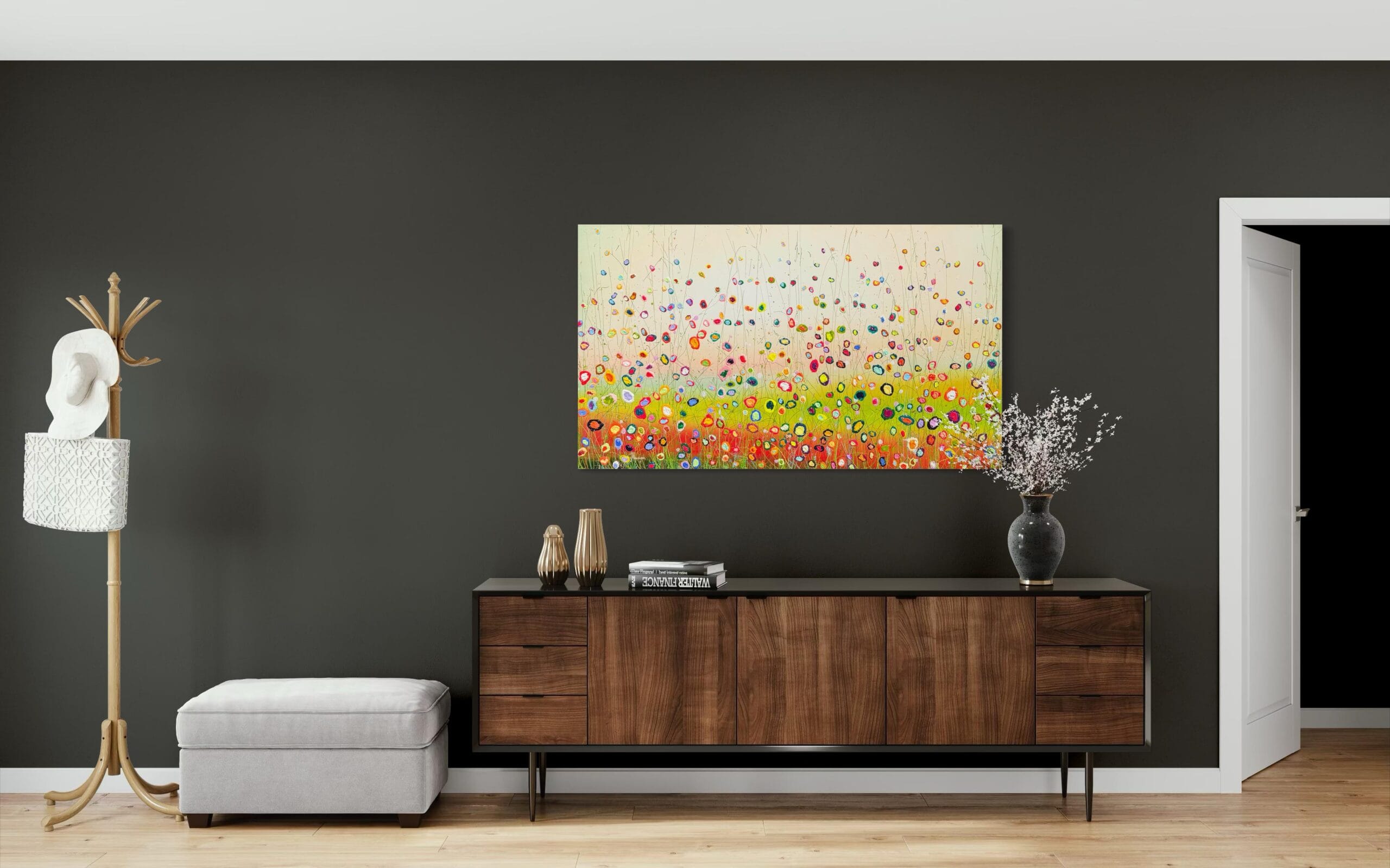
Sometimes you see a piece of art in a gallery or online and immediately think: beautiful. Until once it hangs at home and something still chafes. Not because the work is not good, but because the question “which work of art fits into my interior” requires a little more than personal taste alone. The right choice often arises at the intersection of space, light, color, scale and feeling.
What artwork will fit into my interior if I already know my style?
Many people start with their living style. Logical, because an interior already tells something about what feels comfortable. Yet it is smart not to take style too literally. A sleek, modern interior does not necessarily need only minimalist art. Especially an expressive painting or a graphic work with more tension can give a room character.
If you have a quiet interior with natural materials, soft tones and lots of light, artworks with layering often work beautifully. Think abstract compositions, photography with subtle contrasts or work in which texture remains visible. In a more classically decorated home, contemporary art can be surprisingly powerful because old and new reinforce each other. And in an industrial space, size, contrast and bold color are often allowed to go a bit further.
Therefore, the most important question is not only what style you have, but also what the space still lacks. Sometimes that is tranquility, sometimes energy.
Look first at format and placement
One of the most common mistakes is choosing a work that is beautiful on its own, but not right in relation to the wall. A small work of art on a large wall quickly looks lost. A work too large over a compact piece of furniture can actually feel heavy. Format determines more than many people think.
Above a sofa, dresser or dining table, a piece of art usually works best if it is in proportion to the furniture below it. Not exactly the same width, but visually balanced. Hanging height is also a factor. Art that hangs too high becomes detached from the rest of the space. Art should become part of the interior, not float above it.
In narrow spaces such as a hallway, a vertical work is often stronger. In a wide living room, a horizontal painting or series of works can actually bring more peace. And some places require not one big statement, but a smaller composition that you discover gradually.
Large artwork or just a series?
It depends on the effect you are looking for. A large work brings instant focus and calm. It gives a wall presence without needing much around it. A series of smaller works feels more personal and playful, but requires more attention in construction.
When in doubt between the two, look at the space itself. If a lot of furniture, materials and accessories are already present, then one clearly chosen work can be stronger than several separate accents. On the other hand, if the space is sober and open, then a series can add more rhythm.
Color sets the mood, but doesn’t have to bravely match
Those who wonder what artwork will fit into my interior often look first at color. This is understandable, but choosing color is less simple than “taking something that matches the sofa.” A work of art does not have to literally repeat colors from the interior to work well.
There are roughly three directions. You can choose a work that complements existing tones, creating tranquility and cohesion. You can seek contrast, such as a warm work of art in a cool space or a bright accent in a neutral interior. Or you can choose a work that brings together multiple colors, tying together different elements in the space.
What often works well is to choose an artwork that reflects one or two colors that are already subtly present in the interior. Consider an ochre hue from a pillow, a blue from a rug or an earth tone from wood and ceramics. Then the work feels connected without becoming predictable.
Light changes color more than you think
A work that looks fresh and open in daylight can become warmer or heavier at night. Therefore, it is smart to think not only about color, but also about light. In a north-facing room, cool tones come across differently than in a room with lots of sunlight. Glossy finishes also react differently than matte surfaces.
This does not mean that you should technically start looking like a museum curator. What it does mean is that it helps to ask yourself when you see the artwork most often. In morning light, at dusk or especially at night with lamplight? That context helps determine how a work feels.
Choose not only with your eyes, but also with the function of the space
A living room usually requires something different than a study, bedroom or reception hall. In living spaces, art is often allowed to trigger something. There, a work may stimulate, open conversations or create a clear atmosphere. In a bedroom, people are more likely to opt for stillness, softer compositions or a visual language that provides tranquility.
In a home office, art often works well if it supports concentration without becoming boring. Graphic work, photography or textured abstraction can do nicely there. For a hallway or landing, the first impression is more important. There, art may say something immediately, even if you look at it for a shorter time.
Business spaces have an additional layer to play with. Art then has to match not only the interior, but also the look and feel of the company. Professional, warm, quirky or representative – that matters for the choice.
Personal taste remains leading, but not every preference works the same everywhere
Sometimes you instantly fall in love with a work. This is valuable, because art does not have to be chosen purely rationally. At the same time, an honest look is important. A favorite work of art may fit you perfectly as far as content is concerned, but may not do as well in a particular space. That doesn’t mean it’s not a good choice, just maybe not for that one wall.
This is why it helps to put two questions side by side: do I really like this work, and does it also do something good in this space? Only if both answers are yes will a choice usually emerge that you will enjoy for a long time.
When contrast actually works better
Many interiors are decorated more securely than necessary. Nice basics, pleasant colors, good furniture – but little excitement. Art can make exactly the difference there. A powerful work in a quiet space can lift everything. A polyphonic abstract work can make a sleek interior less distant. And figurative art can add warmth to a space that otherwise consists mostly of lines and materials.
Too much contrast, of course, is also possible. If a room is already crowded in color, prints and objects, a very loud piece of art sometimes has competition rather than impact. Then nuance is often stronger than volume.
Material, frame and finish complete it
A work of art never stands completely alone. How it is presented affects how it lands in your interior. A painting on canvas feels different from a work on paper in a frame. Photography can look modern and sleek, but can also become softer and richer with the right frame.
The frame is not a detail after the fact. A good frame connects the work to the space. Black can be graphic and powerful, wood natural and warm, white just airy and reserved. Sometimes a passe-partout makes a work more peaceful and chic, especially with smaller sizes or work on paper.
Again, it depends on what you want to achieve. Do you want the artwork to completely draw attention, or should it blend in more with the whole?
Doubting is normal – that’s why trying often works better than gambling
Art is not something you choose every week. That’s precisely why the step can feel big. Looking at a picture from the wall helps, but doesn’t quite replace the real view of scale, color and look in the room. That’s why, for many people, having the space to compare, get advice or first experience how a work works at home is nice.
This is also why art lending is so appealing to many interior-oriented clients. You don’t have to make a final decision on everything at once. You can discover what a work does to your space, how it feels after a few days or weeks, and whether it really continues to fit. That freedom often makes choosing easier and more certain. At Amersfoort Art, we regularly find that people only see which work is really right at home – which is exactly how art becomes part of everyday life.
Which artwork fits my interior? Start smaller than you think
Not with a smaller work, but with a smaller question. Instead of immediately wanting to find the perfect artwork for the whole house, start with one wall, one room or even one feeling. Do you want more warmth in the living room? More tranquility in the bedroom? More character in the hall? That’s how choosing becomes clear.
From there, direction emerges. Then you can see more quickly whether you are looking for color, contrast, size, stillness or just movement. And then the question “which work of art fits into my interior” turns out to be less complicated than it first seemed. Not because there is one right answer, but because a well-chosen work of art does something that no piece of furniture or accessory can do: it makes a space personal, without feeling forced.
So above all, take the time to look, compare and take your feelings seriously. The most beautiful work for your interior is rarely the safest work – but the work that gives the space and yourself something extra.


