
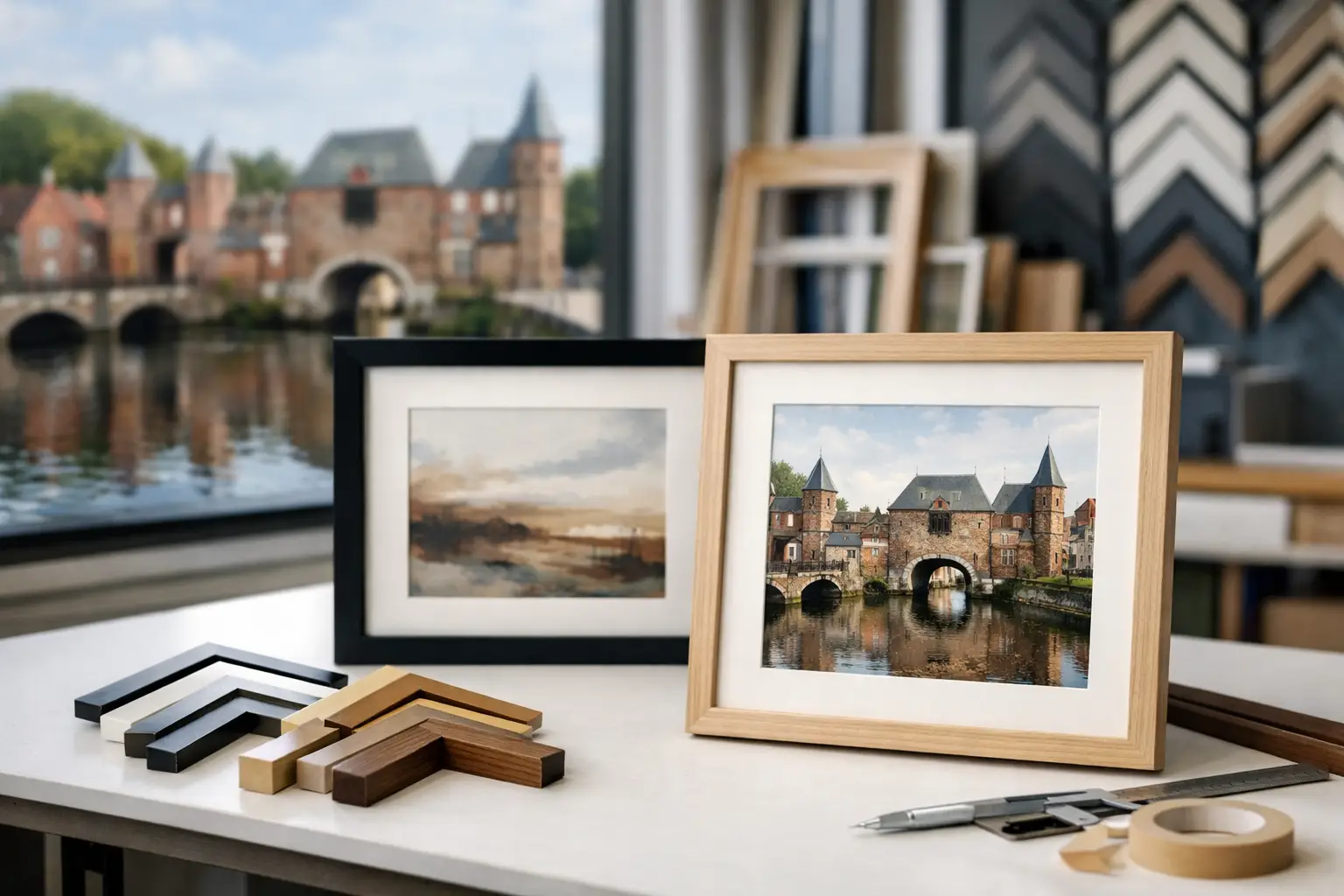
A beautiful print, a treasured photograph or an original work of art can be so strong – without the right frame it often lacks peace, protection and radiance. Anyone searching for framing Amersfoort, therefore, is usually not just looking for a border around a work, but a solution that matches the image, space and use.
Why good framing does more than many people think
Framing is not a last-ditch step. The frame determines how a work is read. A fine drawing in too heavy a frame can lose its subtlety, while a powerful painting can stand firmer with a well-chosen profile and color.
There’s something practical about it. A good frame protects against dust, knocks, discoloration and warping. Especially with works on paper, photographs, screen prints, diplomas or memories with emotional value, that difference is greater than many people expect beforehand. Good framing not only makes a work more beautiful, but also more durable.
For many people, this is precisely the reason for not choosing a standard shelf frame. Custom work looks quieter, fits the dimensions better and prevents a work from falling in just barely. You can usually see that “just not” faster at home than in the store.
Framing in Amersfoort: what to look out for?
Anyone who wants to have something framed in Amersfoort often has one of two questions. The first is aesthetic: which frame fits best? The second is practical: what is wise for this particular work? The two always belong together.
The list should support the work, not overpower it
A frame is successful when it enhances the artwork or image. This sounds simple, but it requires fine-tuning. For modern art, a clean, understated frame often works well, while graphic work or photography can benefit from extra white space with a passe-partout. For warmer, more classic images, wood can provide a softer, richer look than aluminum.
Yet there is no set rule. A minimalist black frame is not automatically the best choice for every modern work. Sometimes, on the contrary, a natural wood profile adds more tension and warmth to an interior. And in a business space, a calm, professional finish may be more important than a distinct style choice.
Glass is not a detail
Many people look at the frame first and only then at the glass. In reality, the glass is at least as decisive. Ordinary clear glass is often fine, but can be more reflective. For work that hangs across from windows or goes into a bright room, anti-reflective glass is often more pleasant to look at.
In addition, protection comes into play. For fragile work on paper or photographs, glass with extra UV protection may be a wise choice. This is not always necessary, because it depends on the location and the incidence of light, but for valuable or irreplaceable pieces it is a serious consideration. Good advice is precisely in that kind of nuance – not automatically choosing the most expensive, but what suits the work and the environment.
A passe-partout does more than fill in
A passe-partout is sometimes seen as decoration, while it primarily creates air and distance. It prevents the work from lying directly against the glass and helps give the composition peace. Especially with photographs, etchings, posters and smaller works of art, a passe-partout can make the difference between “nice” and “totally balanced.”
The color and width are important here. Off-white often works softer than pure white. A narrow border can look modern, while a wider margin puts more emphasis on the work. What is best depends on size, level of detail and where it will hang.
Not every job requires the same approach
That is perhaps the most important thing about framing in Amersfoort: there is no universal solution. A concert poster requires something different than an original lithograph. A child’s drawing has different priorities than an expensive photo print for the office.
Art on paper often involves conservation work. Then you want to use materials that do not affect the work and a mounting that can be safely removed later. With posters or decorative prints, on the other hand, things can sometimes be a bit looser and more budget-friendly, as long as the final image is good.
For objects with emotional value, such as a birth card, sports jersey, embroidery or collection of small memories, there is an additional layer. Then a frame must not only be beautiful, but also technically fit with depth, fastening and protection. It is precisely customization that makes such pieces compelling.
What customization brings to the home or office
A well-framed work immediately feels more finished. In the home, this creates cohesion. A work of art gains more presence on the wall, and even a simple print can look surprisingly strong when the proportions are right.
In a work environment, representation additionally plays a role. Art and framed images influence how a space feels to visitors, customers and employees. A messily chosen frame can detract from an otherwise carefully decorated office. An appropriate frame shows that attention has been paid to detail.
The same goes for multiple works side by side. A series of photographs, certificates or works of art becomes more peaceful when formats, profiles and distances are coordinated. Especially then, guidance is valuable, because you are not just looking at one frame, but at the overall picture on the wall.
The trade-off between standard and customization
Of course, not everything has to be luxurious or complex. Sometimes a simple standard frame will do, especially for temporary applications or decorative prints without great value. That’s a fair consideration, and not every job requires extensive custom work.
Yet the difference quickly becomes apparent as soon as dimensions vary, a work is vulnerable or it really needs to become part of your interior. This is when customization almost always pays off. You avoid concessions in size, appearance and protection. Ultimately, you pay not only for materials, but for peace of mind in the end result.
Therefore, cheap is not automatically advantageous. A frame that looks just too small, shines too much or becomes discolored over time often quickly feels like a bad buy. Conversely, custom work doesn’t have to be overly expensive either if you choose purposefully and get clear advice on what is and isn’t needed.
Good advice makes choosing easier
Many customers know very well what they like, but find it difficult to translate that into the right combination of frame, glass and passe-partout. This is logical. On the table, two profiles sometimes seem barely different from each other, while on the wall the effect can be huge.
That’s why personal advice works so nicely. You can bring a work, put materials next to each other and see together what it does. Not from complicated art language, but simply practical: does this suit a light living room, a sleek office or a work with lots of color? This makes choosing easy.
Moreover, a specialist looks beyond taste alone. Does the work hang in direct sunlight? Is it an original or a reproduction? Should it be able to be transported safely? Will it be in a representative reception area or rather in a more informal home environment? These questions ensure that the solution is not only beautiful on day one, but also continues to work well in the long run.
With a full-service art partner such as Amersfoort Art, that advantage is even greater. This is where knowledge of art, presentation and framing comes together, so that a frame is not considered separately from the work or the space in which it will hang.
For which moments framing is extra valuable
Some occasions almost automatically call for good framing. Think of a new piece of art you want to give a prominent place in your home, a photo that may become more than a file on your phone, or a gift that needs to be personal and lasting.
Framing is also often a smart move when moving, remodeling and redecorating. It is precisely then that you look again at what you already have and what can come into its own. A work that has been in a temporary frame for years can suddenly feel right at home again in an appropriate frame.
Corporate clients see that same effect in reception areas, meeting rooms and executive offices. Art and presentation are not an afterthought there. They enhance the identity of the space and can appear professional, warm or creative – depending on the choice.
How to recognize quality at framing Amersfoort
Quality is not just in a pretty corner or a neat back. It’s about the overall picture. Do the proportions fit the work well? Is the material chosen appropriately? Is the advice matched to use, light and value? And does the end result feel like the work has really become more than it was before it was framed?
The latter may be the best test. A good list does not draw all the attention to itself, but makes you think: this is how it should have always been. This is exactly why it pays to look calmly, ask questions and not settle too quickly for a solution that is only approximately right.
Anyone who frames something is ultimately choosing not just for protection or decoration, but for attention. And attention is reflected on the wall – every day.


