
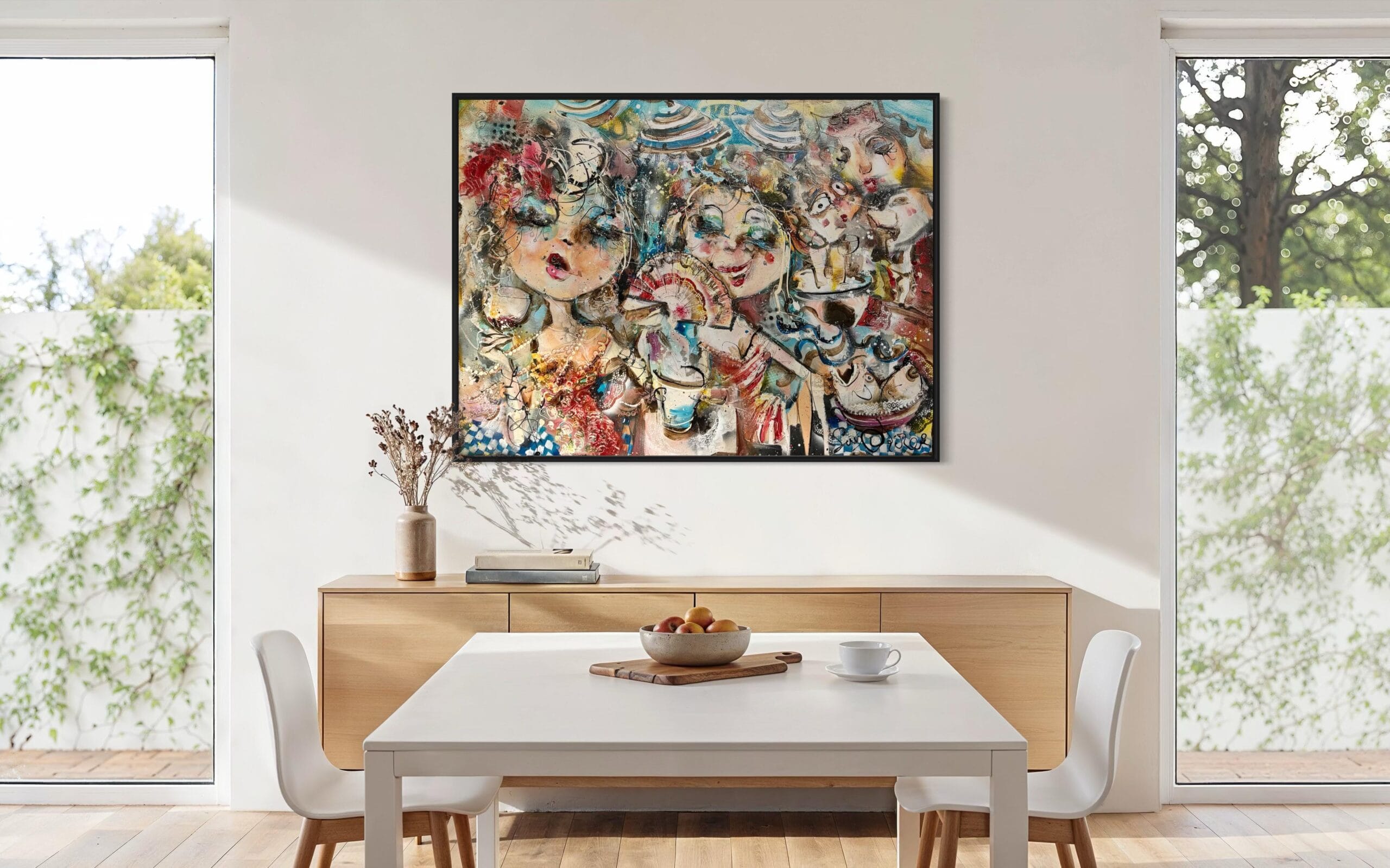
Buying a Guy Olivier painting rarely begins with just asking if you like it. Often something more direct happens: you see a work, linger for a moment and notice that the image brings energy to a room. That initial feeling is valuable, but when buying art, you also want to be sure the work fits your interior, your long-term tastes and the budget you have in mind.
Guy Olivier’s art appeals to many enthusiasts through its combination of expression, color and a distinct signature of his own. His work can have a powerful presence, but can also lift a space without being overpowering. That makes the choice interesting, because not every painting works the same way on the wall. This is precisely why it pays to look a little further than just the initial enthusiasm.
Why buying a Guy Olivier painting is so appealing
Those considering a Guy Olivier painting are often not looking for safe background art. Rather, you are choosing a work with character, rhythm and a recognizable imagery. This is attractive if you want art to really add something to your living space, office or reception area.
At the same time, therein lies the trade-off. A pronounced work can fascinate for years, but requires a good match with the place where it will hang. In a minimalist interior this can work out beautifully, because the painting gives the room tension. In an already busy room it is smarter to pay extra attention to balance in color and size.
What appeals to many buyers is that a work by an artist like Guy Olivier is not just decorative. It gives a space identity. Visitors remember it. You don’t look through it yourself after a week. That is often exactly the difference between a nice wall filler and art that really keeps working.
What do you look for when buying a Guy Olivier painting?
A good art purchase is personal, but not arbitrary. There are a few points that really help you choose with more confidence.
Look at the space first, not just the work
A painting can look perfect in the gallery or on a screen, but turn out differently at home. This is usually not due to the work itself, but to its relationship to its surroundings. Consider light, wall color, furniture arrangement and viewing distance.
A large, expressive canvas needs space to breathe. Above a narrow closet or in a compact hallway, a smaller work can appear stronger. Conversely, a too modest size on a large empty wall can get lost. Many people, in retrospect, do not buy too big, but rather too small.
Also consider the function of the space. In a living room, art can be quite present. In a workspace or conference room, you may want more tranquility, or a work that evokes conversation without being distracting. It depends on what you want the space to exude.
Pay attention to color, but think beyond matching
When buying art, colors are often considered first. This makes sense, because a painting should blend pleasantly with your interior. Yet tight matching is not always the best choice. Art does not have to repeat the exact same shades as your sofa, rug or accessories.
Often contrast works better. A lively work can add warmth to a neutral space. A painting with depth or movement, on the other hand, can bring calm to a sleek interior because it makes the space more human. So it’s less about “does it fit exactly?” and more about “does it make the space stronger?
When in doubt between two works, don’t just look at the main color. Pay attention to the undertone as well. Warm colors react differently to natural light than cooler tones. During the day a work can look open and light, while at night it feels more intimate or heavy.
Buy Guy Olivier painting as an investment in years of viewing pleasure
Not every buyer is looking for an investment in a financial sense, nor does it have to be. For most people, art is first and foremost about daily enjoyment, charisma and connection to a work. Still, it is wise to take quality and provenance seriously.
When you buy a Guy Olivier painting, you want clarity on authenticity, condition and execution. Is it an original work, a uniquely painted piece or a different edition form? What technique was used? How was the canvas stretched or finished? Such questions are not business cool, but rather helpful. They help you make conscious choices.
Condition also plays a part. A work in good condition retains its appearance better and gives peace of mind when purchased. Especially with larger or more pronounced paintings, professional presentation is important. A good work deserves a good finish, whether it is unframed or with an appropriate frame.
Original, circulation and presentation
For some buyers, only an original is of interest. Others find it more important that a work touches them and fits within budget. Both approaches are fine, as long as it is clear what you are buying. Transparency prevents disappointment and makes comparison more fair.
Presentation also does a lot. A frame can give a painting more tranquility or, on the other hand, overemphasize it. In modern and contemporary art, less is often more, but this is not a set rule. It depends on the work, the wall and the atmosphere you are looking for. Precisely personal advice often makes the difference there.
Browse online or view in person?
Many art buyers start online. This is practical and gives a quick overview. You can quietly compare, view dimensions and make an initial selection. For an artist with a powerful visual style, that’s a fine start, but a screen never tells everything.
Texture, paint build-up, gloss and depth often come out better in real life. Size is also frequently misjudged online. A canvas of 100 by 120 centimeters sounds clear, but on the wall it can be much more dominant than expected. Or just the exact statement a room needs.
That’s why a combination usually works best: orientate first, then view in real life if possible or get advice on presentation in your own interior. A gallery that thinks along with you makes buying art a lot easier and more pleasant. For many customers, it is precisely this guidance that makes the step from doubt to choosing with conviction.
Does a Guy Olivier painting match your interior?
That question is often asked too strictly, as if art must first prove that it behaves. In reality, a good painting may well bring some tension. An interior rarely becomes more interesting from art that completely blends into the background.
If you have a quiet, modern interior with natural materials and soft tones, then a powerful work may be just the right counterpart. If you live more colorful or eclectic, then it’s smart to see if the painting still brings focus rather than added turmoil. You can usually feel that difference quickly when you see the work in context.
Placement at eye level, wall width and distance from furniture are also more important than many people think. A well-chosen painting can make a room seem larger, connect a sitting area or break up a long wall. That’s not a trick, just the effect of a strong composition in the right place.
When is the right time to buy?
Many people wait for complete certainty. Understandable, but with art it rarely comes in perfect form. You obviously want to choose thoughtfully, only there is a difference between deciding carefully and continuing to procrastinate.
If you keep a work in mind several times, revisit it and find that it continues to pull you in, that usually says it all. Art doesn’t have to be rationally dense. However, it does help to ask yourself a few practical questions: will I still like this in a few years, does the format really fit, and do I want this work to tell something about my taste or space?
Sometimes buying immediately makes sense. Sometimes it is nicer to first experience how art works in your interior. Especially then, a party with knowledge of sales, presentation and accessible advice is pleasant. Amersfoort Art responds to this in an accessible way, with attention to both the work of art and the place where it ends up.
Buying a Guy Olivier painting without regret afterwards
Regret usually arises not because the work is less beautiful than imagined, but because the choice was made too quickly or just too technically. Buying by feel alone can be risky if you underestimate the format. Buying only by ratio, on the contrary, more quickly leads to a dull work for which little love arises.
The best purchase is in between. You feel a clear click with the painting, but you also take a moment to look at size, color effect, finish and placement. This does not make the choice more distant, but rather stronger.
A good painting does something lasting. It adds atmosphere on days you don’t even consciously look for it, it makes a space more personal, and it often stays interesting longer than many other interior purchases. When you choose a work by Guy Olivier that truly suits you and your environment, you are not just buying art for the wall, but an image you will enjoy looking at again and again.


