
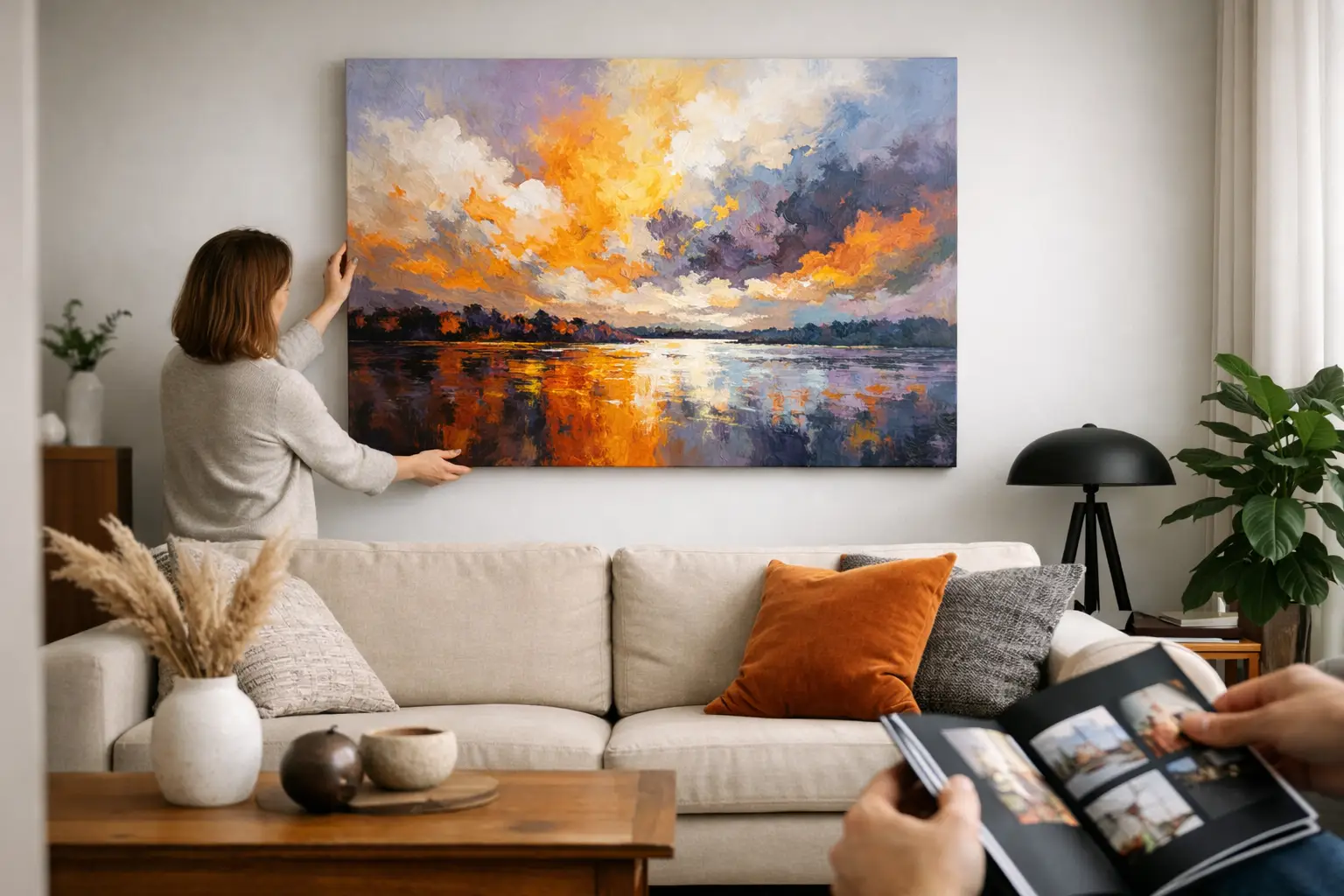
A blank wall does not always require a big purchase. Often it mainly requires a good feeling: does this work really fit the space, the light, your taste? This is precisely why renting art for your home is so attractive. You get something special into your home, without having to make a final decision right away.
For many people, buying art feels like a big step. Not because they lack interest, but because a work of art can come across differently at home than in a gallery. Format, color, material and appearance do a lot to an interior. What seems perfect in a well-organized exhibition space may suddenly prove too small, too present or just surprisingly good at home. Renting removes that doubt and makes room for discovery.
Why renting art for home works so well
An interior lives. Furniture shifts, walls change color, your taste evolves with it. Then it is nice if art is not immediately fixed for the next ten years. Renting gives flexibility, but at the same time it feels full. You still choose quality, appearance and character – only with more freedom of movement.
This is immediately an important difference from decoration that is mainly to fill an empty space. A real work of art adds tension, tranquility or energy to a room. It makes a living room more personal, a hallway more inviting or a study more inspiring. By renting, you can experience what art does to a space on a daily basis, without any immediate pressure to decide.
For families, couples who have just moved or people who are building their interiors step by step, this is often exactly the right route. First see, then feel, then possibly buy. That order is down-to-earth, pleasant and, for many homes, simply smarter.
What you notice once art hangs on the wall
People often think of art first in terms of style. Abstract or figurative. Colorful or subdued. Modern or timeless. But at home, it’s ultimately about something else: how a work makes the space feel.
A large painting can make an open living room more cohesive. Instead, a series of smaller works can bring rhythm to a long wall. A graphic work in quiet tones can make a bedroom more refined, while an expressive canvas above the sofa adds energy without having to change the entire decor. So art does not work separately from the interior, but within it.
Therefore, format is at least as important as taste. A work that is artistically strong is not automatically suitable for every wall. Light also plays a role. During the day a work can look cool and calm, while in evening light it becomes warmer and deeper. Those who rent will automatically notice these differences in practice. That makes choosing not only easier, but also better.
Who is art rental at home interesting for?
Actually for more people than is often thought. Not only for experienced art lovers, but also for people who are looking for something beautiful, but do not yet know exactly what. Renting is interesting if you take art seriously, but do not want to make a hasty decision.
This applies, for example, to people who have just moved and want to experience first what a space needs. Also, those who already have a well-kept interior but are missing one strong eye-catcher can use rentals to quietly search for the right work. And for those who like to alternate, it is a logical solution. After all, some interiors call for change. Not every wall needs to tell the same story for years.
In addition, renting is nice if you are looking for quality within a manageable budget. You don’t have to release the full purchase price right away, but you can still enjoy quality work. That lowers the threshold, without compromising the experience.
How do you choose art that really works at home?
A good choice rarely begins with the question of what is trendy. Better to look at the space itself. Where does the eye fall in when you step into the room? Which wall could use tranquility, and which could use character? And what is the role of the artwork – a statement, a unifying element or a subtle addition?
Color is important here, but it does not have to be literally reflected in the interior. A work may rub off, surprise or counterbalance. In a quiet beige interior, a powerful blue or red work can work beautifully. Conversely, a subdued drawing or photography can bring balance to a space with lots of material, texture or color.
Size also deserves attention. A common mistake is choosing too small. Especially above a sofa, sideboard or dining table, art can often be more generous than people think. A larger work gives peace, because it does not stand out against the rest of the room. If you are hesitating between two sizes, it is wise to look not only at the wall, but at the whole around it.
And then there is the personal element. Art does not always have to be immediately explicable. Sometimes you simply know: this continues to fascinate. That is usually a good sign. A work that evokes something after just one look often lasts longer at home than a choice that only neatly matches the sofa.
Renting or buying: it’s not always either-or
Many people see renting as an interim solution, but in practice it is often a very logical way to move toward a purchase. You get to know a work at home. You see how it holds up at different times of the day. You notice if it continues to fit, even as first impressions get used.
Exactly therein lies the power. Buying from conviction feels more pleasant than buying under time pressure. At the same time, renting is also fine as an end choice. Not everyone wants to build up a permanent collection. Sometimes flexibility suits the stage of life, the home or simply the way you want to live.
So there is no standard answer to the question of what is better. It depends on your budget, your living plans and your need for variety. Those who already know very clearly what they are looking for are more likely to buy. Those who like to experience first often prefer to choose renting. Both routes are valuable, as long as the choice fits with how you want to live at home with art.
The practical side of renting art for home
The nice thing about a good art loan is that the process remains manageable. You don’t have to be a connoisseur to choose well. Clear guidance makes all the difference. Think of advice on style, size and placement, but also on the question of which work will look best technically and visually in your home.
In this regard, framing and presentation also play a larger role than many people expect. A suitably framed work looks calmer, stronger and more finished. Especially in a residential environment, where art becomes part of the daily picture, that finish counts. The difference between nice and just right is often in those kinds of details.
Personal advice also helps prevent mis-buying. Not by determining for you what is beautiful, but by looking with you. What is already there? How does the light fall? Are you looking for one striking work or for consistency on several walls? A full-service party like Amersfoort Art can take away a lot of uncertainty, because collection, advice and presentation come together.
Common doubts – and why they are understandable
One of the biggest misconceptions is that renting art would only be interesting for people who definitely want to buy later. That doesn’t have to be the case at all. Renting can also simply be a pleasant, lasting way to live with art.
Another doubt is about style security. What if you don’t like it as much after a few weeks? That’s exactly what renting is for. Taste is not static, nor is an interior. It is not a weakness to want to experience what works first. Rather the opposite.
Budget also obviously plays a role. Art is a serious choice, but serious does not have to mean rigid. Those who choose wisely can bring quality into their homes in a way that remains financially comfortable. This makes art more accessible to people who value originality and charisma, but do not want to incur an immediate large expense.
Perhaps that is the main reason why this form fits so well at home. Art becomes less distant once it becomes part of your daily environment. Not as something to look at carefully, but as something you live with, can walk past, look at again and experience differently each time.
A home doesn’t have to be finished all at once. Sometimes atmosphere starts with one work on the wall that does just enough to make the space feel right.


